All species › Birds of prey › Hawks, eagles and kites › Lappet-Faced Vulture
Lappet-Faced Vulture | Torgos tracheliotos
Oorgier | Buitre orejudo
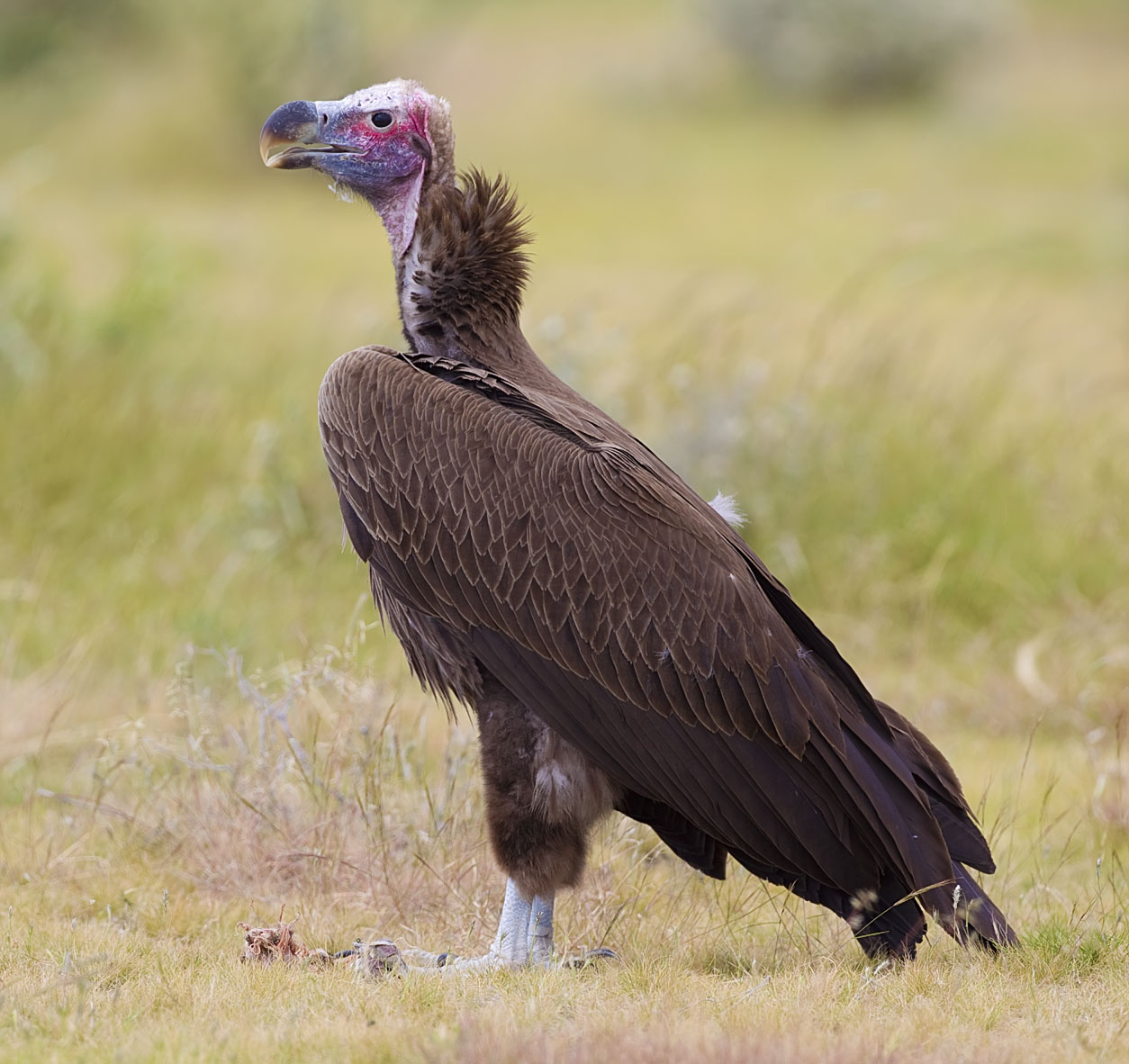
The Lappet-faced Vulture is the most powerful vulture of Arabia, with a huge bill and a bare, pinkish-red head with flaps of skin at the sides. The Arabian form negevensis, named after the Negev, where it has disappeared as a breeder, lives in small numbers on the stony deserts and acacia plains of Saudi Arabia, Oman and Yemen.
Voice
Almost silent; at carcasses a short bark, hisses and growls.
No recording with a suitable Creative Commons licence is available for this species yet.
Identification
98–115 cm, wingspan 255–290 cm. Dark brown with a bare, pink to red head and neck with hanging skin folds, and an enormous, deep bill. On the breast long, lanceolate brown feathers over white down; the thighs are white in adults. In flight very large and broad-winged with a short, slightly wedge-shaped tail; from below a narrow white band along the leading edge of the underwing and the white thighs stand out. The juvenile is uniformly dark brown with a paler pink head, lacking white on the thighs and wing, and takes six years to mature.
Confusion species
Mainly confusable with Cinereous Vulture (Aegypius monachus), which is also large and dark but has a feathered head with a dark neck ruff, no white thighs and no white leading edge below the wing. Griffon Vulture (Gyps fulvus) and Rueppell's Griffon (Gyps rueppelli) have a long, downy neck, a paler, sandy or scaly underwing, and hold their wings in a shallow V.
Habitat
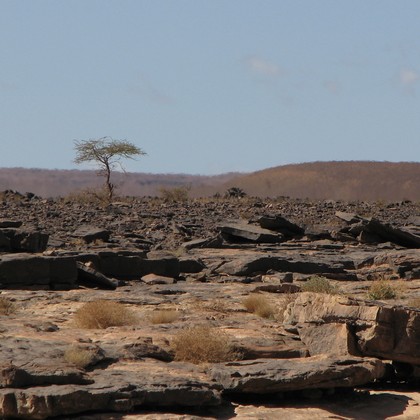
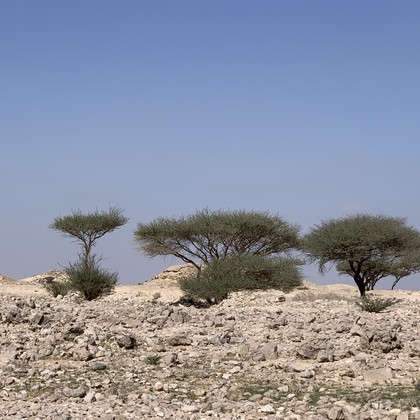
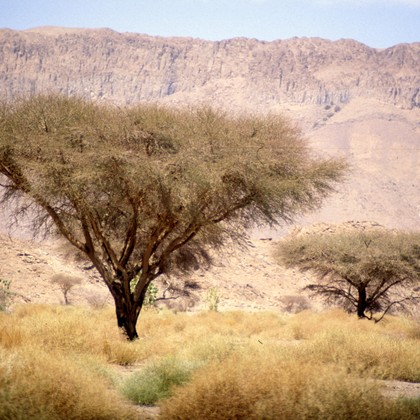
Flat stony and gravel desert, sandy plains with scattered acacias, dry wadis and the thorn scrub of the Arabian plains, also lava fields. Nests singly on top of a flat-topped acacia, rarely on a rock. Follows herds of camels and goats and visits rubbish dumps and slaughter sites.
Where the bird is most at home, classified by the habitats of North Africa and the Middle East.
Range and movements
In Saudi Arabia scattered through the central, western and northern interior, with the highest numbers in protected areas such as Mahazat as-Sayd and Harrat al-Harrah. In Oman mainly on the Jiddat al-Harasis and in Dhofar; scarce in the Emirates, mostly in western Abu Dhabi; scarce in the interior of Yemen. In Egypt a small relict population in the south-east (Gebel Elba, Wadi Allaqi). In Israel lost as a breeder since the late 1980s and now very rare; gone from Jordan and from the Sahara of North Africa. Beyond the region in the Sahel and East and southern Africa.
- Resident
- Summer visitor (c. Apr–Sep)
- Winter visitor (c. Oct–Mar)
- Passage (Mar–Apr, Oct–Nov)
- dark = core range, pale = thinly spread
How and when to look
The best chances are in Oman on the Jiddat al-Harasis and at the rubbish dumps of Dhofar, such as around Thumrait and Salalah, or in the Saudi reserves. On clear mornings look for large dark birds perched on top of an acacia, and wait for them to rise on the thermals.
Conservation status
Endangered. Declined steeply worldwide through poisoning, persecution, nest disturbance and food shortage. The Arabian population is estimated at a few hundred pairs and is vulnerable to poison, electrocution, shooting and the decline of nomadic herding.
Scientific name
Torgos tracheliotos | (Forster, 1796)
Forster described the species in 1796 as Vultur tracheliotus; because it was later moved to another genus, the author and year stand in brackets. The genus Torgos was introduced in 1828 by Kaup. Torgos is an ancient Greek word for 'vulture'. tracheliotos comes from Greek trachēlos, 'neck', and ous, ōtos, 'ear' — for the skin folds ('ears') on the sides of the bare neck. The specimen the first description was based on came from Great Namaqualand, Namibia.