All species › Sandgrouse › Sandgrouse › Chestnut-Bellied Sandgrouse
Chestnut-Bellied Sandgrouse | Pterocles exustus
Roodbuikzandhoen | Ganga moruna
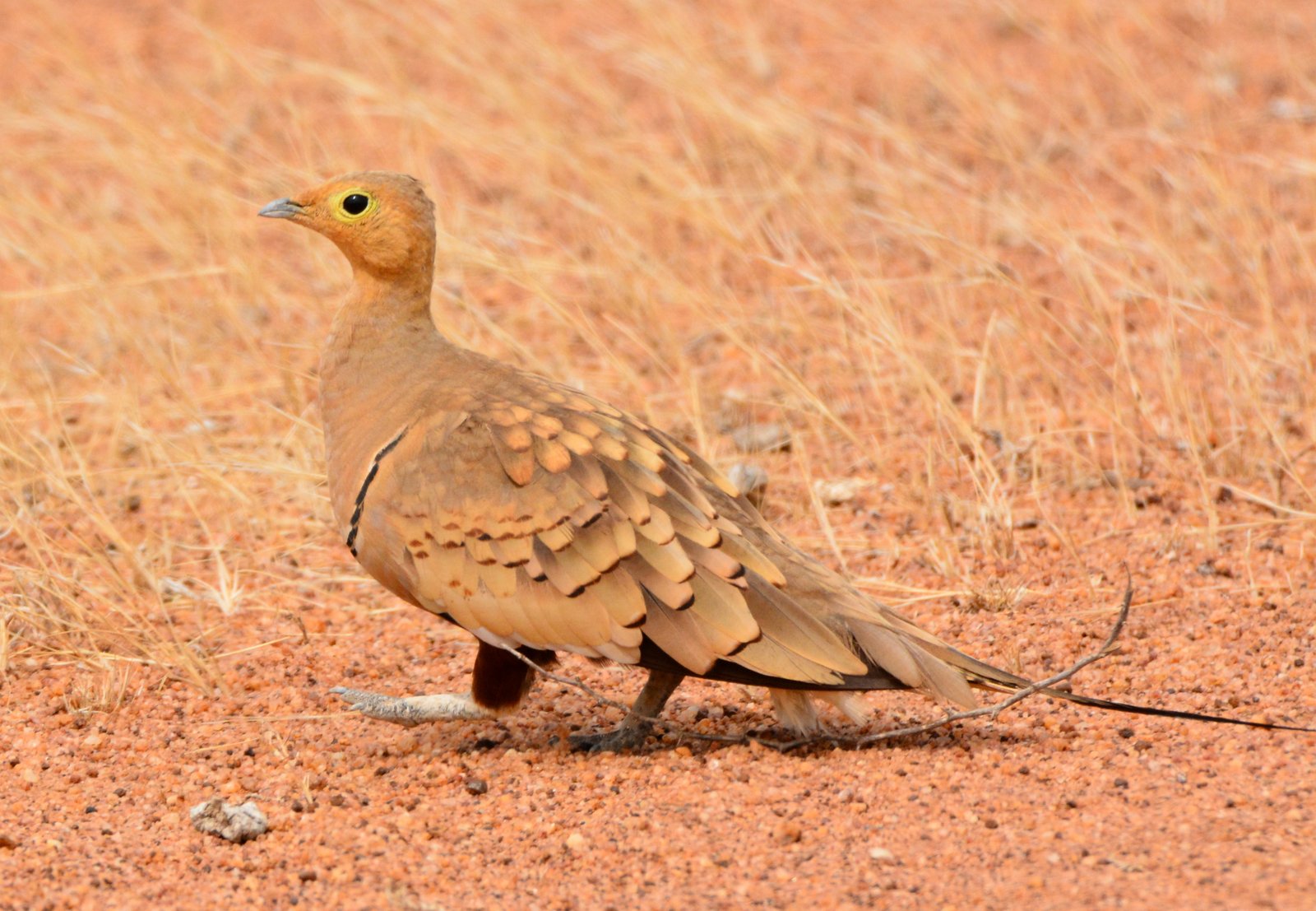
The sandgrouse of the Arabian lowlands and the Sahel: a slender, plain sandy sandgrouse with tail pins and a dark, almost blackish-brown belly. In the region it is mainly a bird of Saudi Arabia, Yemen and Oman; the Nile Valley's own subspecies in Egypt has vanished.
Voice
In flight a guttural, cackling kwit-kwerr kwit-kwerr or gutter-gutter, lower and jerkier than the call of Spotted Sandgrouse. Flocks call mostly when approaching water.
Recording: David Darrell-Lambert — CC BY-NC-SA 4.0 · converted to mono · xeno-canto
Identification
Medium-sized and slim, with pointed wings and two long, thin central tail feathers. The male is grey-brown to ochre, with a yellowish face and throat, a narrow black breast line and below it a pale breast grading into a dark chestnut to blackish-brown belly. The wing coverts carry large pale spots. The female is densely streaked and barred on head, breast and back, with a pale breast band above the barred dark belly. In flight the wholly dark underwing stands out, coverts included: no white panel as in Pin-tailed Sandgrouse.
Confusion species
Spotted Sandgrouse (Pterocles senegallus) also has tail pins but a pale belly with only a narrow black central stripe and pale underwing coverts. Pin-tailed Sandgrouse (Pterocles alchata) has a white belly and white underwing. Black-bellied Sandgrouse (Pterocles orientalis) is bulkier, lacks tail pins and has a black belly but white underwing coverts, and lives further north. Lichtenstein's Sandgrouse (Pterocles lichtensteinii) and Crowned Sandgrouse (Pterocles coronatus) lack tail pins.
Habitat
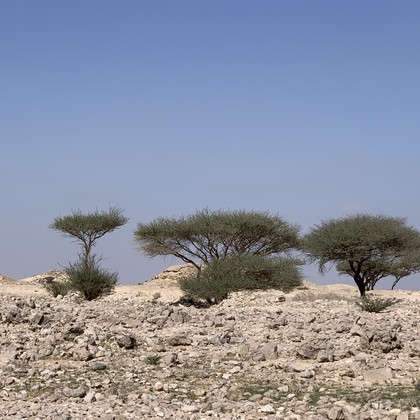
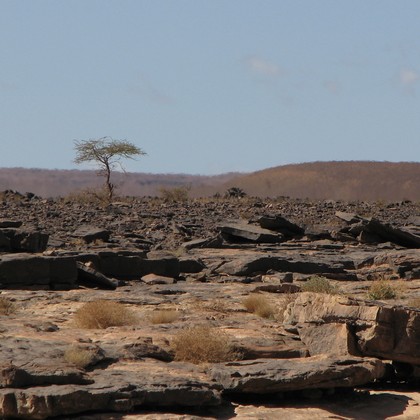
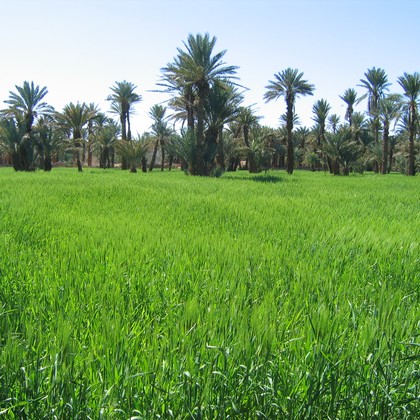
Flat, open country with sparse vegetation: gravel plains with scattered acacias, dry thorn scrub, semi-desert with grass tufts, the Tihama coastal plain, and also fallow and irrigated farmland along its edges. Avoids high dunes and mountains. Drinks in the morning, often in large flocks, at springs, wells, troughs and reservoir margins.
Where the bird is most at home, classified by the habitats of North Africa and the Middle East.
Range and movements
In the region in south-western and southern Arabia (subspecies P. e. erlangeri): in Saudi Arabia along the Tihama and in the western and southern interior, in Yemen from the coastal plain to the eastern interior, and in Oman on the central plains and in Dhofar; rare and irregular in the UAE. In Egypt the subspecies P. e. floweri lived in the Nile Valley and the Faiyum; it has not been seen with certainty since the 1970s and is considered extinct. Beyond the region in the Sahel from Senegal and Mauritania to Sudan and Ethiopia, in East Africa to Tanzania, and in southern Iran, Pakistan and India.
- Resident
- Summer visitor (c. Apr–Sep)
- Winter visitor (c. Oct–Mar)
- Passage (Mar–Apr, Oct–Nov)
- dark = core range, pale = thinly spread
How and when to look
In Oman or southern Saudi Arabia, go to a well or trough on the plain in the morning and wait from about an hour after sunrise; flocks announce themselves from afar with their guttural call. In Yemen the fields and water points of the Tihama are the best place.
Conservation status
Not globally threatened and common in many parts of Africa and South Asia. In the region the picture is mixed: the Egyptian population has disappeared through the conversion of the Nile Valley to farmland and through hunting, and in parts of Arabia numbers are under pressure from hunting at drinking places and overgrazing. There is little recent information on numbers in Yemen and Saudi Arabia.
Scientific name
Pterocles exustus | Temminck, 1825
Temminck described the species in 1825 and placed it straight away in the genus where it still stands. The genus Pterocles was introduced in 1815 by Temminck. Pterocles is Greek, from pteron 'wing' and -klēs 'notable, splendid'. exustus is Latin for 'burnt' or 'scorched', from exurere 'to burn up', for the dark belly. The specimen the first description was based on came from Senegal.