All species › Sandgrouse › Sandgrouse › Crowned Sandgrouse
Crowned Sandgrouse | Pterocles coronatus
Kroonzandhoen | Ganga coronada
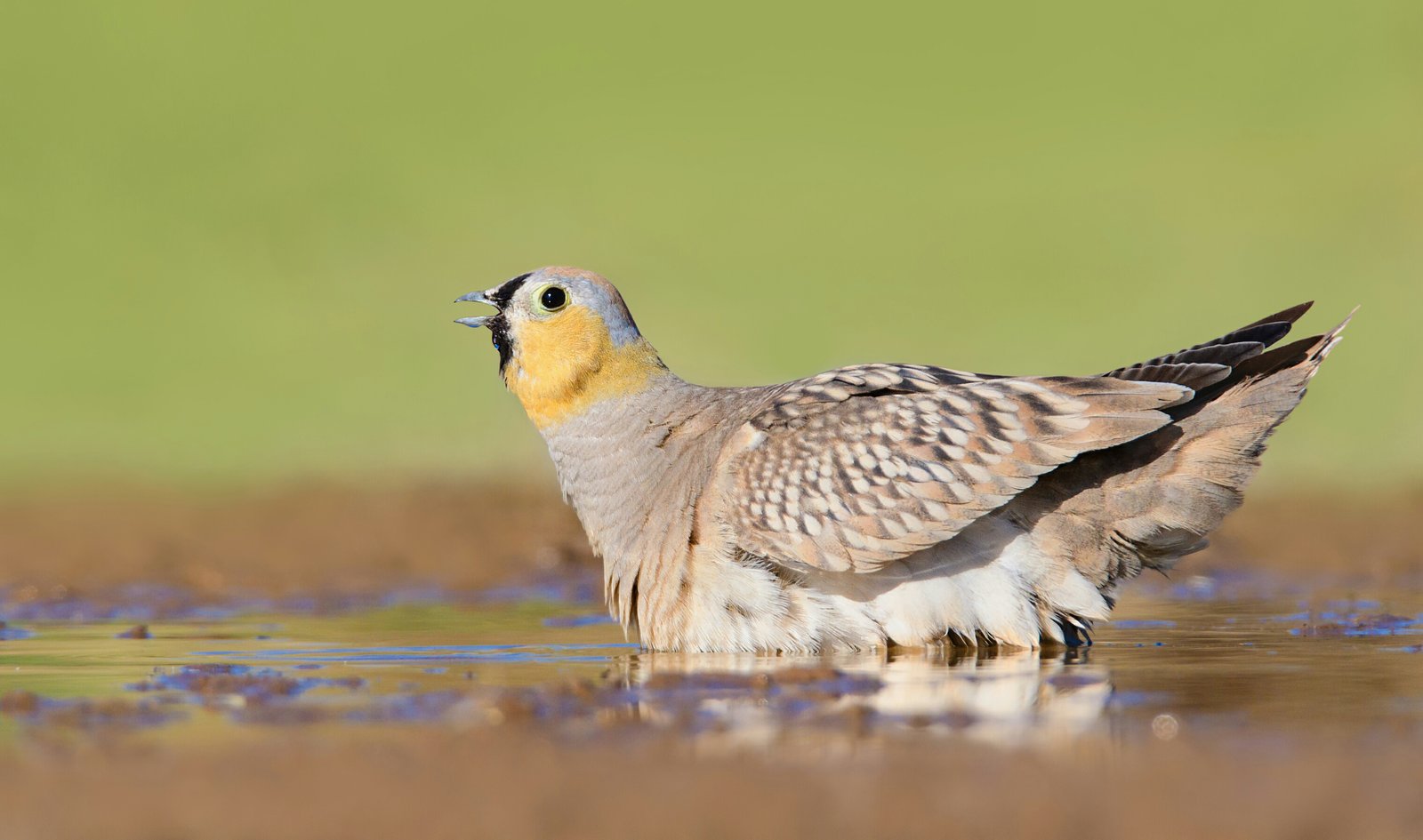
The sandgrouse of bare stone and gravel desert, from the hamada south of the Atlas to the gravel plains of Oman. Small, stocky and without tail pins, the male with a short black-and-white mask around the bill. On the ground it is almost impossible to find against dark rock; you notice it by its harsh, nasal call.
Voice
A harsh, nasal, multi-syllabic chaga-chagarra or kla-kla-klakla, repeated by the whole flock in flight. Sharper, faster and more pinched than the bubbling kwitoo of Spotted Sandgrouse.
Recording: Patrik Åberg — CC BY-NC-SA 4.0 · converted to mono · xeno-canto
Identification
Small and compact, with a short, pointed tail without elongated feathers. The male has a rufous crown edged blue-grey, an orange-yellow cheek and throat and a black patch running from the forehead along the base of the bill to the chin, bordered white. Breast and belly are plain greyish-pink to sandy, without breast band or belly stripe; back and wing coverts are ochre with pale spots. The female has a yellow throat and is densely and finely barred dark on head, breast and back. In flight the dark flight feathers contrast with the pale wing coverts and creamy underwing.
Confusion species
Spotted Sandgrouse (Pterocles senegallus) is larger and slimmer, with tail pins, a black central belly stripe and, in the male, a plain orange face without black. Lichtenstein's Sandgrouse (Pterocles lichtensteinii) is slightly smaller, coarsely barred black and white all over, with an orange bill and, in the male, a black-and-white forehead pattern; it drinks at dusk. Chestnut-bellied Sandgrouse (Pterocles exustus) has tail pins and a dark belly.
Habitat
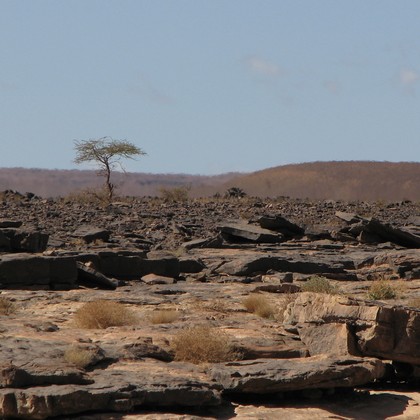
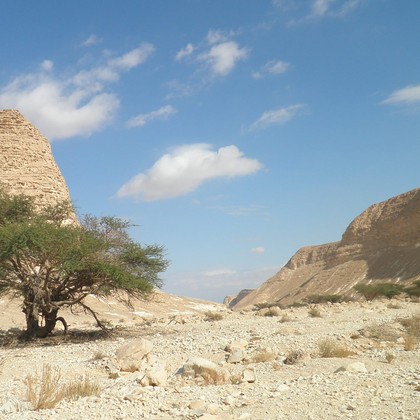
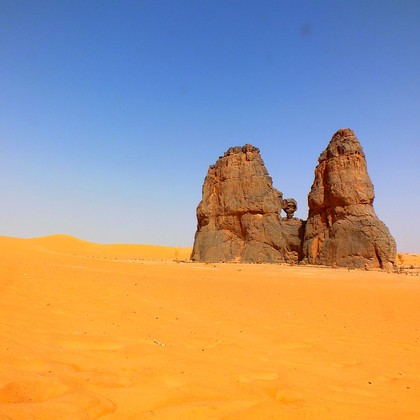
The barest parts of the desert: hamada and reg (flat gravel desert), stony plains, low rocky hills, mountain edges and broad, dry wadis with hardly any vegetation. Avoids open sand and farmland. Eats hard seeds and some green matter. Drinks in the morning, often mid-morning, in smaller flocks than Spotted Sandgrouse, sometimes at the same drinking place.
Where the bird is most at home, classified by the habitats of North Africa and the Middle East.
Range and movements
Throughout the desert belt of the region. In the Maghreb south of the High Atlas: south-eastern Morocco (the Tagdilt plain near Boumalne Dadès, the Ouarzazate area, the Draa and the Tafilalt) and Western Sahara, the Algerian Sahara including the Ahaggar, southern Tunisia and the Libyan Sahara. Egypt: the Western and Eastern Deserts and Sinai. In the east in Israel (Negev and Arava), southern and eastern Jordan, Saudi Arabia, Yemen, Oman, and scarce in the UAE and the western desert of Iraq. Beyond the region in the southern Sahara and the Sahel from Mauritania to Sudan, and from Iran to Pakistan.
- Resident
- Summer visitor (c. Apr–Sep)
- Winter visitor (c. Oct–Mar)
- Passage (Mar–Apr, Oct–Nov)
- dark = core range, pale = thinly spread
How and when to look
On the Tagdilt plain near Boumalne Dadès and in the gravel desert of the southern Arava: drive slowly across the plain and stop regularly to listen, as the nasal call of passing flocks is usually the first thing you hear. If you find a drinking place, arrive shortly after sunrise and keep well back.
Conservation status
Not globally threatened and widespread in the Sahara and Arabia, but everywhere at low densities. Numbers fluctuate with rainfall and seed supply. On the northern edge of the range, as in Israel and Morocco, disturbance and loss of quiet drinking places play a role, and elsewhere hunting at water; reliable trends are scarcely available.
Scientific name
Pterocles coronatus | Lichtenstein, 1823
Lichtenstein described the species in 1823 and placed it straight away in the genus where it still stands. The genus Pterocles was introduced in 1815 by Temminck. Pterocles is Greek, from pteron 'wing' and -klēs 'notable, splendid'. coronatus is Latin for 'crowned', from corona 'wreath, crown', after the male's black-and-white head pattern. The specimen the first description was based on came from Nubia.