All species › Sandgrouse › Sandgrouse › Lichtenstein's Sandgrouse
Lichtenstein's Sandgrouse | Pterocles lichtensteinii
Lichtensteins zandhoen | Ganga de Lichtenstein
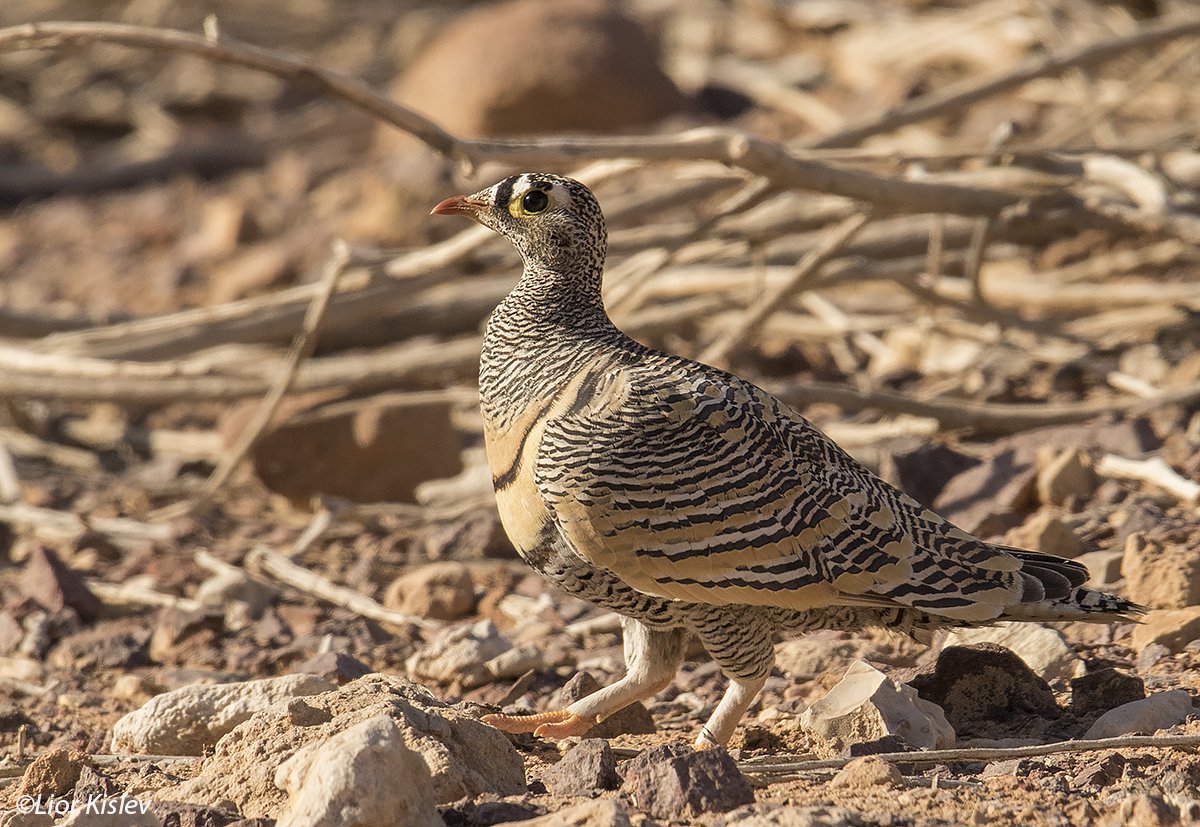
The smallest and most intricately patterned sandgrouse of the region, a crepuscular bird of rocky wadis and the foot of desert mountains. By day it hides under an acacia or among stones; only after sunset do pairs and small flocks fly in to water with a soft whistling call. Anyone wanting to see it must wait at a spring or pool for dusk.
Voice
In flight a whistling, somewhat plaintive kwee-kwee-kweeweet or chip-weet, often already in darkness on arrival at water. On the ground soft, grating contact calls. Not nasal like Crowned Sandgrouse.
Recording: Sven Normant — CC BY-NC-SA 4.0 · converted to mono · xeno-canto
Identification
Small and stocky, with a short, rounded tail without pins and an orange bill with a bare yellow ring around the eye. The whole plumage is densely and boldly barred black and white to black and ochre, like a fine wave pattern. The male has a white forehead patch with a black band behind it and a black stripe above, and two bands across the breast: one ochre-yellow and one chestnut, separated by a narrow black line. The female lacks the head and breast pattern and is evenly and finely barred throughout. In flight dark and barred, with a greyish underwing.
Confusion species
Crowned Sandgrouse (Pterocles coronatus) is slightly larger, the male with plain breast and belly, black only around the bill base, a grey bill and morning drinking times; the female is more finely and less contrastingly barred. Black-bellied Sandgrouse (Pterocles orientalis) is much larger, with a black belly, and lives on open steppe. Beyond the region it resembles the African Double-banded Sandgrouse (Pterocles bicinctus).
Habitat
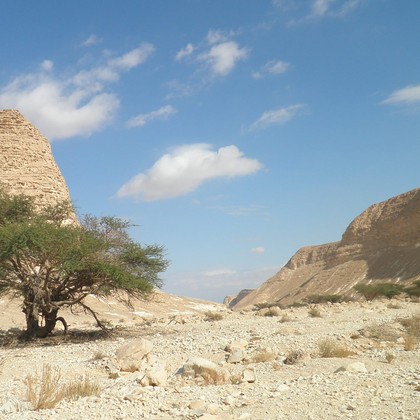
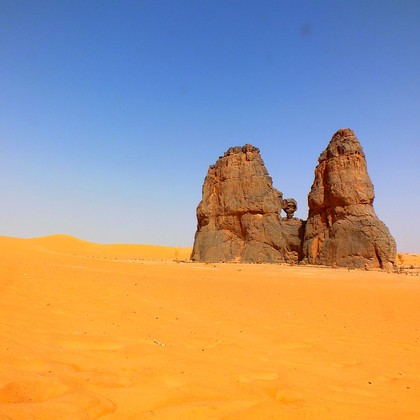
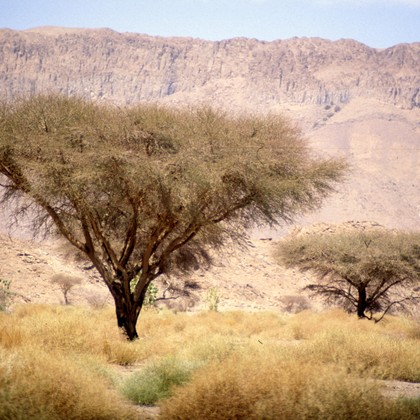
Rocky wadis with acacias and shrubs, the foot of bare mountains, stony slopes and dry riverbeds in desert and semi-desert, and in Arabia also acacia savanna and thorn scrub along the mountain edge. Eats seeds of grasses, herbs and acacias. Drinks after sunset and often well into dusk, also before dawn, at springs, wadi pools, troughs and oasis edges.
Where the bird is most at home, classified by the habitats of North Africa and the Middle East.
Range and movements
Widespread in the east of the region: Egypt (the Eastern Desert along the Red Sea mountains, Gebel Elba and Sinai), Israel (the Eilat Mountains, the Arava and the Dead Sea area), southern Jordan (Wadi Rum, Aqaba and the wadis along the Dead Sea and the Arava), western and southern Saudi Arabia, Yemen, Oman (the Hajar Mountains and Dhofar) and the UAE (the foot of the Hajar Mountains). In the Sahara in the mountains of southern Algeria (the Ahaggar and Tassili n'Ajjer, subspecies P. l. targius), in south-western Libya and very locally in the far south of Morocco and Western Sahara. Beyond the region in the Sahel and the Horn of Africa, from Mauritania to Somalia and Kenya, and from southern Iran to Pakistan.
- Resident
- Summer visitor (c. Apr–Sep)
- Winter visitor (c. Oct–Mar)
- Passage (Mar–Apr, Oct–Nov)
- dark = core range, pale = thinly spread
How and when to look
In the Arava, the Eilat Mountains or at Wadi Rum, sit at a spring or pool half an hour before sunset, with the sun behind you and not too close. Shortly after sunset the first birds come in whistling; with a dim torch or thermal scope you can follow them long afterwards. In Oman the troughs in the wadis of the Hajar Mountains are suitable.
Conservation status
Not globally threatened. Because of its secretive, crepuscular habits its numbers are probably underestimated. Local threats are disturbance at drinking places, hunting and overgrazing of wadis, and in Israel and Jordan increasing desert tourism; little is known about the Saharan populations.
Scientific name
Pterocles lichtensteinii | Temminck, 1825
Temminck described the species in 1825 and placed it straight away in the genus where it still stands. The genus Pterocles was introduced in 1815 by Temminck. Pterocles is Greek, from pteron 'wing' and -klēs 'notable, splendid'. lichtensteinii honours the German naturalist Martin Lichtenstein (1780–1857), director of the Zoological Museum in Berlin. The specimen the first description was based on came from Nubia.