All species › Passerines › Starlings › Bank Myna
Bank Myna | Acridotheres ginginianus
Oevermaina | Miná ribereño
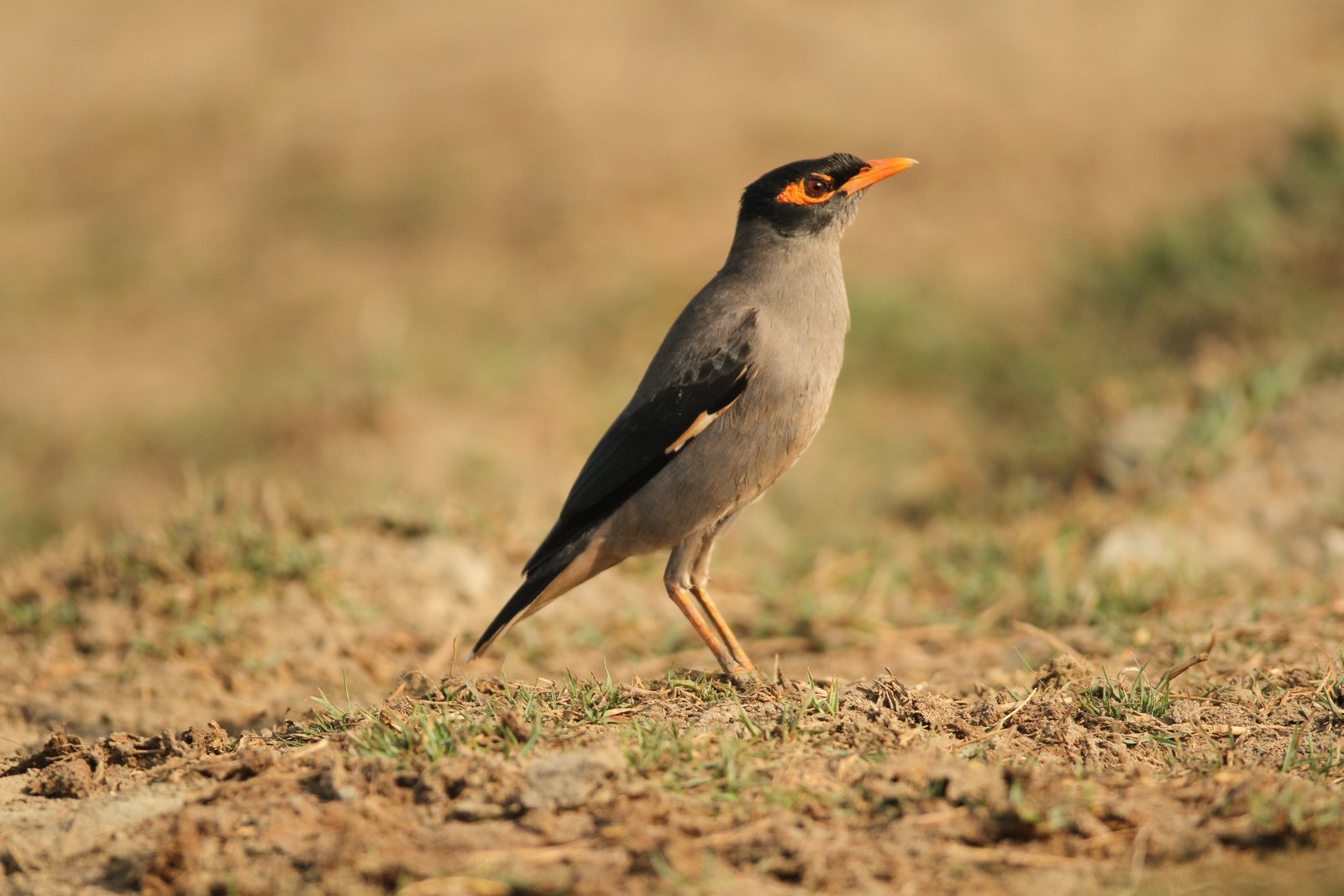
The Bank Myna is a grey myna with a red eye patch from the Gangetic plain, occurring in this region only as an introduced species. In the Gulf states it lives in small, local populations in parks, on farms and around markets, often together with the Common Myna.
Voice
A chattering, jumbled series of whistles, twitters and grating sounds, softer and higher than in Common Myna; the call is a harsh chook.
Recording: David Darrell-Lambert — CC BY-NC-SA 4.0 · converted to mono · xeno-canto
Identification
21–23 cm. Slightly smaller and greyer than Common Myna: body blue-grey, head and a short tuft above the bill black, with bare brick-red to orange-red skin behind the eye and an orange-yellow bill and legs. In flight a buff patch on the primaries, a buff terminal band on the tail and a pale, buffy-yellow underwing. Juveniles are browner, with a brown head and a duller eye patch.
Confusion species
Common Myna (Acridotheres tristis) is warm brown, with a yellow eye patch, a black head without a tuft and a white (not buff) wing patch and white tail tips. Indian Pied Myna (Gracupica contra) is black and white with a white cheek.
Habitat
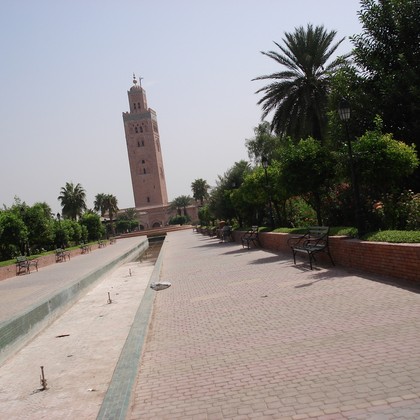
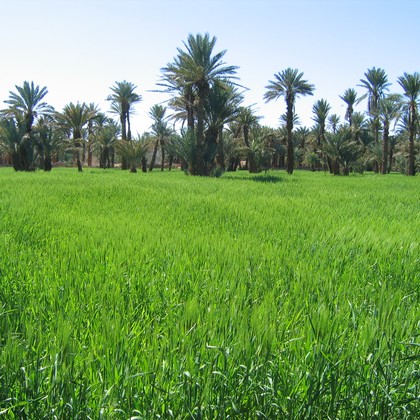
Around human habitation: parks, gardens, farms and irrigated land, livestock markets, rubbish dumps and car parks. In its native range it nests in colonies in holes in steep river banks, hence its name; in the Gulf states in holes in walls, palms and buildings.
Where the bird is most at home, classified by the habitats of North Africa and the Middle East.
Range and movements
Introduced only. Established in Kuwait since about 1980, with small resident populations, mainly at the Jahra farms and along the Gulf Road in Kuwait City; also introduced to the United Arab Emirates. From there it has spread to Oman, mainly the Batinah and Muscat, and to eastern Saudi Arabia, with odd birds in Bahrain and Qatar. Everywhere local and much scarcer than Common Myna; numbers fluctuate from year to year. The natural range covers Pakistan, northern and central India, Nepal and Bangladesh.
- Resident
- Summer visitor (c. Apr–Sep)
- Winter visitor (c. Oct–Mar)
- Passage (Mar–Apr, Oct–Nov)
- dark = core range, pale = thinly spread
How and when to look
In Kuwait at the Jahra farms, in the UAE in parks and on farms around Dubai and Abu Dhabi: search groups of Common Mynas for a greyer bird with a red eye patch and a tuft.
Conservation status
Not globally threatened. In this region an introduced species that is not native to the region itself; populations are small and fluctuating, but as a hole-nester it may compete with native species.
Scientific name
Acridotheres ginginianus | (Latham, 1790)
Latham described the species in 1790 as Turdus ginginianus; because it was later moved to another genus, the author and year stand in brackets. The genus Acridotheres was introduced in 1816 by Vieillot. Acridotheres is Greek, from akris, genitive akridos, 'locust', and thērēs, 'hunter'. ginginianus refers to Gingee (Gingi), a town in Tamil Nadu, India. The specimen the first description was based on came from Nadia, West Bengal, India.