All species › Passerines › Starlings › Indian Pied Myna
Indian Pied Myna | Gracupica contra
Indiase eksterspreeuw | Estornino pío
The Indian Pied Myna is a black-and-white myna of South and South-East Asia that occurs in this region only as the descendant of escaped or released cage birds. In the Gulf states small, scattered groups live in parks and irrigated land, but whether they are self-sustaining is not certain everywhere.

Voice
Noisy and varied: fluid, clear whistles alternating with grating and clucking sounds, often in duet. Calls include a harsh chek and a high cheeoo.
No recording with a suitable Creative Commons licence is available for this species yet.
Identification
22–24 cm. Boldly black and white: head, breast, back and wings black, cheek and ear-coverts white, belly off-white, with a white stripe across the shoulder and a white rump. The bill is long and pointed, orange-red at the base and yellowish-white towards the tip, with bare orange skin around the eye. Juveniles are brown where adults are black, with a less clean cheek patch.
Confusion species
Common Myna (Acridotheres tristis) and Bank Myna (Acridotheres ginginianus) are brown or grey with a black head and a pale patch in the primaries, without a white cheek. Eurasian Magpie (Pica pica) is much larger, with a long tail and a black bill.
Habitat
Parks, gardens, playing fields and irrigated land with lawns, often near water; forages on the ground for insects and worms. Unlike most mynas it builds an untidy domed nest in a tree.
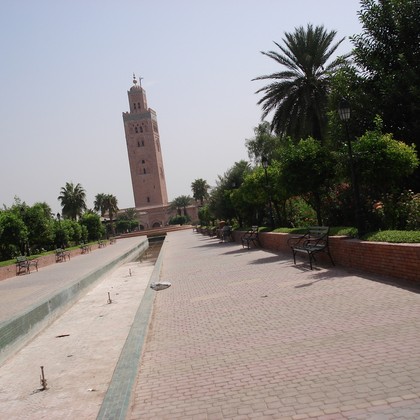
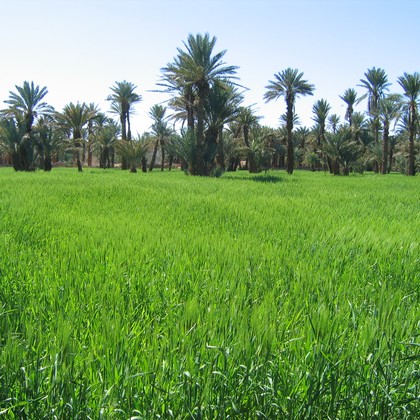
Where the bird is most at home, classified by the habitats of North Africa and the Middle East.
Range and movements
Introduced only. Small populations and scattered groups in the United Arab Emirates, mainly around Dubai and Abu Dhabi; scattered records of escaped birds in Oman, Qatar, Bahrain, Kuwait and Saudi Arabia. The natural range extends from northern and central India and Nepal through Bangladesh and Myanmar to south-west China and Indochina.
- Resident
- Summer visitor (c. Apr–Sep)
- Winter visitor (c. Oct–Mar)
- Passage (Mar–Apr, Oct–Nov)
- dark = core range, pale = thinly spread
How and when to look
Search the lawns of town parks and golf courses in Dubai and Abu Dhabi, where it forages among Common and Bank Mynas; the white cheek and pied plumage are immediately obvious.
Conservation status
Not globally threatened and common in Asia. In this region an introduced species of cage-bird origin that is not native to the region itself; populations are small and the effect on native species is unknown.
Scientific name
Gracupica contra | (Linnaeus, 1758)
Linnaeus described the species in 1758 as Sturnus contra; because it was later moved to another genus, the author and year stand in brackets. The genus Gracupica was introduced in 1831 by Lesson. Gracupica is a blend of Gracula 'myna' and Pica 'magpie'. contra probably goes back to 'Contra', a name Albin (1738) took from Bengal and which presumably derives from an Indian vernacular name. The specimen the first description was based on came from Kolkata, West Bengal, India.