All species › Passerines › Starlings › Burmese Myna
Burmese Myna | Acridotheres burmannicus
Jerdons maina | Miná birmano
Burmese Myna is the Myanmar counterpart of Vinous-breasted Myna, until recently lumped with it as a single species. In this region it is known only as an escaped cage bird, and it is often unclear which of the two species is involved.

Voice
Like other mynas: loud, harsh and whistled notes and a chattering, varied song.
Recording: Kuan-Chieh (Chuck) Hung, Taiwanbirdguide.com — CC BY-NC-SA 4.0 · shortened to the first 60 s, mono · xeno-canto
Identification
24–25 cm. Built like Vinous-breasted Myna: a slim, long-legged myna with a pale grey to greyish-white head, a black eye mask of bare skin, a grey back and black wings with a large white primary patch and white tail tips. The underparts are warmer and darker vinous than in Vinous-breasted Myna, the head greyer, and the bill mainly red. Legs yellow to orange-yellow. Juveniles are duller and browner.
Confusion species
Vinous-breasted Myna (Acridotheres leucocephalus) has a whiter head, paler, pinker underparts and a yellow bill with a reddish base; separation in the field is difficult and needs good photographs. Common Myna (Acridotheres tristis) is brown with a black head and a yellow eye patch.
Habitat
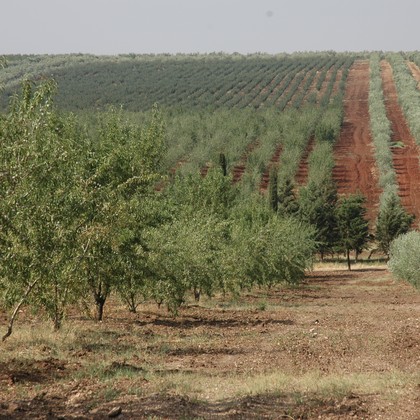
In this region parks, gardens and other urban greenery; in its native range dry open country, fields, villages and open woodland.
Where the bird is most at home, classified by the habitats of North Africa and the Middle East.

Range and movements
Only as an escaped cage bird. Birds of the Vinous-breasted Myna group have been reported from the Gulf states, mainly the UAE; how many of these are Burmese Mynas is unclear, and no established population is known. The species does not originate from the region itself. Its native range lies in central and southern Myanmar.
How and when to look
Photograph any pale myna with a vinous breast in the parks of the Gulf states, paying particular attention to the colour of the bill and head; report good records to the national rarities committee.
Conservation status
Not globally threatened. In this region an introduced species that does not originate from the region itself; there is no definitely established population.
Scientific name
Acridotheres burmannicus | (Jerdon, 1862)
Jerdon described the species in 1862 as Sturnus burmannicus; because it was later moved to another genus, the author and year stand in brackets. The genus Acridotheres was introduced in 1816 by Vieillot. Acridotheres is Greek, from akris, genitive akridos, 'locust', and thērēs, 'hunter'. burmannicus is New Latin for 'of Burma', the country (now Myanmar) where the species occurs naturally.