All species › Tubenoses › Northern storm petrels › Band-Rumped Storm Petrel
Band-Rumped Storm Petrel | Hydrobates castro
Madeirastormvogeltje | Paíño de Madeira
A sturdy, dark storm-petrel of the Macaronesian islands that only rarely reaches the Atlantic waters off Morocco and Western Sahara. The few records come mainly from boat trips far offshore and from seawatches at headlands; every sighting needs good photographs, as separation from Leach's Storm-Petrel is tricky.
Voice
Silent at sea. At the colony at night a squeaky, rhythmic cherr-wee-ka and a soft purring from the nest cavity.
Recording: Ben Porter — CC BY-NC-SA 4.0 · converted to mono · xeno-canto
Identification
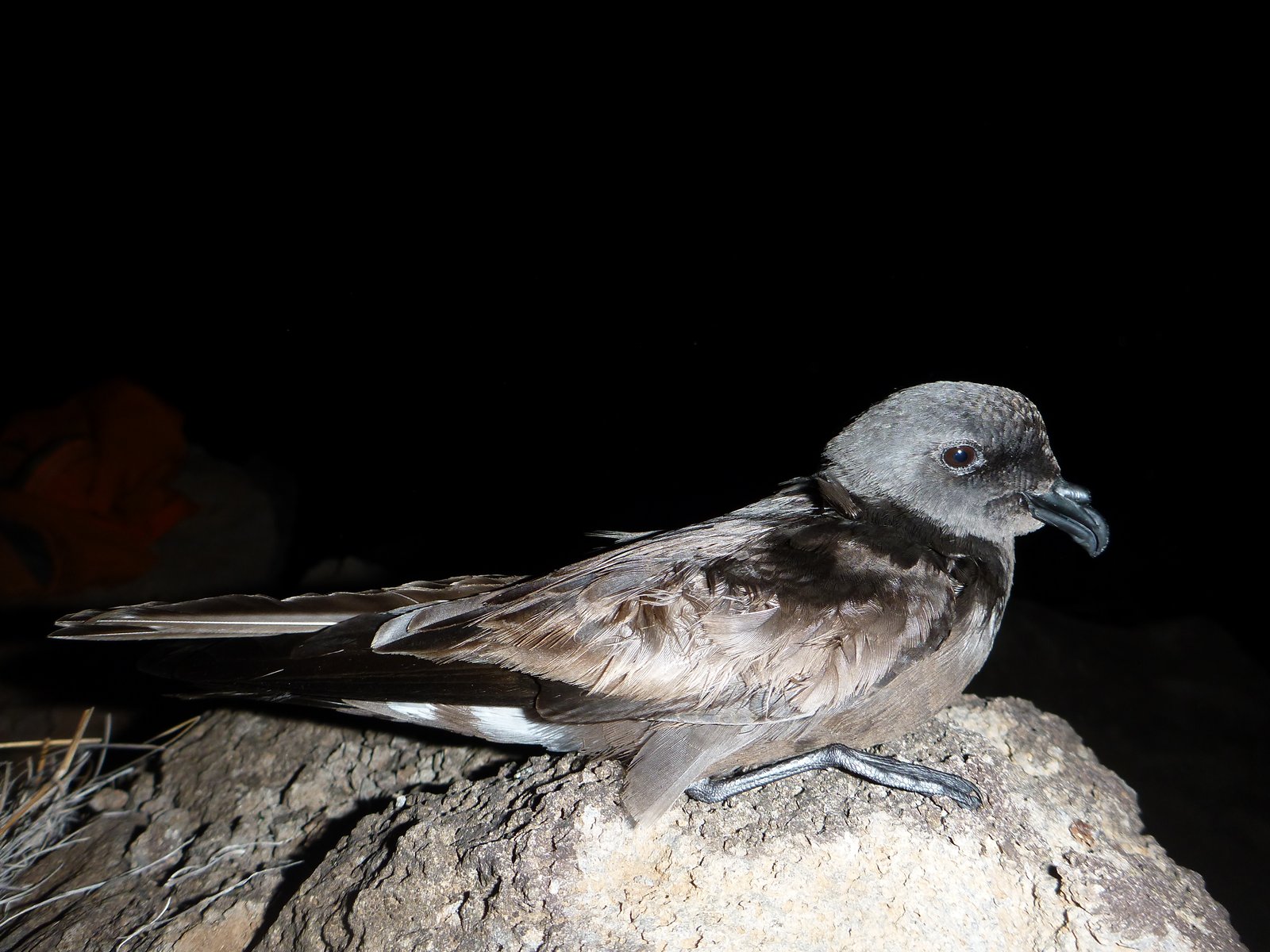
Medium-sized, sooty brown to blackish, with a broad, cleanly cut white rump band that extends well onto the sides of the undertail coverts. Tail square or at most slightly notched. Upperwing with a faint, short paler bar that does not reach the leading edge. Wings long but broader and less angled than in Leach's; feet do not project beyond the tail. Flight calm and shearwater-like, with stiff glides on slightly bowed wings alternating with shallow beats, rarely fluttering.
Confusion species
Leach's Storm-Petrel (Hydrobates leucorhous) has a deeper tail fork, a narrower, V-shaped white rump split by grey and a prominent pale upperwing bar reaching the leading edge; its flight is more erratic and tern-like. Wilson's Storm-Petrel (Oceanites oceanicus) is smaller, flutters more and shows long legs with yellow webs projecting beyond the tail. European Storm-Petrel (Hydrobates pelagicus) is much smaller and has a white underwing stripe.
Habitat
Deep, open ocean, usually well beyond the continental shelf; rarely follows ships. Breeds in rock crevices and burrows on remote islands, not in the region.
Where the bird is most at home, classified by the habitats of North Africa and the Middle East.
Range and movements
Morocco: rare and poorly known; the Moroccan rarities committee gives its status as vagrant or possible passage migrant. Records at Cap Ghir (November 1985, July 2010) and in October 2023 more than 400 kilometres offshore level with Casablanca. Western Sahara: a few records off Dakhla (February 2016, September 2018) and a group of sixteen at sea far off the southern coast in November 2012. No confirmed records from the Mediterranean, the Red Sea or Arabian waters. Elsewhere it breeds on the Azores, Madeira and the Desertas, the Selvagens, the Canary Islands, the Berlengas off Portugal and the Cape Verde Islands, and further on St Helena, Ascension, the Gulf of Guinea, the Galápagos, Hawaii and Japan. Outside the breeding season it wanders over the tropical and subtropical Atlantic. The group is often split into several species, including separate hot-season and cool-season populations in Macaronesia.
How and when to look
The best chance is a pelagic trip far out of Dakhla or Agadir in autumn, or a seawatch at Cap Ghir after a south-westerly gale. Photograph every dark storm-petrel with a white rump and note the tail shape, the width of the rump band and the pale wing bar: without photographs a record is usually not accepted.
Conservation status
Not globally threatened, but many breeding populations are small and vulnerable to introduced rats, cats and artificial light. For the region the species matters only as a vagrant.
Scientific name
Hydrobates castro | (Harcourt, 1851) (GBIF: Oceanodroma castro)
Harcourt described the species in 1851 as Thalassidroma castro; because it was later moved to another genus, the author and year stand in brackets. The genus Hydrobates was introduced in 1822 by Boie. Hydrobates is Greek, from hudro- 'water' and batēs 'walker': 'water walker'. castro is not Latin but the bird's local name: the original description records the petrel as the roque de castro of the Madeirans, and that word was taken over as the epithet. The specimen the first description was based on came from the Desertas Islands, Madeira.