All species › Tubenoses › Petrels and shearwaters › Jouanin's Petrel
Jouanin's Petrel | Bulweria fallax
Jouanins stormvogel | Petrel de Jouanin
An all-dark, long-winged and long-tailed petrel that is almost the region’s own: the only known breeding site is on Socotra, and it probably also breeds in southern Oman. At sea in the Arabian Sea and the Gulf of Aden it is at times numerous.
Voice
Silent at sea; calls at the breeding site are barely described.
No recording with a suitable Creative Commons licence is available for this species yet.
Identification
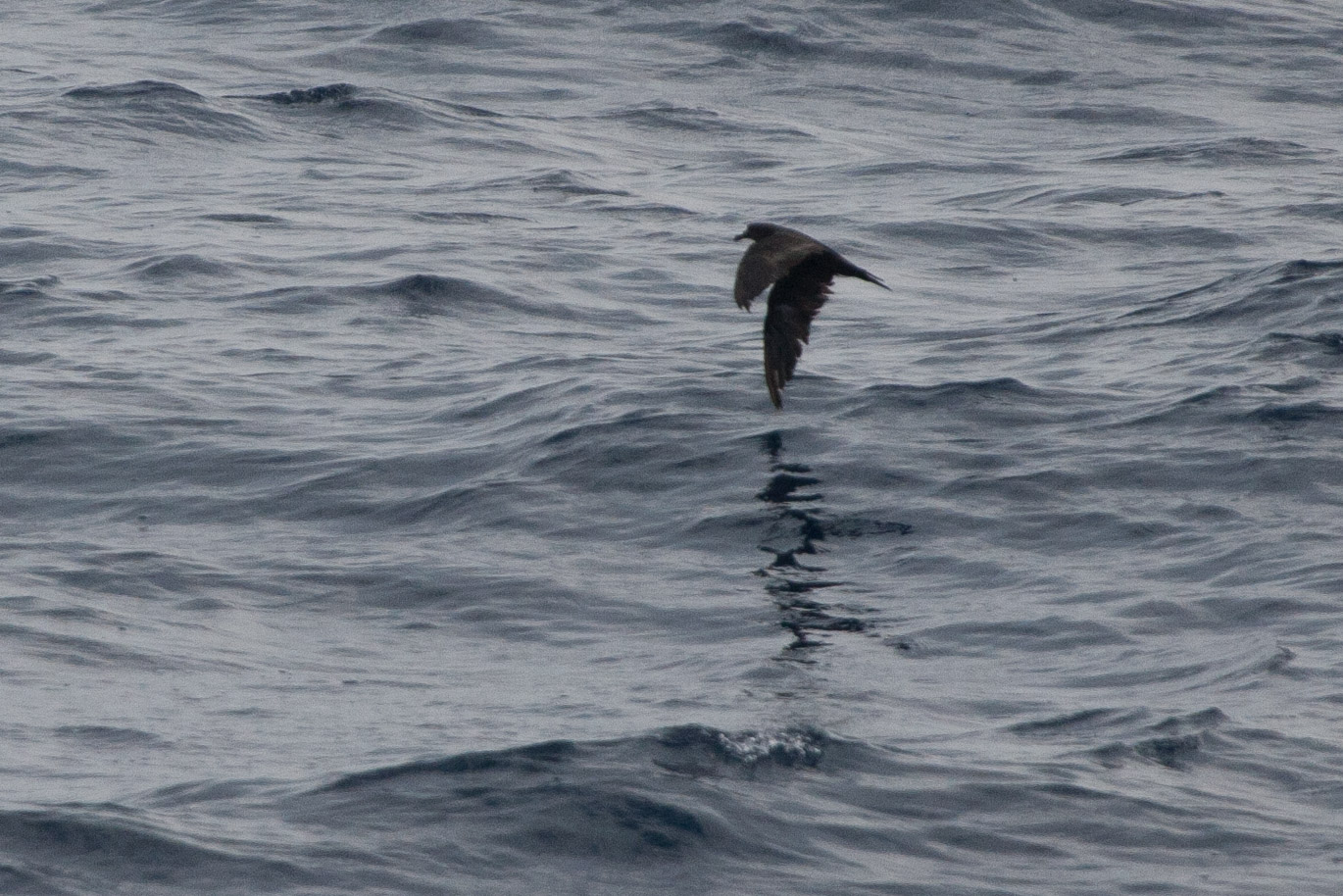
Larger and bulkier than Bulwer’s Petrel, all dark chocolate-brown, black at distance. A pale diagonal bar across the upperwing coverts is usually dull, but flashes in strong sunlight and in worn birds. The head is fairly large and the black bill strikingly deep and heavy, with a swollen hook; females and young birds have a slightly slimmer bill. The wings are long and fairly broad, the long wedge-shaped tail usually closed and pointed. Flies low over the water with loose, rather floppy beats and short glides, arcing in strong wind. Sits upright on the water like a ‘floating black banana’.
Confusion species
Bulwer’s Petrel (Bulweria bulwerii) is smaller and slimmer, with a finer bill, a longer, narrower tail, a brighter wing bar and more agile flight; it barely occurs in Arabian waters. Dark Wedge-tailed Shearwater (Ardenna pacifica) and Flesh-footed Shearwater (Ardenna carneipes) are much larger, with a pale pinkish bill; the latter also has pale legs. Mascarene Petrel (Pseudobulweria aterrima), outside the region, lacks the pale wing bar and flies more stiffly.
Habitat
Open, warm sea over deep water, especially where summer-monsoon upwelling brings food to the surface; sometimes comes close inshore, particularly in rough weather. Breeds in cavities in high, sheer sea cliffs and possibly inland on mountain walls.
Where the bird is most at home, classified by the habitats of North Africa and the Middle East.
Range and movements
The only confirmed breeding site is on Socotra (Yemen), where a nest was found in 2001 in a cave in a high sea cliff; over a thousand birds have been seen at sea at once and the population is estimated at several thousand pairs. Breeding is suspected on the Hallaniyat Islands off Dhofar (Oman) and possibly inland in southern Oman. At sea year-round around Socotra and Abd al-Kuri, in the Gulf of Aden and in the Arabian Sea off Dhofar and Masirah; outside the breeding season also in the Gulf of Oman, with large influxes off the east coast of the Emirates (up to 609 birds in December 2012) and off Muscat, mainly from September to December. Not in the Persian Gulf or the Red Sea. Beyond the region it wanders over the north-western Indian Ocean to Kenya, the Maldives, India and Sri Lanka, with far-flung vagrants to Australia, Hawaii and Italy.
- Summer visitor (c. Apr–Sep)
- Winter visitor (c. Oct–Mar)
- Passage (Mar–Apr, Oct–Nov)
- dark = core range, pale = thinly spread
How and when to look
Pelagic trips from Mirbat in Dhofar and between Socotra and Abd al-Kuri produce most sightings. In autumn, boat trips from Fujairah and Dibba (Emirates) or Muscat give a good chance; in some years there are hundreds, in others almost none.
Conservation status
Near Threatened. The breeding range is tiny and most breeding sites are unknown. On Socotra fat chicks are sometimes taken for food, and a ring road along the cliffs could damage breeding sites; rats, cats and oil pollution at sea are potential risks.
Scientific name
Bulweria fallax | Jouanin, 1955
Jouanin described the species in 1955 and placed it straight away in the genus where it still stands. The genus Bulweria was introduced in 1843 by Bonaparte. Bulweria was formed from the specific name bulwerii and so honours the same man, James Bulwer. fallax is Latin for 'deceptive', as the species closely resembles other petrels. The specimen the first description was based on came from northwestern Indian Ocean, near Socotra.