All species › Passerines › Laughingthrushes › Afghan Babbler
Afghan Babbler | Argya huttoni
Afghaanse babbelaar | Tordalino afgano
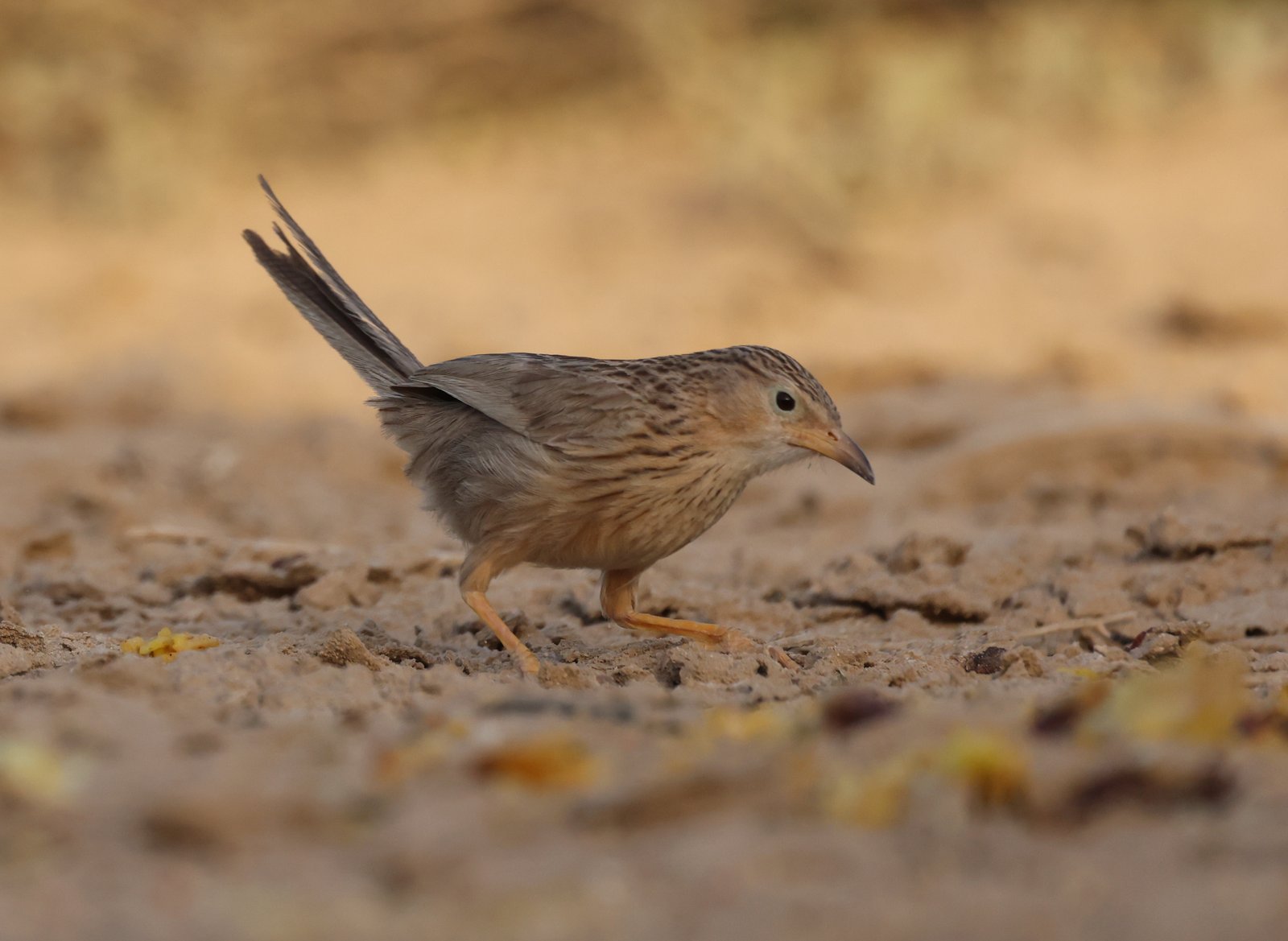
The Afghan Babbler reaches the western edge of a range extending to Pakistan in southern Iraq and the far north of Kuwait. It was long treated as a subspecies of Common Babbler (Argya caudata); the birds in the region belong to the form salvadorii. A noisy social bird of dry scrub and gardens.
Voice
A chattering chorus of high, rolling whistles and trills, such as a rapid tiritiritiri and thin wee calls; when alarmed a hard, grating cherr. Group members call almost constantly.
Recording: Remco Hofland — CC BY-NC-SA 4.0 · shortened to the first 60 s, mono · xeno-canto
Identification
23 cm. Slim, with short, rounded wings and a long, graduated tail that is often cocked or fanned. Upperparts sandy greyish brown with clear dark streaks on crown and back; underparts paler, pale buff with a whitish throat and fine dark streaks on breast sides and flanks. Bill fairly heavy and slightly decurved, iris pale yellowish. Sexes alike; juveniles have a darker iris and less streaking.
Confusion species
Iraq Babbler (Argya altirostris) is smaller and plainer, with an almost unstreaked breast and a dark eye, and lives in reeds and riverside scrub. No other babbler overlaps with this species in the region; Arabian Babbler (Argya squamiceps) of western and southern Arabia is larger, with a scaly crown and no streaking on the breast.
Habitat
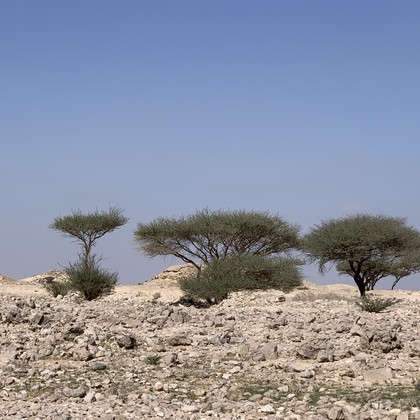
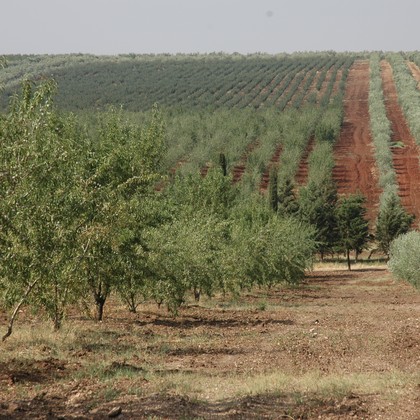
Dry, open country with bushes and low trees: thorn scrub, tamarisk scrub on the desert edge, date-palm groves, farms and orchards with hedges. Forages in parties of five to fifteen on the ground, hopping one after another from bush to bush.
Where the bird is most at home, classified by the habitats of North Africa and the Middle East.
Range and movements
In the region only in southern Iraq, in the dry lowlands around Basra and Zubair and along the western edge of the Mesopotamian plain, and in northern Kuwait, where a small breeding population has lived at the Abdaly farms on the Iraqi border since about 2007; elsewhere in Kuwait, as at Jahra, only single birds. Beyond the region from south-western and eastern Iran through Afghanistan to south-western Pakistan.
- Resident
- Winter visitor (c. Oct–Mar)
- Passage (Mar–Apr, Oct–Nov)
- dark = core range, pale = thinly spread
How and when to look
In Kuwait, Abdaly Farms on the Iraqi border is the regular site; search the hedges and orchards early in the morning, when the parties are most vocal.
Conservation status
Only recently split from Common Babbler; the IUCN has not yet assessed the species separately. In its large range it is not rare and there are no signs of a steep decline. In the region the population is small and local; in Kuwait the species has only recently become established.
Scientific name
Argya huttoni | (Blyth, 1847) (GBIF: Turdoides huttoni)
Blyth described the species in 1847 as Malacocercus Huttoni; because it was later moved to another genus, the author and year stand in brackets. The genus Argya was introduced in 1831 by Lesson. Argya was formed by René Lesson from Latin argutus 'noisy'. huttoni honours Thomas Hutton (1807–1874), British army officer and naturalist in India and Afghanistan. The specimen the first description was based on came from Kandahar, Afghanistan.