All species › Passerines › Tyrant flycatchers and allies › Western Olivaceous Flatbill
Position in the tree Birds Aves › Birds with a flexible palate Neognathae › All other modern birds Neoaves › Landbirds Telluraves › Falcons, parrots and passerines Australaves › Falcons and passerines Eufalconimorphae › Parrots and passerines Psittacopasserae
Western Olivaceous Flatbill | Rhynchocyclus aequinoctialis
Westelijke groene breedbektiran | Picoplano equinoccial
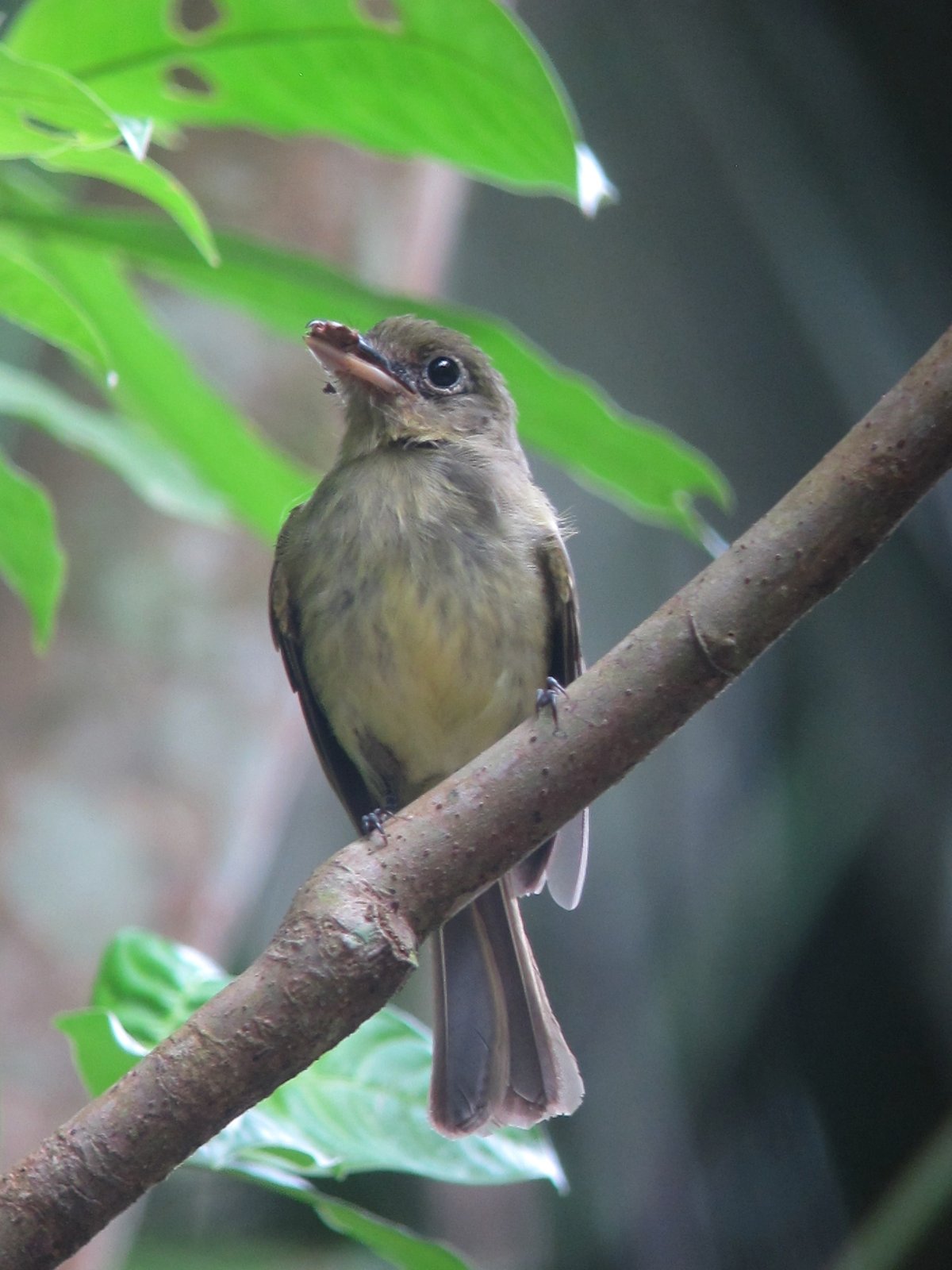
The Western Olivaceous Flatbill is an olive-green tyrant flycatcher with a very broad, flat bill that occurs in the guide area only in eastern Panama. It used to be treated as one species together with an eastern sister species. It lives quietly and inconspicuously in the middle level of humid lowland forest.
Voice
A high, shrill, slightly rising whistle and sharp, short calls.
Recording: Mabelin — CC BY-NC 4.0 · converted to mono · iNaturalist
Identification
15 cm, with a large head and a very broad, flat bill, black above and paler below. Upperparts olive-green, with a narrow pale eye-ring. The dark wings have distinct yellow edges to the coverts and tertials. Throat and breast olive with faint yellow streaks, belly yellowish. Male and female are alike.
Confusion species
Eye-ringed Flatbill Rhynchocyclus brevirostris has a greyer head with a broad white eye-ring and less prominent yellow wing edgings; in Panama it lives mainly in the west and in the mountains of Darién. Yellow-olive Flatbill Tolmomyias sulphurescens and Yellow-winged Flatbill Tolmomyias flavotectus are smaller and slimmer, with a grey head and a yellower belly.
Habitat
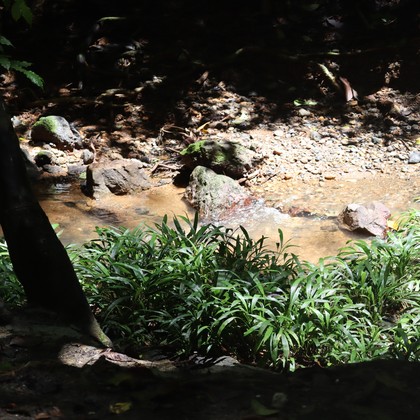
Interior of humid lowland forest and tall secondary forest, also gallery forest. It sits quietly in the middle level and takes insects with a short sally to the underside of leaves. Like the other flatbills of its genus, it builds a hanging nest with a downward-facing entrance.
Where the bird is most at home, classified by the vegetation units of Mexico and Central America.



Range and movements
In the guide area only in eastern Panama, mainly in Darién and eastern Panamá province; scarce farther west. Outside the guide area in north-western and northern Colombia and through Venezuela, Ecuador and Peru to western Amazonian Brazil and Bolivia.
- Resident
- dark = core range, pale = thinly spread
How and when to look
In humid lowland forest in eastern Panama, look for a motionless green bird with a strikingly broad bill and yellow wing edgings.
Conservation status
Not evaluated separately; the IUCN includes it in a broader species that is not threatened. In the guide area restricted to eastern Panama and dependent on forest.
Scientific name
Rhynchocyclus aequinoctialis | (Sclater, 1858) (GBIF: Rhynchocyclus olivaceus)
Sclater described the species in 1858 as Cyclorhynchus aequinoctialis; because it was later moved to another genus, the author and year stand in brackets. The genus Rhynchocyclus was introduced in 1860 by Cabanis & Heine. Rhynchocyclus is Greek, from rhunkhos 'bill' and kuklos 'circle', after the very broad, rounded bill. aequinoctialis is Latin for 'equatorial', after the type locality in Ecuador. The specimen the first description was based on came from Río Napo, Ecuador.