All species › Passerines › Cardinals and allies › Yellow-green Grosbeak
Position in the tree Birds Aves › Birds with a flexible palate Neognathae › All other modern birds Neoaves › Landbirds Telluraves › Falcons, parrots and passerines Australaves › Falcons and passerines Eufalconimorphae › Parrots and passerines Psittacopasserae
Yellow-green Grosbeak | Caryothraustes canadensis
Geelgroene kardinaal | Picogordo de antifaz
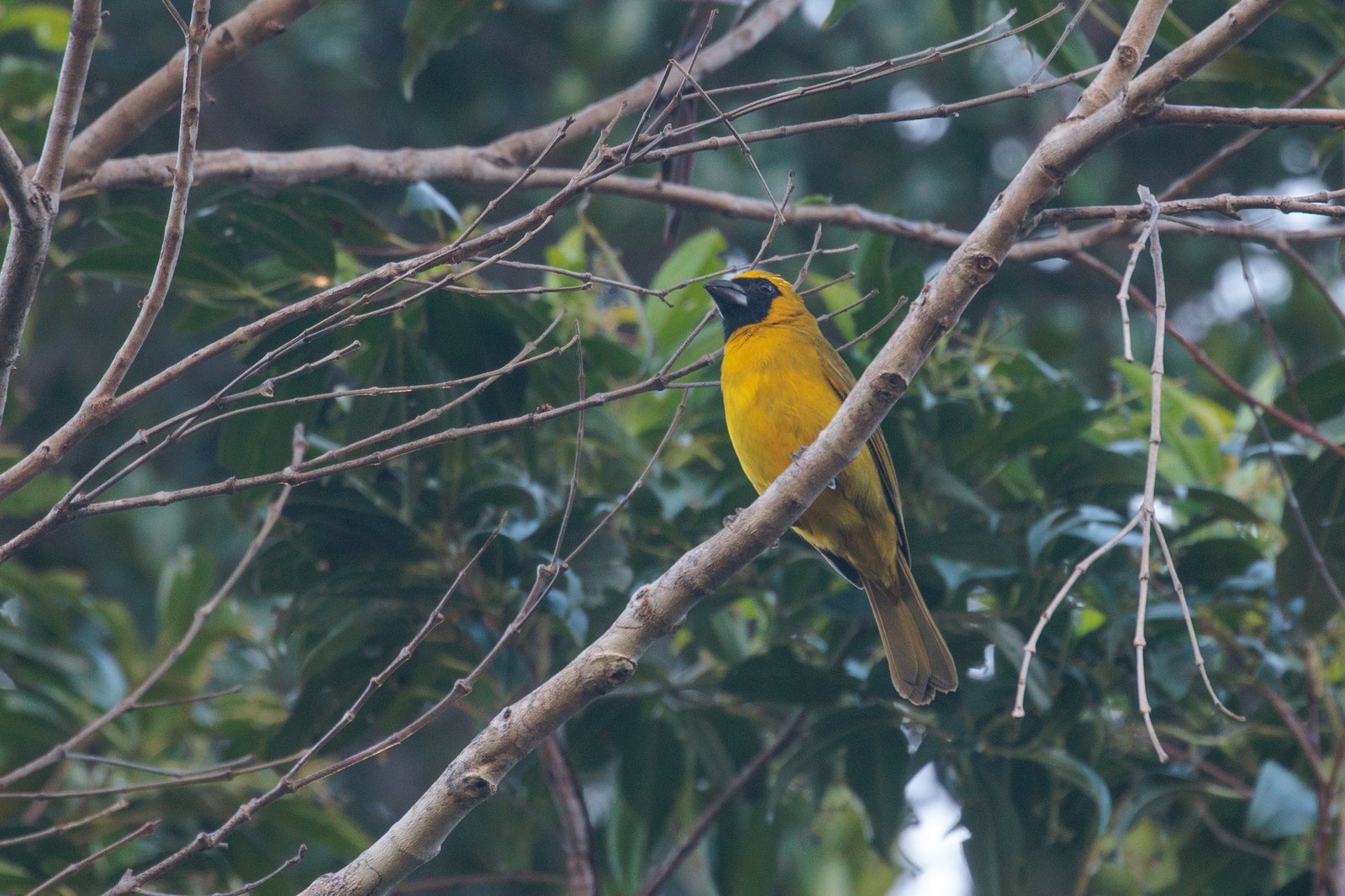
The Yellow-green Grosbeak is a yellow-green grosbeak with a small black mask around the base of the bill and a thick, conical bill. It lives in groups in the canopy and along the edges of humid lowland forest. In the guide area it occurs only in eastern Panama; most of its range lies in South America.
Voice
Groups give harsh, buzzy calls and dry chip notes. The song is a series of clear whistled notes, such as chee-chee-choo.
Recording: Wim Jacobs — CC BY-NC-SA 4.0 · converted to mono · xeno-canto
Identification
16–17 cm. A stocky grosbeak with a heavy, conical blackish bill with a greyer lower mandible. Forehead, lores, chin and a narrow ring around the bill black. Head and upperparts bright olive yellow-green; underparts yellow, greener on the flanks. Wings and tail dark with olive-green edges. The sexes are alike.
Confusion species
Black-faced Grosbeak Caryothraustes poliogaster (south-eastern Mexico to central Panama) is larger, with a more extensive black mask over cheeks and throat, a grey rump and a grey belly. Female tanagers of the genus Piranga have a slimmer bill and no black on the face.
Habitat
Canopy and middle storey of humid lowland and foothill forest, forest edges and tall secondary forest, mainly below 800 m. It eats seeds, fruit and insects, often in mixed flocks.
Where the bird is most at home, classified by the vegetation units of Mexico and Central America.



Range and movements
In the guide area only in eastern Panama, mainly in Darién and the east of Panamá province. Outside the guide area in northern and eastern Colombia, Venezuela, the Guianas and much of Brazil.
- Resident
- Winter visitor (c. Oct–Mar)
- dark = core range, pale = thinly spread
How and when to look
In the guide area the best chance is in the lowland forest of Darién, for example around El Real and Cana. Groups give themselves away with their buzzy calls in the canopy.
Conservation status
Not threatened (LC). Widespread in South America; in the guide area local and little known, with a limited number of records.
Scientific name
Caryothraustes canadensis | (Linnaeus, 1766)
Linnaeus described the species in 1766 as Loxia canadensis; because it was later moved to another genus, the author and year stand in brackets. The genus Caryothraustes was introduced in 1850 by Reichenbach. Caryothraustes is Greek, from karuon 'nut' and thraustēs 'breaker': 'nut-cracker', after the heavy, conical bill. canadensis means 'of Canada', but is an error: the type came from Cayenne (French Guiana) and the species does not occur in Canada. The specimen the first description was based on came from Cayenne, French Guiana (erroneously 'Canada').