All species › Passerines › Tanagers and allies › Yellow-faced Grassquit
Position in the tree Birds Aves › Birds with a flexible palate Neognathae › All other modern birds Neoaves › Landbirds Telluraves › Falcons, parrots and passerines Australaves › Falcons and passerines Eufalconimorphae › Parrots and passerines Psittacopasserae
Yellow-faced Grassquit | Tiaris olivaceus
Grote cubavink | Semillero oliváceo
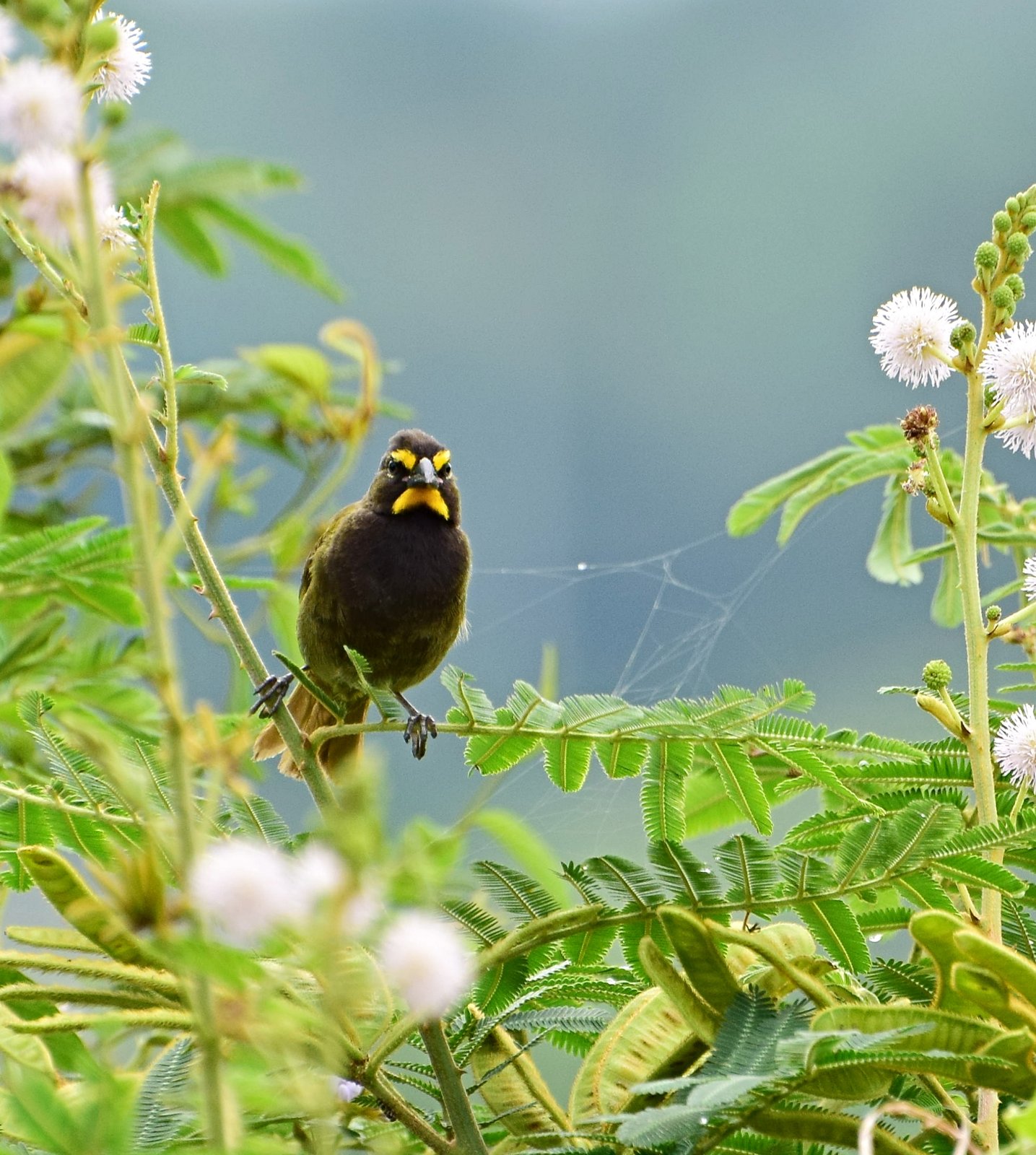
The Yellow-faced Grassquit is a small seed-eater of grassland and rank roadsides with a yellow eyebrow and yellow throat. Despite its Dutch name, which refers to Cuba, the species also lives on the mainland of Mexico and Central America, where it is common in open, grassy country from the lowlands to the high mountains.
Voice
The song is a thin, high, insect-like trill, like tititititi, often repeated many times from a low perch. The call is a soft, high tsip.
Recording: FREDERIC Lionel — CC BY-NC-SA 4.0 · converted to mono · xeno-canto
Identification
10–11 cm. Short, pointed, conical black bill. The male is olive green above, with a bright yellow eyebrow, a yellow throat and a yellow spot below the eye; forehead, lores and breast are black and the rest of the underparts greyish olive. The female is uniform olive grey with a faint yellowish eyebrow and throat and a paler base to the bill. Young birds resemble the female, with even less yellow.
Confusion species
The male Yellow-bellied Seedeater Sporophila nigricollis has an all-black head without yellow and a thick, rounded, pale bill. Female seedeaters such as Morelet's Seedeater Sporophila morelleti and Variable Seedeater Sporophila corvina have a thicker, more rounded bill and no trace of a yellow eyebrow. The female Blue-black Grassquit Volatinia jacarina is browner and streaked on the breast.
Habitat
Rank grassland, pasture with bushes, roadsides, field edges, forest edges, clearings in pine-oak forest and gardens, from sea level to about 2300 m. Lives in pairs or small groups, often with other seed-eaters; searches low in the grass for seeds.
Where the bird is most at home, classified by the vegetation units of Mexico and Central America.






Range and movements
On the mainland from northeastern Mexico south along the Caribbean side and in the highlands of southern Mexico, through all of Central America to Panama, on both sides of the mountains. Beyond the guide area in northwestern South America and in the Greater Antilles, including Cuba.
- Resident
- dark = core range, pale = thinly spread
How and when to look
The singing male with its yellow eyebrow is most often found along grassy roadsides and in highland pastures. Females can be recognised by the pointed bill and the faint yellow face pattern.
Conservation status
Not threatened (LC). Common and widespread; benefits from the creation of pasture and open country.
Scientific name
Tiaris olivaceus | (Linnaeus, 1766)
Linnaeus described the species in 1766 as Emberiza olivacea; because it was later moved to another genus, the author and year stand in brackets. The genus Tiaris was introduced in 1827 by Swainson. Tiaris is Greek, from tiaris or tiara 'tiara, head-dress', after the coloured head pattern. olivaceus is New Latin for 'olive-green', after the olive-green upperparts. The specimen the first description was based on came from Hispaniola.