All species › Passerines › Tanagers and allies › Bananaquit
Position in the tree Birds Aves › Birds with a flexible palate Neognathae › All other modern birds Neoaves › Landbirds Telluraves › Falcons, parrots and passerines Australaves › Falcons and passerines Eufalconimorphae › Parrots and passerines Psittacopasserae
Bananaquit | Coereba flaveola
Suikerdiefje | Reinita mielera
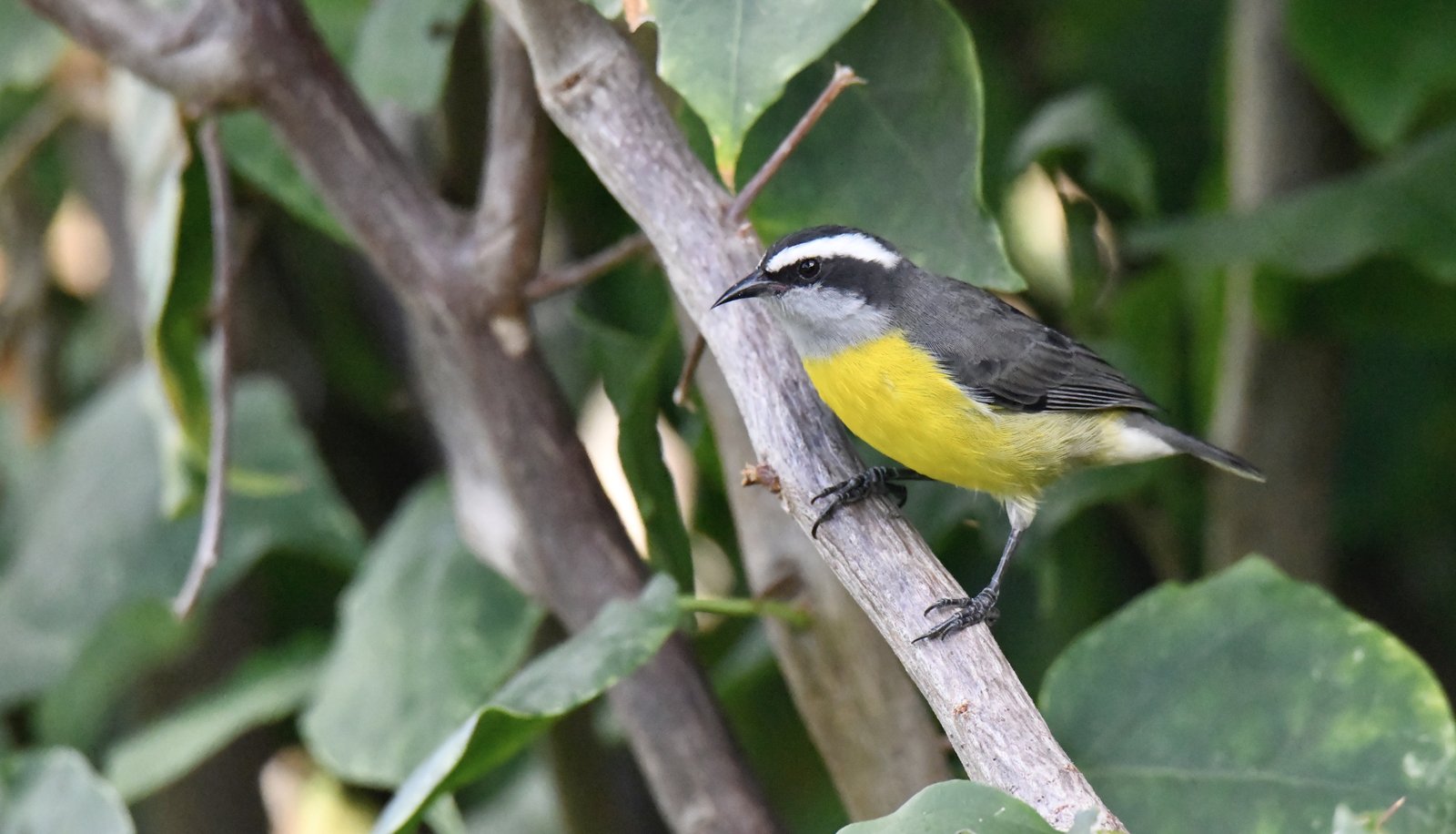
The Bananaquit is a small, active bird with a curved bill that feeds on nectar, fruit and small insects. It has dark upperparts, a white eyebrow and a yellow breast. In humid parts of the guide area it is common in forest edges, gardens and plantations, and it also comes to sugar water and fruit at houses.
Voice
The song is a high, fast, hissing and squeaky series, like tsee-tsee-tseee-tsitsitsi, heard all year and often throughout the day. The call is a short, sharp tsip.
Recording: José María Loaiza B. — CC BY-NC-SA 4.0 · converted to mono · xeno-canto
Identification
10–11 cm. Short, pointed, slightly curved black bill with a small red or pink spot at the gape. The upperparts are dark slate grey to blackish, with a broad white eyebrow, a small white wing speculum and white tips to the outer tail feathers. The throat is pale grey, the breast and rump are bright yellow and the lower belly is whitish. The sexes are alike; young birds are duller and more olive, with a yellowish eyebrow.
Confusion species
Female Red-legged Honeycreeper Cyanerpes cyaneus and Purple Honeycreeper Cyanerpes caeruleus are green or streaked, without a white eyebrow or yellow rump. Mangrove Warbler Setophaga petechia is all yellow with a straight bill. Several tyrant flycatchers such as Great Kiskadee Pitangus sulphuratus have a similar colour pattern but are much larger, with a straight, flat bill.
Habitat
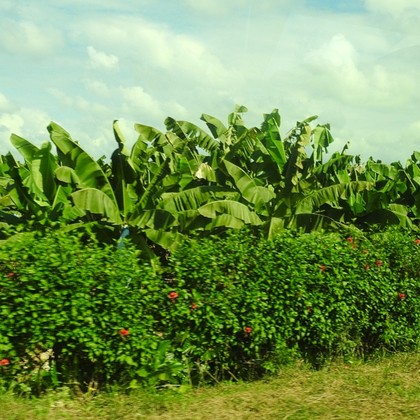
Edges and clearings of humid forest, secondary forest, shade coffee and cacao plantations, gardens, parks and mangroves, from sea level to about 1500 m, locally higher. Pierces flowers at the base to steal nectar, eats ripe fruit and searches for insects; builds round nests with a side entrance, also used for roosting.
Where the bird is most at home, classified by the vegetation units of Mexico and Central America.






Range and movements
In the guide area from southern Mexico, including the Caribbean lowlands and the coast and islands of Quintana Roo, through all of Central America to Panama, mainly on the Caribbean side and in humid parts of the Pacific side. Beyond the guide area in the Caribbean and much of South America, with many regional forms that are sometimes treated as separate species.
- Resident
- dark = core range, pale = thinly spread
How and when to look
Flowering trees and shrubs in gardens, feeders with fruit and dishes of sugar water are the best places. The high, hissing song often gives the species away before it is seen.
Conservation status
Not threatened (LC). Very common and widespread; benefits from gardens, plantations and secondary forest.
Scientific name
Coereba flaveola | (Linnaeus, 1758)
Linnaeus described the species in 1758 as Certhia flaveola; because it was later moved to another genus, the author and year stand in brackets. The genus Coereba was introduced in 1809 by Vieillot. The origin of Coereba is uncertain; possibly from a Tupí name (guirá) for a small black-and-yellow bird. flaveola is a diminutive of Latin flavus 'golden-yellow', after the yellow breast and rump. The specimen the first description was based on came from Jamaica.