All species › Passerines › New World blackbirds, troupials and allies › Yellow-billed Cacique
Position in the tree Birds Aves › Birds with a flexible palate Neognathae › All other modern birds Neoaves › Landbirds Telluraves › Falcons, parrots and passerines Australaves › Falcons and passerines Eufalconimorphae › Parrots and passerines Psittacopasserae
Yellow-billed Cacique | Amblycercus holosericeus
Geelsnaveltroepiaal | Cacique pico claro
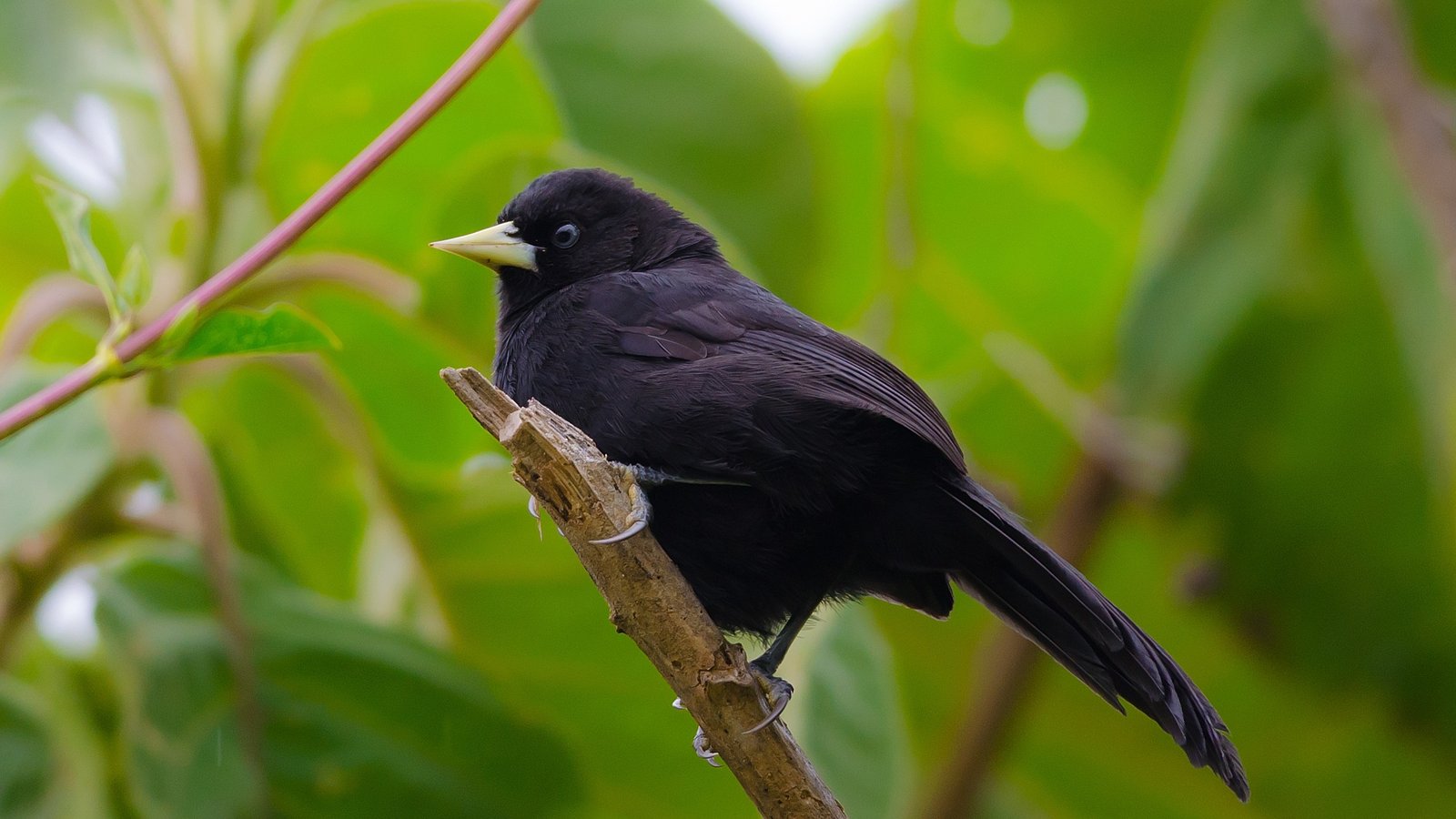
The Yellow-billed Cacique is an all-black blackbird with a pale bill that lives hidden in dense undergrowth and bamboo. It is heard far more often than seen. Despite its name it is not closely related to the true caciques and forms a genus of its own.
Voice
Pairs often sing in duet. The male gives loud, clear whistles, often in series such as whee-oo whee-oo or a rising pee-pee-pee; the female answers with a hoarse rattle or a nasal cheh. Also various harsh and mewing calls.
Recording: Max Noack — CC BY-NC-SA 4.0 · converted to mono · xeno-canto
Identification
21–28 cm. The male is clearly larger than the female. Entirely dull black, with a long tail and a long, pointed, pale ivory-yellow bill. Iris pale yellow. No colour on the rump or wings. The sexes are otherwise alike; young birds have a dark iris and are browner black.
Confusion species
Scarlet-rumped Cacique Cacicus uropygialis in Costa Rica and Panama has a red rump and a blue iris and lives in the canopy, not in undergrowth. Melodious Blackbird Dives dives has a black bill and a dark iris and lives in open, settled country. The male Great-tailed Grackle Quiscalus mexicanus has a black bill, glossy plumage and a long, keel-shaped tail. Giant Cowbird Molothrus oryzivorus has a black bill, a red iris and a small head.
Habitat
Dense thickets, forest edges, overgrown fields and secondary forest, rank vegetation along rivers and marshes, and bamboo stands in cloud forest. From the lowlands into the highlands. It forages low in the vegetation, prying open stems and leaf sheaths with its bill in search of insects.
Where the bird is most at home, classified by the vegetation units of Mexico and Central America.




Range and movements
Occurs from eastern Mexico, from southern Tamaulipas and San Luis Potosí, along the slopes towards the Gulf of Mexico and across the Yucatán Peninsula and Chiapas, through all of Central America to Panama, and on in northern and western South America to the Andes of Bolivia. Scarcer and more local on the Pacific side.
- Resident
- dark = core range, pale = thinly spread
How and when to look
Best tracked down by its loud whistles from dense undergrowth. Waiting patiently near a calling bird sometimes gives a brief view of the pale bill among the leaves.
Conservation status
Not threatened (LC). Widespread and locally fairly common. It tolerates disturbance well and benefits from the thickets and scrub that grow up after forest clearance.
Scientific name
Amblycercus holosericeus | (Deppe, 1830)
Deppe described the species in 1830 as Sturnus holosericeus; because it was later moved to another genus, the author and year stand in brackets. The genus Amblycercus was introduced in 1851 by Cabanis. Amblycercus is Greek, from amblus 'blunt' and kerkos 'tail', after the rounded tail. holosericeus is Greek, from holos 'entire' and sērikos 'silken': 'all silky', after the glossy black plumage. The specimen the first description was based on came from Alvarado, Veracruz, Mexico.