All species › Swifts › Hummingbirds › Xantus's Hummingbird
Position in the tree Birds Aves › Birds with a flexible palate Neognathae › All other modern birds Neoaves › Birds of the elements Elementaves › Nightjars and swifts Strisores
Xantus's Hummingbird | Basilinna xantusii
Cactussaffierkolibrie | Zafiro de Xantus
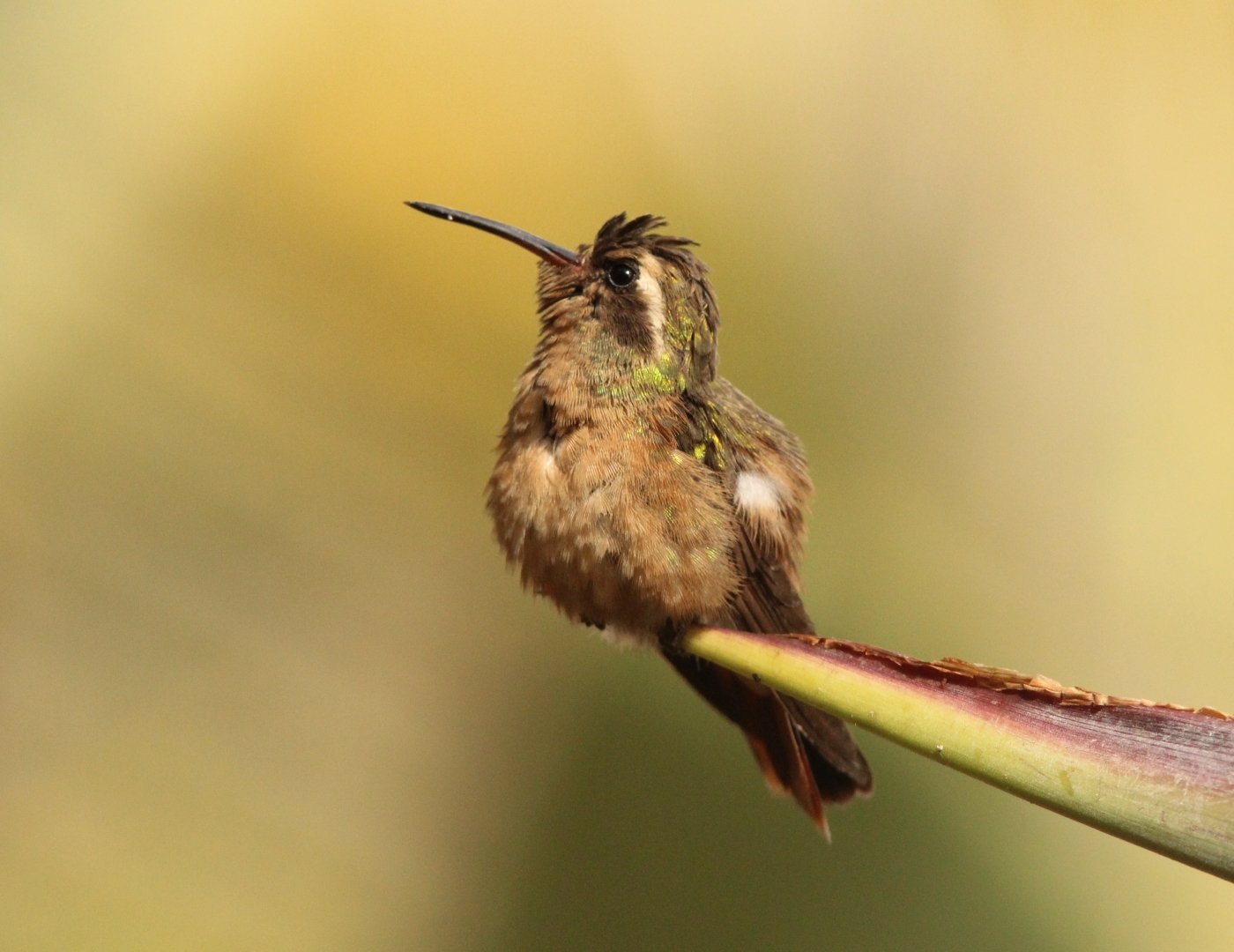
Xantus's Hummingbird is endemic to the southern half of the Baja California peninsula. It is the only hummingbird in the area with a broad white stripe behind the eye and cinnamon underparts. It breeds mainly in winter and spring, when many desert plants are in flower.
Voice
A low, dry tik or chik, and in chases a fast, rattling series.
Recording: Sue Riffe — CC BY-NC-SA 4.0 · converted to mono · xeno-canto
Identification
8–9 cm, with a straight red bill with a black tip. Both sexes have a dark face with a broad white stripe behind the eye, green upperparts, cinnamon underparts and a rufous tail. The male has a black forehead and chin and a glittering green throat; the central tail feathers are green. The female has a cinnamon throat and a rufous tail with a dark band near the tip.
Confusion species
Costa's Hummingbird Calypte costae has a black bill and greyish-white underparts; the male has a purple throat and crown. Females of Selasphorus species, such as Rufous Hummingbird Selasphorus rufus, are rufous only on the flanks and at the base of the tail, have a black bill and no broad white eyestripe. White-eared Hummingbird Basilinna leucotis of the mainland has green or white, spotted underparts and does not occur in Baja California.
Habitat
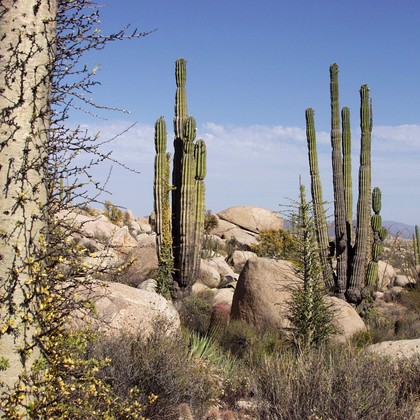
Desert scrub, cactus forest and dry forest in the Cape region, oases with palms and figs, dry riverbeds with trees, oak and pine forest in the Sierra de la Laguna, and gardens; from sea level to about 2000 m. Outside the breeding season some birds move to lower areas rich in flowers.
Where the bird is most at home, classified by the vegetation units of Mexico and Central America.





Range and movements
Endemic to the southern half of the Baja California peninsula in Mexico, from about the Vizcaíno Desert and the Sierra de San Francisco south to Cabo San Lucas, also on some islands in the Gulf of California such as Espíritu Santo and Cerralvo. Vagrants have reached California and British Columbia.
- Resident
- dark = core range, pale = thinly spread
How and when to look
In gardens and at flowering shrubs around La Paz, Todos Santos and San José del Cabo, at the oases of the Cape region and in the mountain forests of the Sierra de la Laguna. Also at feeders.
Conservation status
Not threatened. The range is limited, but the species is fairly common there and also lives in gardens. Tourism and building in the Cape region take up habitat locally.
Scientific name
Basilinna xantusii | (Lawrence, 1861)
Lawrence described the species in 1861 as Amazilia Xantusii; because it was later moved to another genus, the author and year stand in brackets. The genus Basilinna was introduced in 1831 by Boie. Basilinna is Greek for 'queen', in praise of these handsome hummingbirds. xantusii honours the Hungarian collector and naturalist János Xántus (John Xantus, 1825–1894), who collected in Baja California. The specimen the first description was based on came from Cabo San Lucas, Baja California Sur, Mexico.