All species › Passerines › Thrushes and allies › White-throated Thrush
Position in the tree Birds Aves › Birds with a flexible palate Neognathae › All other modern birds Neoaves › Landbirds Telluraves › Falcons, parrots and passerines Australaves › Falcons and passerines Eufalconimorphae › Parrots and passerines Psittacopasserae
White-throated Thrush | Turdus assimilis
Mexicaanse witneklijster | Mirlo garganta blanca
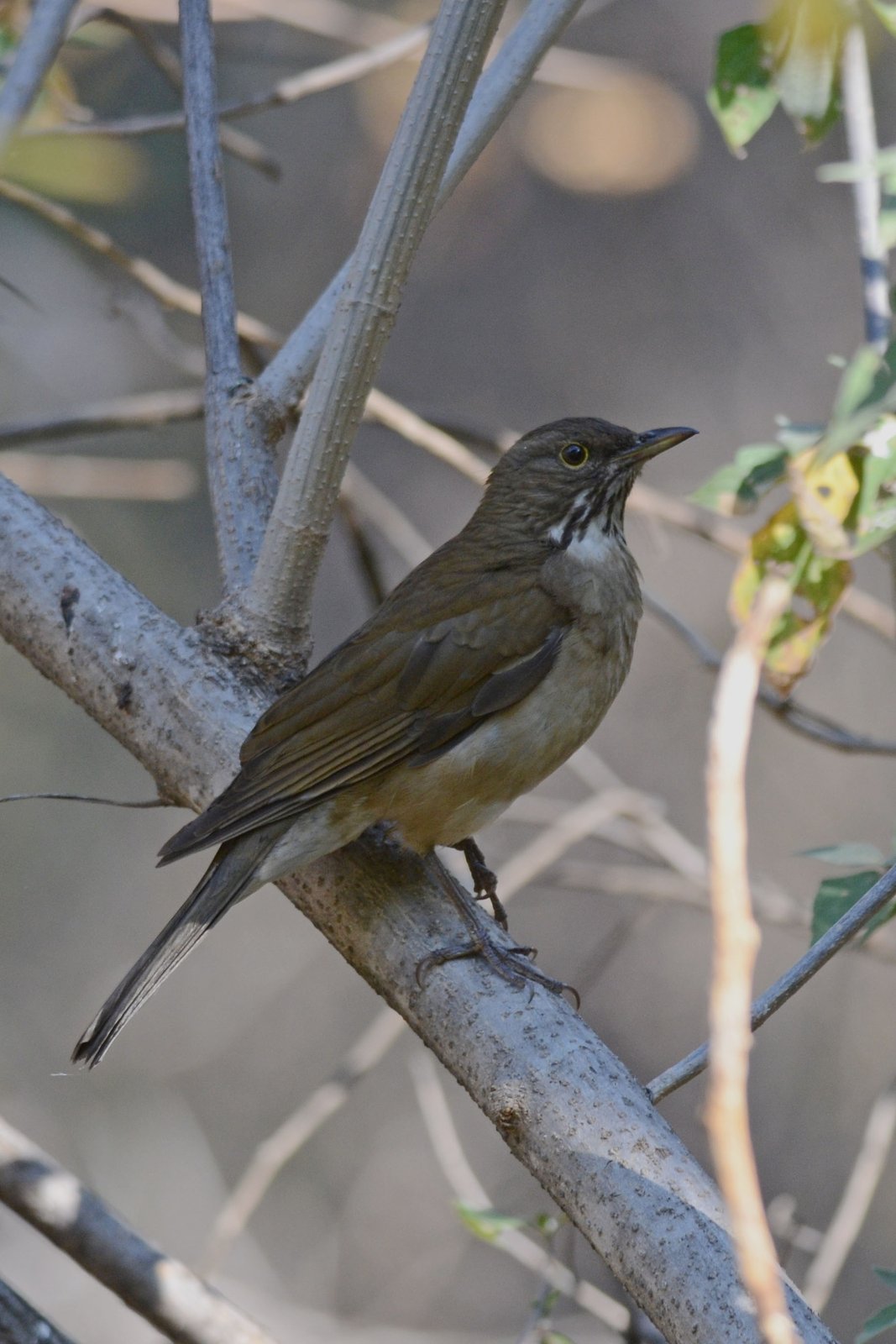
The White-throated Thrush is a greyish-brown thrush of humid foothill and montane forest, recognised by the white crescent below the streaked throat and the yellow eye-ring. It lives mainly in the middle and upper levels of the forest and is heard more often than seen. In the guide area it occurs from north-western and north-eastern Mexico to Panama.
Voice
The song is a rich, varied series of clear, whistled phrases, each repeated a few times, sometimes including imitations of other birds. The call is a nasal enk or unk and a low chuk.
Recording: Manuel Grosselet — CC BY-NC-SA 4.0 · converted to mono · xeno-canto
Identification
21–24 cm. Upperparts olive-brown to greyish brown. Throat white with dense black streaks, below it a striking, unstreaked white crescent on the upper breast. Breast and flanks greyish brown, centre of belly and undertail white. Narrow yellow to orange-yellow eye-ring. Bill dark to yellowish, depending on the population; legs brownish. The sexes are alike.
Confusion species
Clay-colored Thrush Turdus grayi is buffy brown, lacks the white crescent and the yellow eye-ring and lives mainly in open country. Pale-vented Thrush Turdus obsoletus (Costa Rica and Panama) is warmer brown, without white crescent or eye-ring. Rufous-backed Thrush Turdus rufopalliatus of western Mexico has a grey head and a rufous back. Wood Thrush Hylocichla mustelina has white underparts spotted with black.
Habitat
Humid evergreen foothill forest, cloud forest and oak and pine-oak forest, on the Pacific slope of Mexico also semi-humid forest and forest in ravines; mostly between 200 and 2000 m, sometimes lower outside the breeding season. Also mature secondary forest and forest edges. It eats fruit and searches the ground for invertebrates.
Where the bird is most at home, classified by the vegetation units of Mexico and Central America.





Range and movements
In Mexico on the Pacific slope from southern Sonora and on the Gulf slope from southern Tamaulipas, south through southern Mexico and the highlands and foothills of Central America to Costa Rica and western Panama. Birds in eastern Panama and further south are now treated as a separate species, Turdus daulias.
- Resident
- dark = core range, pale = thinly spread
How and when to look
In Mexico regularly heard at El Cielo in Tamaulipas and in the montane forests of Oaxaca and Chiapas. Best found by listening for the song in the breeding season, or by waiting at fruiting trees.
Conservation status
Not threatened (LC). Widespread and fairly common. Declines where foothill and montane forest disappears.
Scientific name
Turdus assimilis | Cabanis, 1851
Cabanis described the species in 1851 and placed it straight away in the genus where it still stands. The genus Turdus was introduced in 1758 by Linnaeus. Turdus is the ordinary Latin word for 'thrush'. assimilis is Latin for 'similar', after its resemblance to the related White-necked Thrush (Turdus albicollis). The specimen the first description was based on came from Xalapa, Veracruz, Mexico.