All species › Passerines › Tanagers and allies › White-throated Shrike-Tanager
Position in the tree Birds Aves › Birds with a flexible palate Neognathae › All other modern birds Neoaves › Landbirds Telluraves › Falcons, parrots and passerines Australaves › Falcons and passerines Eufalconimorphae › Parrots and passerines Psittacopasserae
White-throated Shrike-Tanager | Lanio leucothorax
Witkeelklauwiertangare | Tangara gorjiblanca
The White-throated Shrike-Tanager is a large tanager with a heavy bill hooked at the tip. It lives in the middle levels of humid forest and acts as the sentinel of mixed flocks of forest birds: it is the first to give the alarm when danger appears. The species occurs only in the guide area, from Honduras to western Panama.
Voice
A sharp, repeated cheep or chet, often the first sound heard when a mixed flock approaches. The song is a series of clear, whistled notes such as tee-chew.
Recording: Roland Rumm — CC BY-NC-SA 4.0 · converted to mono · xeno-canto
Identification
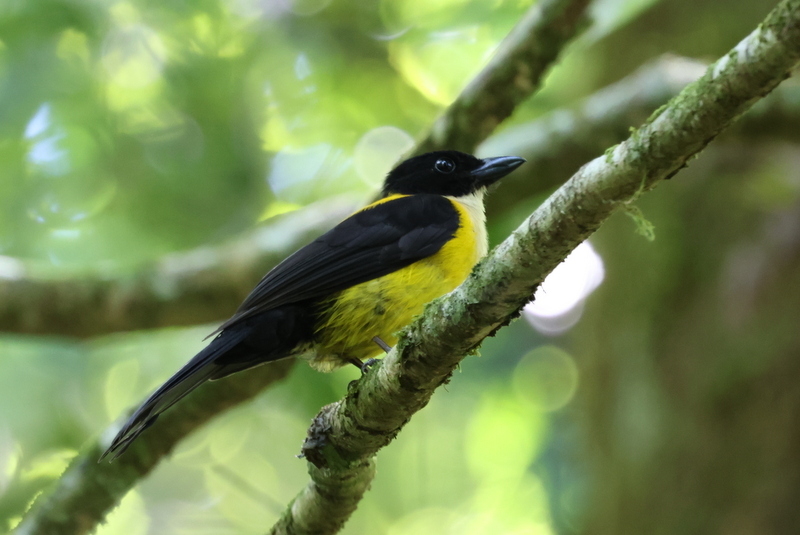
18–20 cm. A sturdy tanager with a heavy black bill with a hooked tip. The male has a black head, black wings and tail, a white throat and otherwise golden-yellow breast, belly and back. Birds on the Caribbean slope have a yellow rump, those on the Pacific slope of south-western Costa Rica and western Panama a black one. The female is olive-brown with a greyer head, a rufous-brown rump and tail, a pale greyish throat and ochre-yellow underparts.
Confusion species
Black-throated Shrike-Tanager Lanio aurantius (south-eastern Mexico to Honduras) has a black instead of a white throat; the two species meet only in Honduras. Black-cowled Oriole Icterus prosthemelas is also black and yellow, but has a black throat and breast and a thin, pointed bill. The female resembles female ant tanagers, but the hooked bill, rufous tail and behaviour in mixed flocks separate her.
Habitat
Middle and upper levels of humid evergreen lowland and foothill forest, from sea level to about 1100 m. It stays almost always in continuous forest and seldom enters forest edges or open country. It catches large insects, often flying from a branch to a leaf.
Where the bird is most at home, classified by the vegetation units of Mexico and Central America.


Range and movements
Caribbean slope of eastern Honduras, Nicaragua, Costa Rica and western Panama; also the Pacific slope of south-western Costa Rica and adjacent western Panama. It does not occur outside the guide area.
- Resident
- dark = core range, pale = thinly spread
How and when to look
Seen in humid foothill forest on the Caribbean slope of Costa Rica, for example at La Selva and in Braulio Carrillo. Anyone who finds a mixed flock often hears the sharp call of this species first.
Conservation status
Near Threatened (NT). Dependent on undisturbed forest and therefore vulnerable to lowland deforestation; still fairly regular in large forest areas.
Scientific name
Lanio leucothorax | Salvin, 1865
Salvin described the species in 1865 and placed it straight away in the genus where it still stands. The genus Lanio was introduced in 1816 by Vieillot. Lanio is Latin for 'butcher', after the shrike-like hooked and toothed bill. leucothorax is Greek, from leukos 'white' and thōrax 'breast', after the male's white throat and breast. The specimen the first description was based on came from Tucurrique, Costa Rica.