All species › Passerines › Tanagers and allies › Tawny-crested Tanager
Position in the tree Birds Aves › Birds with a flexible palate Neognathae › All other modern birds Neoaves › Landbirds Telluraves › Falcons, parrots and passerines Australaves › Falcons and passerines Eufalconimorphae › Parrots and passerines Psittacopasserae
Tawny-crested Tanager | Tachyphonus delatrii
Taankuiftangare | Tangara crestinaranja
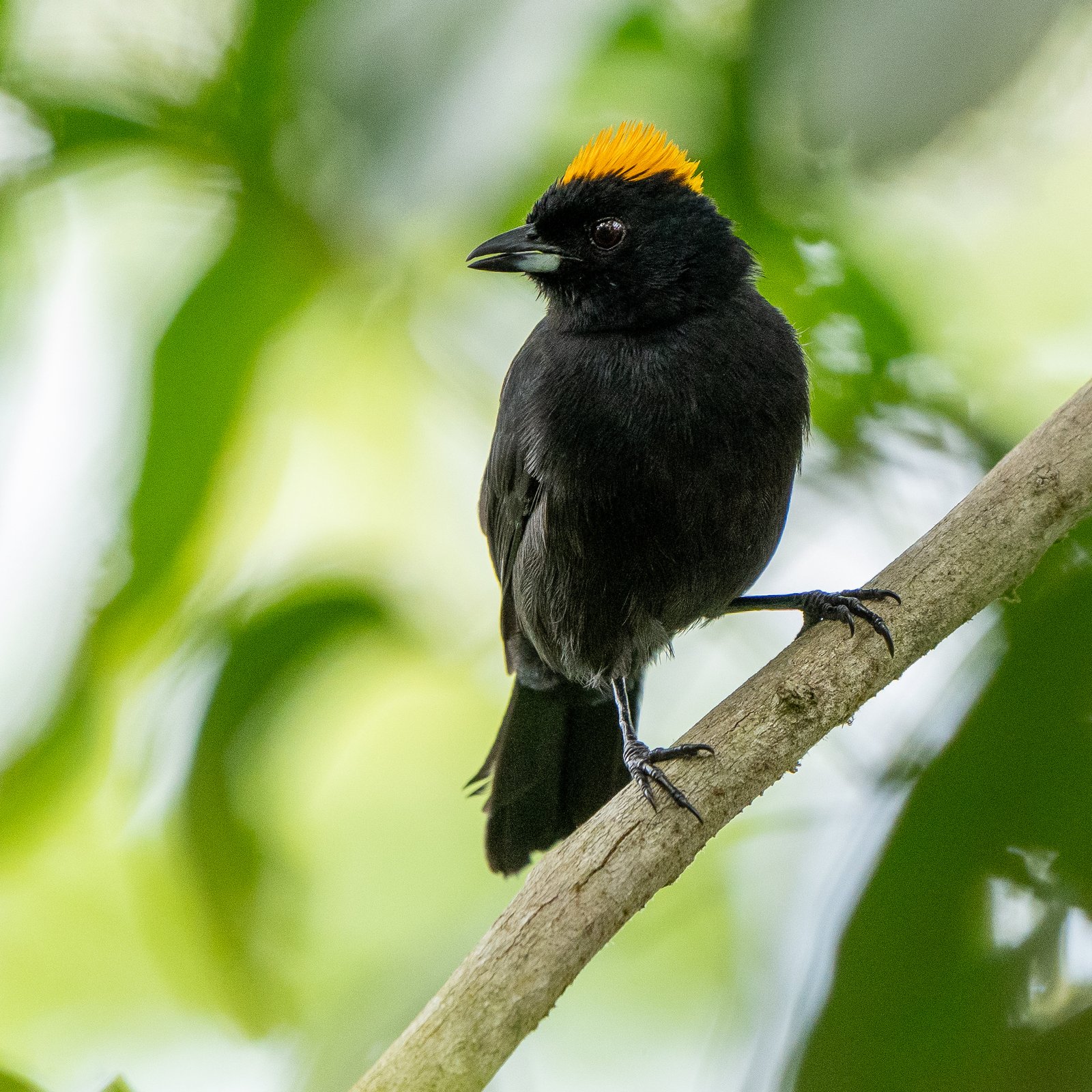
The Tawny-crested Tanager is a small black tanager with an orange-brown crest. It lives in noisy, fast-moving groups in the understorey of humid foothill forest. In the guide area it occurs on the Caribbean slope of Nicaragua and Costa Rica and in Panama.
Voice
Groups give a constant, sharp tsip or tchit while moving quickly through the undergrowth. A true song is rarely heard.
Recording: Juan Freile — CC BY-NC-SA 4.0 · converted to mono · xeno-canto
Identification
13–14 cm. A small, slender tanager with a pointed black bill. The male is entirely dull black with a bright tawny to orange-yellow crest on the crown, which is often slightly raised. The female is uniformly dark olive-brown, without a crest and without markings.
Confusion species
The male White-lined Tanager Tachyphonus rufus is larger, lacks a crest and shows white underwings in flight. The male White-shouldered Tanager Loriotus luctuosus has a white shoulder patch and no orange crest. The female resembles females of other small tanagers, but is darker and more uniformly brown and is almost always in a group with males.
Habitat
Understorey and lower middle levels of humid evergreen forest in the foothills, mainly between 300 and 1200 m, locally down into the lowlands; also tall secondary forest and along streams inside forest. It eats insects and small fruits and sometimes follows army ant swarms.
Where the bird is most at home, classified by the vegetation units of Mexico and Central America.



Range and movements
Caribbean slope of Nicaragua and Costa Rica; in Panama on the Caribbean slope and in the east also on the Pacific slope, including Darién. Outside the guide area in western Colombia and western Ecuador.
- Resident
- dark = core range, pale = thinly spread
How and when to look
The groups move fast; the best chance is a group crossing a forest trail, as in the foothills of Braulio Carrillo in Costa Rica or around Cerro Jefe in Panama.
Conservation status
Not threatened (LC). Locally common in foothill forest; disappears where forest is cleared.
Scientific name
Tachyphonus delatrii | de Lafresnaye, 1847
De Lafresnaye described the species in 1847 and placed it straight away in the genus where it still stands. The genus Tachyphonus was introduced in 1816 by Vieillot. Tachyphonus is Greek, from takhus 'fast' and phōneō 'to speak': 'fast talker'. delatrii honours the French naturalist and collector Adolphe Delattre (1805–1854), who collected in Mexico and Colombia. The specimen the first description was based on came from Buenaventura, Colombia.