All species › Passerines › Tanagers and allies › Black-throated Shrike-Tanager
Position in the tree Birds Aves › Birds with a flexible palate Neognathae › All other modern birds Neoaves › Landbirds Telluraves › Falcons, parrots and passerines Australaves › Falcons and passerines Eufalconimorphae › Parrots and passerines Psittacopasserae
Black-throated Shrike-Tanager | Lanio aurantius
Zwartkeelklauwiertangare | Tángara garganta negra
The Black-throated Shrike-Tanager is a large tanager with a hooked bill that perches upright on a branch in the middle levels of humid lowland forest. It often forms the core of mixed flocks of forest birds and gives loud alarm calls at signs of danger. Its range lies entirely within the guide area, from south-eastern Mexico to Honduras.
Voice
Calls loudly and piercingly, with sharp whistled notes such as chew and a high, falling pee-tchoo; the calls act as a warning for the whole flock.
Recording: Pritam Baruah — CC BY-NC-SA 4.0 · converted to mono · xeno-canto
Identification
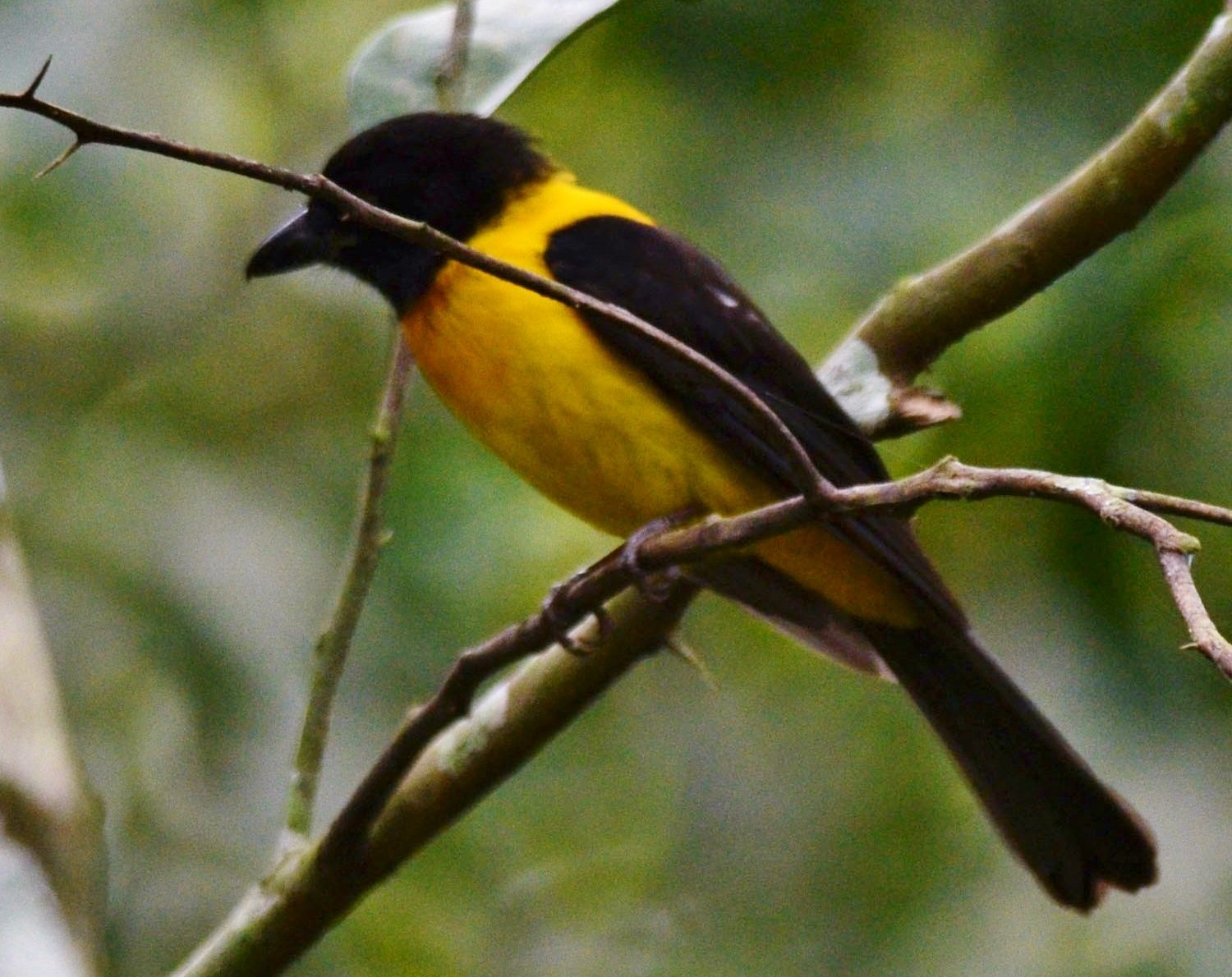
19–20 cm. A large tanager with a strong bill, hooked at the tip with a small tooth, and a fairly long tail. Male with a black head and throat; rest of the body ochre-yellow, warmer ochre-brown on breast and mantle; wings and tail black. Female olive-brown above, warm ochre below, with rufous-brown wings and tail.
Confusion species
The male White-throated Shrike-Tanager Lanio leucothorax, which occurs from Honduras southward, has a white throat. The male Black-cowled Oriole Icterus prosthemelas also has a black head and a yellow body, but a pointed bill and a black back. The female resembles ant tanagers such as Red-crowned Ant Tanager Habia rubica, which lack a hooked bill and perch less upright.
Habitat
Middle levels and lower canopy of humid evergreen lowland and foothill forest, mainly below 800 m; also tall secondary forest. It catches large insects in flight or from leaves, and regularly takes prey flushed by other birds in the flock.
Where the bird is most at home, classified by the vegetation units of Mexico and Central America.



Range and movements
South-eastern Mexico, from southern Veracruz and northern Oaxaca through Tabasco, Chiapas and the southern Yucatán Peninsula, and further in Belize, Guatemala and northern Honduras. It does not occur outside the guide area.
- Resident
- dark = core range, pale = thinly spread
How and when to look
In the forests of Tikal and Palenque it can be found in mixed flocks in the middle levels; the sharp alarm call often reveals a flock before the birds are seen.
Conservation status
Not threatened (LC). Locally fairly common in undisturbed forest, but sensitive to deforestation and fragmentation.
Scientific name
Lanio aurantius | de Lafresnaye, 1846
De Lafresnaye described the species in 1846 and placed it straight away in the genus where it still stands. The genus Lanio was introduced in 1816 by Vieillot. Lanio is Latin for 'butcher', after the shrike-like hooked and toothed bill. aurantius is Latin for 'orange', after the male's orange-yellow body. The specimen the first description was based on came from 'Colombia' (in error; Guatemala suggested).