All species › Cranes, rails and allies › Rails, gallinules and coots › White-throated Crake
Position in the tree Birds Aves › Birds with a flexible palate Neognathae › All other modern birds Neoaves › Birds of the elements Elementaves › Cranes and waders Gruimorphae
White-throated Crake | Laterallus albigularis
Witkeeldwergral | Polluela gargantiblanca
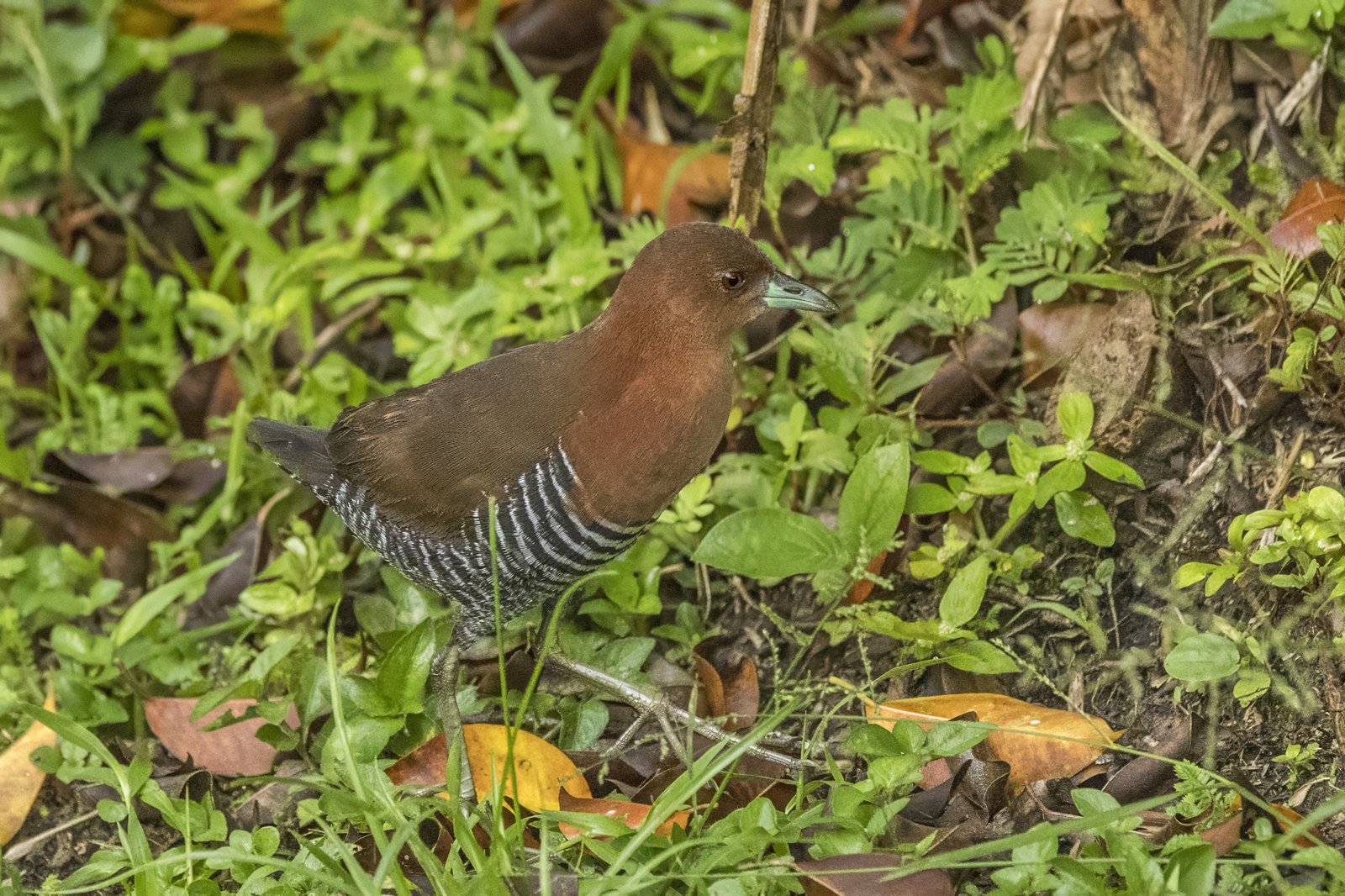
The White-throated Crake is a small, rufous crake with a white throat and flanks barred black and white, the commonest crake of the southern part of the guide area. Its loud, rattling call sounds from almost every wet, grassy spot in Costa Rica and Panama, but the bird itself usually stays out of sight. Here it replaces the Ruddy Crake of further north.
Voice
A long, loud, descending rattle or trill lasting several seconds, reminiscent of a rattlesnake or a small engine, often given as a duet; also a sharp, repeated cheek. Calls all year round and throughout the day, also at night.
Recording: Juan Freile — CC BY-NC-SA 4.0 · converted to mono · xeno-canto
Identification
14–16 cm, small and short-tailed, with a short, greenish-black bill. Head, sides of the neck and breast are warm rufous, the throat white and the crown somewhat darker. The back and wings are plain olive-brown. The rear flanks, belly and undertail are boldly barred black and white. The eye is red, the legs brownish to olive-grey. Male and female are alike. Juveniles are duller, with a greyer head and breast and a dark eye.
Confusion species
Ruddy Crake Laterallus ruber is plain rufous without barring, with a dark grey head. Grey-breasted Crake Laterallus exilis has a pale grey head and breast with a chestnut nape. Ocellated Crake Rufirallus schomburgkii has white spots on the back and wings and reddish legs. Yellow-breasted Crake Laterallus flaviventer is smaller, with a white supercilium and yellow legs.
Habitat
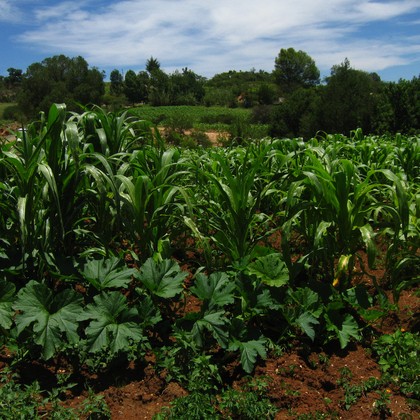
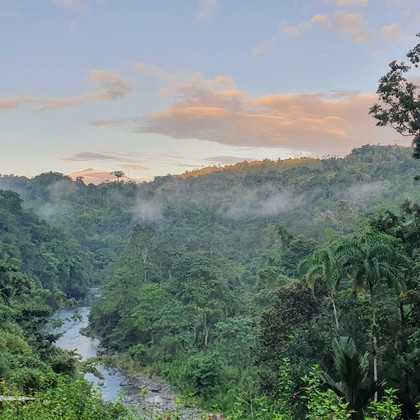
Wet grasslands, marsh edges, damp pastures, rice fields and ditches, and dense vegetation along streams and rivers, also in small wet patches in farmland and at forest edges; from sea level to about 1500 m. Feeds on insects, spiders and seeds. The nest is a domed structure of grass with a side entrance, in dense vegetation just above the ground.
Where the bird is most at home, classified by the vegetation units of Mexico and Central America.


Range and movements
In the guide area from eastern Honduras, in the Mosquitia, and the Caribbean lowlands of Nicaragua, mainly in Río San Juan, throughout Costa Rica, on both slopes and up into the lower highlands, and throughout Panama to Darién. Outside the guide area in western Colombia and western Ecuador.
- Resident
- dark = core range, pale = thinly spread
How and when to look
In Costa Rica and Panama heard almost everywhere along wet ditches and rough pastures, including around lodges and villages in the lowlands. Standing still near a calling bird at the edge of a ditch sometimes gives a brief view as it walks along the edge of the vegetation; the chance is greatest in the early morning.
Conservation status
Not threatened and common in most of its range. The species does well in human-altered land and locally benefits from forest clearance, as long as wet, grassy patches remain.
Scientific name
Laterallus albigularis | (Lawrence, 1861)
Lawrence described the species in 1861 as Corethrura albigularis; because it was later moved to another genus, the author and year stand in brackets. The genus Laterallus was introduced in 1855 by Gray. Laterallus is a contraction of Rallus lateralis, an old synonym of the Rufous-sided Crake; Latin lateralis 'of the side' refers to the coloured flanks. albigularis is Latin, from albus 'white' and gula 'throat', after the white throat. The specimen the first description was based on came from Caribbean side of the Isthmus of Panama, along the railway.