All species › Cranes, rails and allies › Rails, gallinules and coots › Ruddy Crake
Position in the tree Birds Aves › Birds with a flexible palate Neognathae › All other modern birds Neoaves › Birds of the elements Elementaves › Cranes and waders Gruimorphae
Ruddy Crake | Laterallus ruber
Rosse dwergral | Polluela rojiza
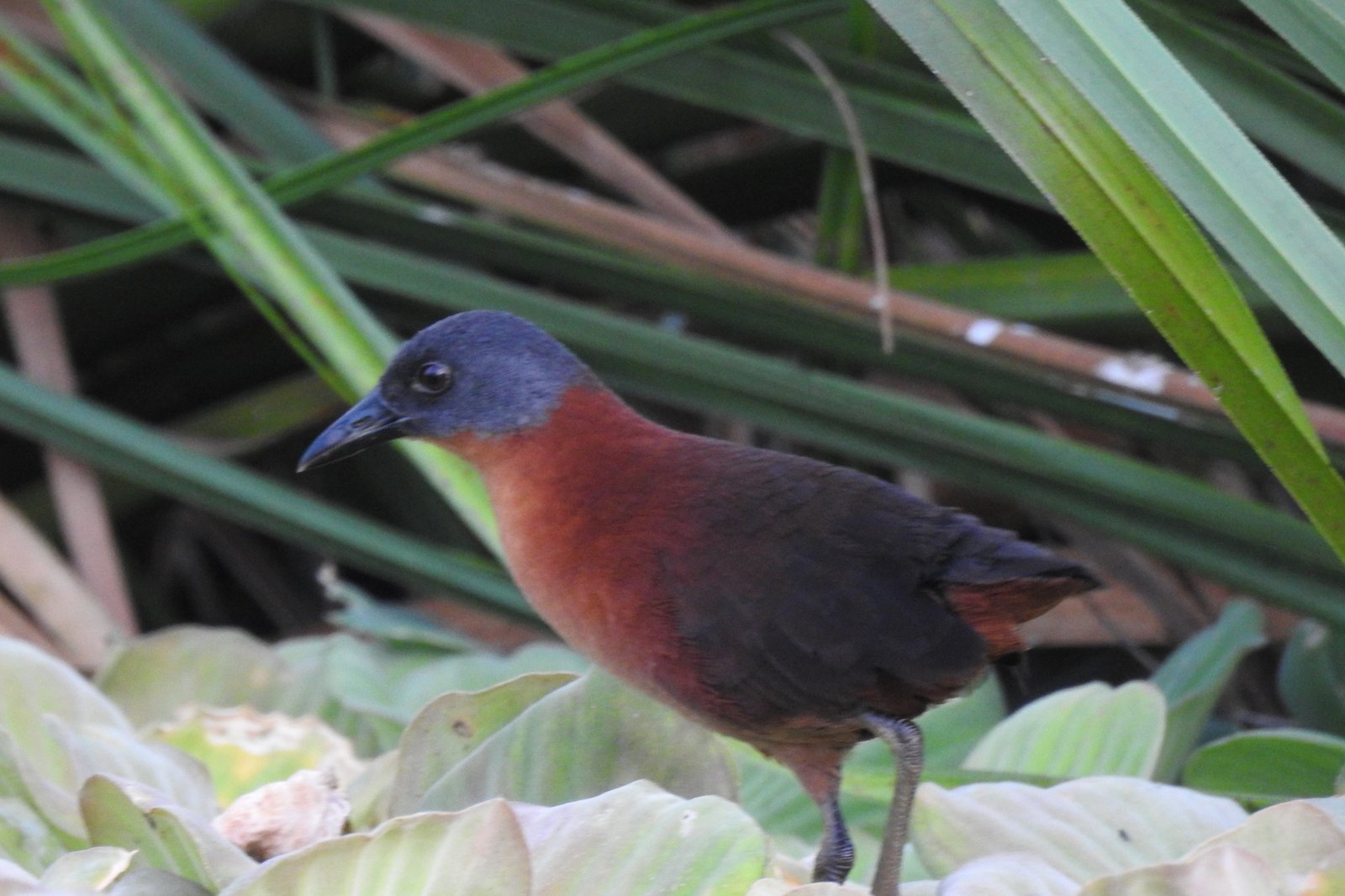
The Ruddy Crake is a small, plain rufous crake with a dark grey head, the commonest crake in the northern part of the guide area. It lives hidden in dense grass and marsh vegetation and is mainly detected by its long, rattling call, often given as a duet. The entire range lies within the guide area, from Mexico to Nicaragua.
Voice
A long, descending, rattling trill lasting several seconds, loud at first and then fading, often given by two birds together; also a sharp chik and a soft churr. Calls all year round, by day and at night.
Recording: Whitney Neufeld-Kaiser — CC BY-NC-SA 4.0 · converted to mono · xeno-canto
Identification
14–16 cm, small and short-tailed, with a short, dark bill. Head and neck are dark slate-grey, the crown darkest, the throat somewhat paler. Back, wings, breast and belly are plain warm rufous, without barring on the flanks. The eye is red, the legs olive-green to brownish. Male and female are alike. Juveniles are duller and darker brown, with a greyer head and a dark eye.
Confusion species
White-throated Crake Laterallus albigularis, which barely overlaps with Ruddy Crake, has a white throat, an olive-brown back and flanks barred black and white. Grey-breasted Crake Laterallus exilis has a pale grey breast and barred flanks. Uniform Crake Amaurolimnas concolor is larger and plain brown, including the head, with a greenish bill and red legs. Paint-billed Crake Mustelirallus erythrops has a red and yellow bill and a grey breast.
Habitat
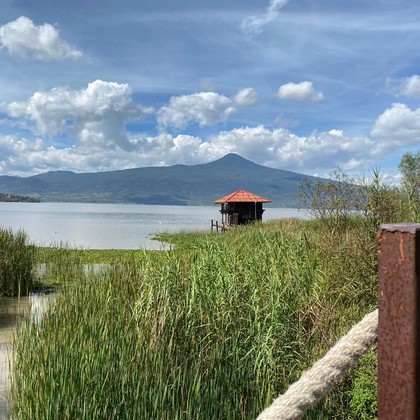
Wet grasslands, marshes and edges of ponds and ditches with dense grass, rough pastures, old fields, rice fields and overgrown roadside ditches; from sea level to about 1500 m. Tolerates human-altered land well, as long as there is dense, damp grass. Feeds on insects, spiders and seeds. The nest is a domed structure of grass with a side entrance, in dense vegetation just above the ground or water.
Where the bird is most at home, classified by the vegetation units of Mexico and Central America.

Range and movements
In Mexico on the Gulf side from southern Tamaulipas through Veracruz and Tabasco to the Yucatán Peninsula, and on the Pacific side mainly from Oaxaca and Chiapas, with scattered records northwest to Colima and Jalisco. Further throughout Belize and Guatemala, in El Salvador, in Honduras up into the highlands around Tegucigalpa, and in Nicaragua, mainly in the north and the highlands. Rare in northwestern Costa Rica. Does not occur outside the guide area.
- Resident
- dark = core range, pale = thinly spread
How and when to look
In Belize, on the Yucatán Peninsula and in Petén in Guatemala heard along almost any wet, grassy roadside or ditch. The rattling call is the key; a bird quickly crossing a track or briefly appearing at the edge of a ditch is often all that is seen. The chance is greatest in the early morning.
Conservation status
Not threatened and common in much of its range. The species locally benefits from the clearing of forest for pasture and farming, as long as wet, grassy patches remain.
Scientific name
Laterallus ruber | (Sclater & Salvin, 1860)
Sclater & Salvin described the species in 1860 as Corethrura rubra; because it was later moved to another genus, the author and year stand in brackets. The genus Laterallus was introduced in 1855 by Gray. Laterallus is a contraction of Rallus lateralis, an old synonym of the Rufous-sided Crake; Latin lateralis 'of the side' refers to the coloured flanks. ruber is Latin for 'red', after the rufous plumage. The specimen the first description was based on came from Verapaz, Guatemala.