All species › Passerines › Swallows › White-thighed Swallow
Position in the tree Birds Aves › Birds with a flexible palate Neognathae › All other modern birds Neoaves › Landbirds Telluraves › Falcons, parrots and passerines Australaves › Falcons and passerines Eufalconimorphae › Parrots and passerines Psittacopasserae
White-thighed Swallow | Atticora tibialis
Witdijzwaluw | Golondrina musliblanca
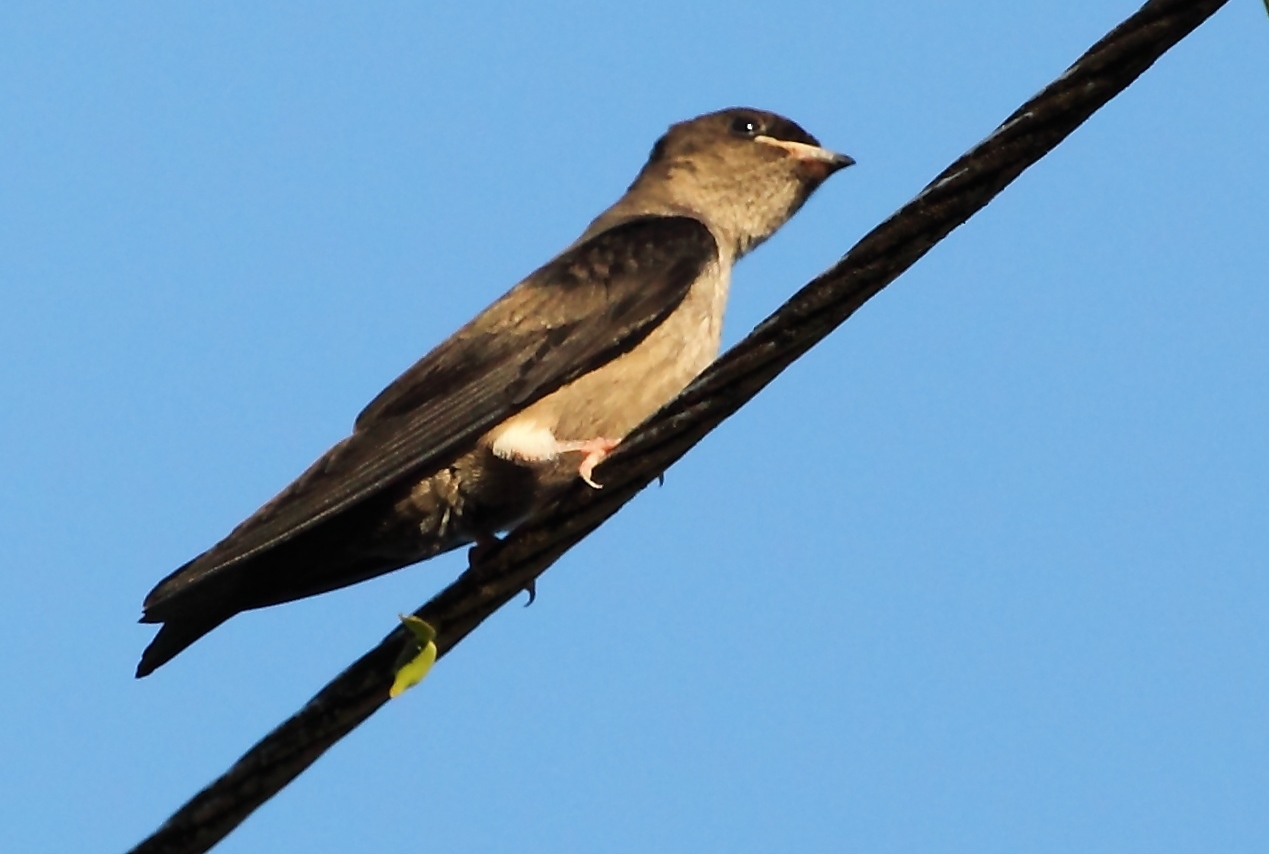
The White-thighed Swallow is a small, dark swallow of humid lowland forest. It hunts with a fluttering, rather erratic flight low over clearings, roads and rivers in the forest and rests on bare branches of dead trees. In the guide area it occurs only in Panama.
Voice
Rather quiet; short, high chirps.
Recording: Juan Freile — CC BY-NC-SA 4.0 · shortened to the first 60 s, mono · xeno-canto
Identification
11–12 cm, with a slightly forked tail. Almost entirely dark sooty brown, the underparts slightly paler grey-brown and the rump sometimes a little paler than the back. The white thighs are small and visible only at close range or on a perched bird. Sexes alike.
Confusion species
Southern Rough-winged Swallow Stelgidopteryx ruficollis is larger, with a cinnamon throat, a pale rump and a pale belly. Northern Rough-winged Swallow Stelgidopteryx serripennis is larger and has a white belly. Small Chaetura swifts have stiffer, narrower wings and a different flight.
Habitat
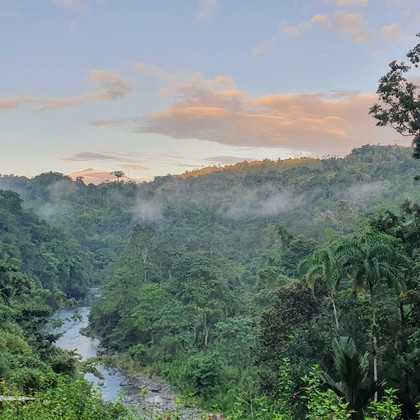
Clearings, roads and rivers in humid lowland and foothill forest, and forest edges with dead trees. It hunts small flying insects low down. It nests in cavities, including holes in banks and road cuts.
Where the bird is most at home, classified by the vegetation units of Mexico and Central America.




Range and movements
In the guide area only in Panama, mainly in the Panama Canal area and further east into Darién. Outside the guide area in northern and western South America and the Amazon basin.
- Resident
- dark = core range, pale = thinly spread
How and when to look
Regularly seen in the Panama Canal area, among other places along forest edges and clearings near Gamboa. Look for small, dark swallows fluttering low over a road or clearing in the forest.
Conservation status
Not threatened. Local and fairly scarce in the guide area; dependent on humid forest.
Scientific name
Atticora tibialis | (Cassin, 1853) (GBIF: Neochelidon tibialis)
Cassin described the species in 1853 as Petrochelidon(?) tibialis; because it was later moved to another genus, the author and year stand in brackets. The genus Atticora was introduced in 1844 by Boie. Atticora is from Greek Atthi kora, a poetic epithet of the swallow: 'Attic maiden', from Attikos 'Attic, Athenian' and korē 'maiden', after the myth of Procne, daughter of the Athenian king. tibialis is Latin, from tibia 'shin', after the white thighs that stand out on this otherwise dark swallow. The specimen the first description was based on came from South America (probably near Rio de Janeiro, Brazil).