All species › Passerines › Shrike-babblers, Erpornis and vireos › White-eyed Vireo
Position in the tree Birds Aves › Birds with a flexible palate Neognathae › All other modern birds Neoaves › Landbirds Telluraves › Falcons, parrots and passerines Australaves › Falcons and passerines Eufalconimorphae › Parrots and passerines Psittacopasserae
White-eyed Vireo | Vireo griseus
Witoogvireo | Vireo ojo blanco
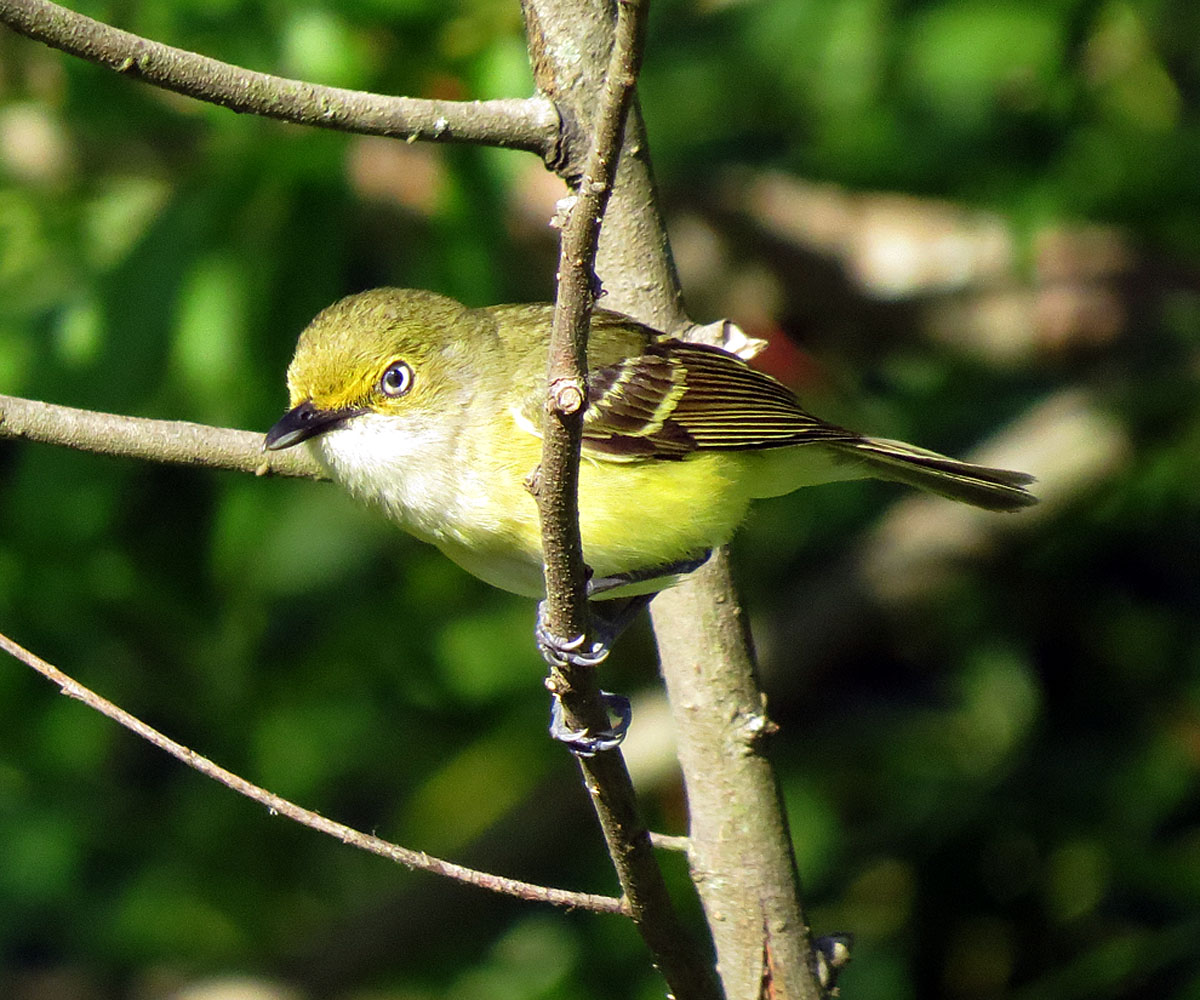
The White-eyed Vireo is a small, active vireo of dense thickets, with yellow spectacles and, in adults, a conspicuous white eye. North-eastern Mexico has resident birds; in winter they are joined by migrants from North America that reach northern Central America.
Voice
The song is a short, explosive phrase of sharp notes, often starting and ending with a short chick, repeated frequently; it sometimes mimics other birds. The call is a rasping, scolding chatter.
Recording: steve — CC BY-SA 4.0 · converted to mono · xeno-canto
Identification
12–13 cm. Head and upperparts olive-green, nape and sides of neck greyish. Lores and eye-ring yellow, forming bold spectacles. Eye white in adults, dark in young birds. Two white wing bars. Underparts white, flanks yellow.
Confusion species
Mangrove Vireo Vireo pallens has a dark eye, lacks the grey nape and has less contrasting wing bars. Yellow-throated Vireo Vireo flavifrons has a yellow throat and breast. Cozumel Vireo Vireo bairdi has cinnamon cheeks and no yellow spectacles.
Habitat
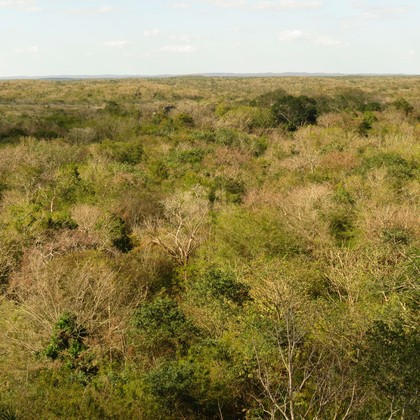
Dense thickets, overgrown forest edges, young secondary forest, riverside scrub and dry to semi-humid forest, in the lowlands. Keeps low and hidden in the vegetation, taking insects and in winter also berries.
Where the bird is most at home, classified by the vegetation units of Mexico and Central America.





Range and movements
Resident on the Atlantic slope of north-eastern Mexico, from Nuevo León and Tamaulipas into Veracruz. Winter visitors spread across eastern Mexico, the Yucatán Peninsula, Belize, northern Guatemala and Honduras; scarce to rare further south. Outside the guide area it breeds in the eastern United States.
- Resident
- Summer visitor (c. Apr–Sep)
- Winter visitor (c. Oct–Mar)
- Passage (Mar–Apr, Oct–Nov)
- dark = core range, pale = thinly spread
How and when to look
Usually heard before it is seen; with patience it generally comes briefly to the edge of the thicket.
Conservation status
Not threatened. Common in its breeding range and fairly common in winter in eastern Mexico and on the Yucatán Peninsula.
Scientific name
Vireo griseus | (Boddaert, 1783)
Boddaert described the species in 1783 as Tanagra grisea; because it was later moved to another genus, the author and year stand in brackets. The genus Vireo was introduced in 1808 by Vieillot. Vireo was used by Latin authors for a small, green, migratory bird, probably the Eurasian golden oriole, though the European greenfinch has also been suggested. griseus is Medieval Latin for 'grey', after the grey tones of the head and back. The specimen the first description was based on came from New Orleans, Louisiana (USA).