All species › Passerines › Shrike-babblers, Erpornis and vireos › Cozumel Vireo
Position in the tree Birds Aves › Birds with a flexible palate Neognathae › All other modern birds Neoaves › Landbirds Telluraves › Falcons, parrots and passerines Australaves › Falcons and passerines Eufalconimorphae › Parrots and passerines Psittacopasserae
Cozumel Vireo | Vireo bairdi
Cozumelvireo | Vireo de Cozumel
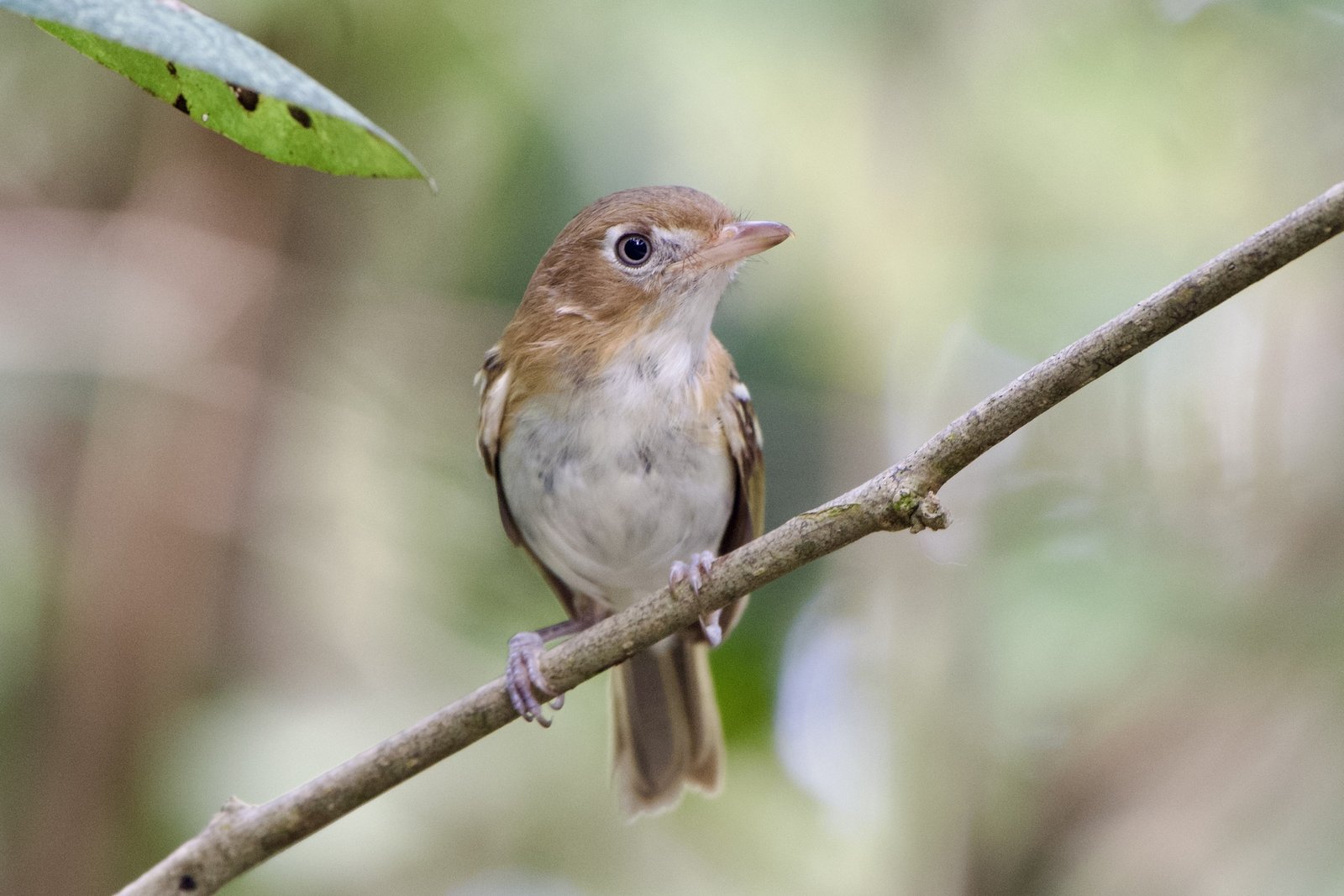
The Cozumel Vireo is a small vireo found only on Cozumel Island off the coast of Quintana Roo. It stands out by its cinnamon-brown cheeks and flanks and two white wing bars. It is one of the few bird species restricted to this island.
Voice
Calls with dry, scratchy notes. The song is a short, rapidly repeated phrase.
Recording: Ross Gallardy — CC BY-NC-SA 4.0 · converted to mono · xeno-canto
Identification
11–12 cm. Crown and upperparts greyish olive-brown. Cheeks and flanks warm cinnamon-brown. Throat and centre of underparts white. Wings dark with two distinct white wing bars. Bill fairly stout, dark with a paler lower mandible.
Confusion species
Yucatan Vireo Vireo magister, which also lives on Cozumel, is larger and browner, with a pale supercilium and no white wing bars. White-eyed Vireo Vireo griseus, a winter visitor in the east of the Yucatán Peninsula, has yellow spectacles, a white eye in adults and lacks the cinnamon cheeks.
Habitat
Dry and semi-deciduous forest, scrub and forest edges, also overgrown ground and the margins of built-up areas with enough vegetation. Searches for insects in the lower and middle levels of forest and thickets.
Where the bird is most at home, classified by the vegetation units of Mexico and Central America.


Range and movements
Only on Cozumel, off the east coast of the Yucatán Peninsula (Quintana Roo, Mexico).
- Resident
- dark = core range, pale = thinly spread
How and when to look
Best found in forest and scrub in the interior of the island, away from the built-up coastal strip. Often responds to small birds calling nearby.
Conservation status
Near Threatened. The entire world population lives on one island, where severe hurricanes and the spread of tourism and building threaten its habitat.
Scientific name
Vireo bairdi | Ridgway, 1885
Ridgway described the species in 1885 and placed it straight away in the genus where it still stands. The genus Vireo was introduced in 1808 by Vieillot. Vireo was used by Latin authors for a small, green, migratory bird, probably the Eurasian golden oriole, though the European greenfinch has also been suggested. bairdi honours the American zoologist Spencer Fullerton Baird (1823–1887) of the Smithsonian Institution. The specimen the first description was based on came from Cozumel, Quintana Roo, Mexico.