All species › Passerines › Manakins › White-crowned Manakin
Position in the tree Birds Aves › Birds with a flexible palate Neognathae › All other modern birds Neoaves › Landbirds Telluraves › Falcons, parrots and passerines Australaves › Falcons and passerines Eufalconimorphae › Parrots and passerines Psittacopasserae
White-crowned Manakin | Pseudopipra pipra
Witkruinmanakin | Saltarín coroniblanco
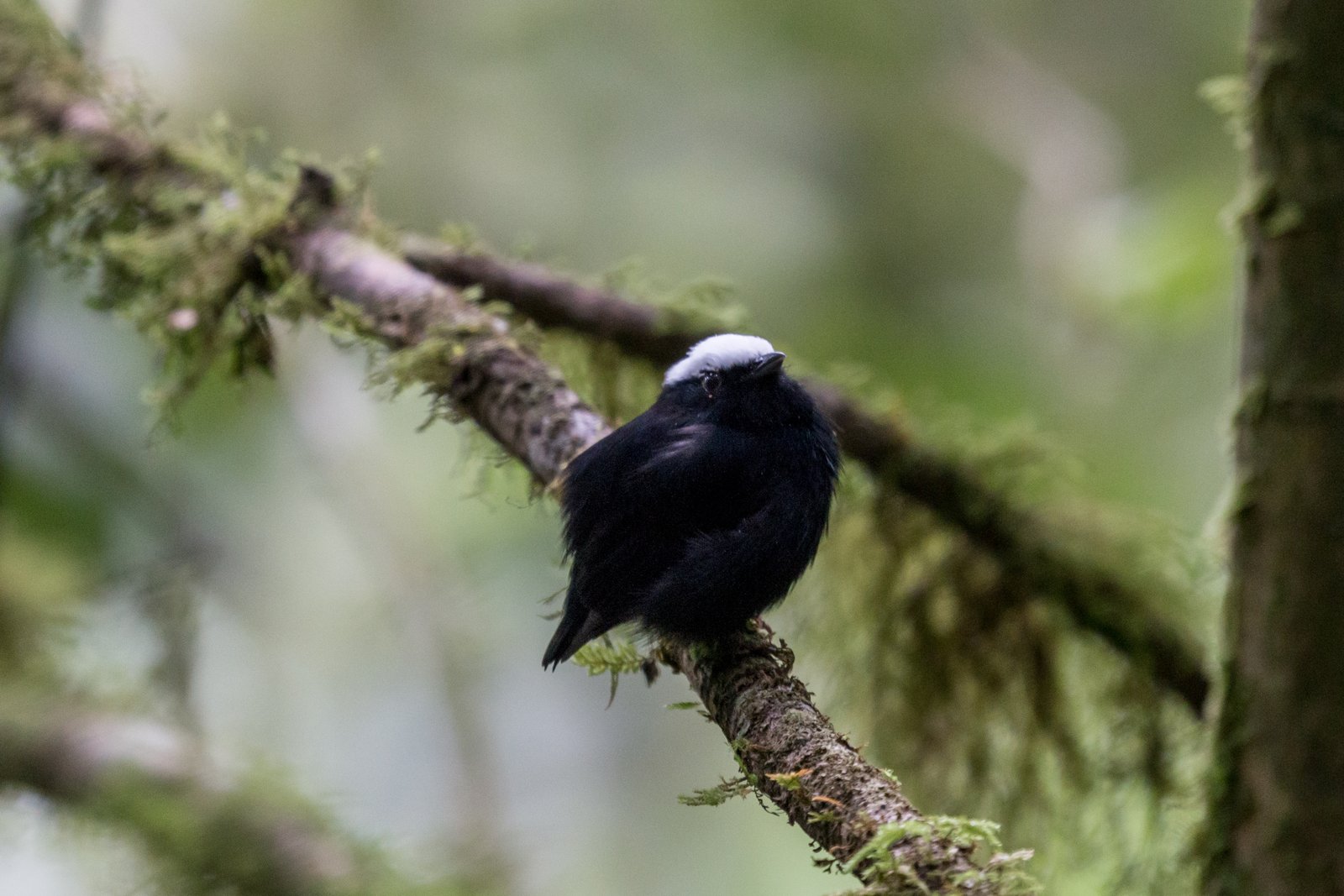
The White-crowned Manakin is a small black manakin with a white crown that in the guide area lives only on the lower mountain slopes of Costa Rica and western Panama. It keeps to the dim understorey of humid forest. Middle American birds belong to the subspecies anthracina, which differs clearly in its genetics from the South American forms.
Voice
A nasal, buzzy dzeeeu, repeated at intervals. Males display dispersed in the undergrowth with short flights between branches.
Recording: Mateus Gonçalves Santos — CC BY-NC-SA 4.0 · converted to mono · xeno-canto
Identification
10 cm. Male: entirely glossy black with a white crown and nape; iris red. Female olive-green with a greyish head, slightly greyer below, iris also reddish. Young males resemble the female and first acquire a grey crown.
Confusion species
In the guide area the male cannot be confused with any other species. The female resembles females of other manakins, such as Red-capped Manakin Ceratopipra mentalis and Blue-capped Manakin Lepidothrix coronata, but has a greyish head and a red iris.
Habitat
Understorey of humid evergreen foothill and montane forest, roughly between 400 and 1500 m, mainly in undisturbed forest. It eats small fruits and insects.
Where the bird is most at home, classified by the vegetation units of Mexico and Central America.


Range and movements
Caribbean slope of the mountains of Costa Rica, from the Cordillera de Guanacaste and Cordillera Central to the Cordillera de Talamanca, and the mountain slopes of western Panama in Bocas del Toro, Chiriquí, Ngäbe-Buglé and Veraguas. Outside the guide area widespread in South America: in the Andes, the Amazon basin, the Guianas and eastern Brazil.
- Resident
- dark = core range, pale = thinly spread
How and when to look
Found in Tapantí National Park in Costa Rica and around Fortuna in western Panama. A quiet bird that often sits still for long periods on a branch in the understorey; its buzzy call gives it away.
Conservation status
Not threatened. Widespread globally; in the guide area local and scarce, and dependent on undisturbed forest on the mountain slopes.
Scientific name
Pseudopipra pipra | (Linnaeus, 1758) (GBIF: Pipra pipra)
Linnaeus described the species in 1758 as [Parus] Pipra; because it was later moved to another genus, the author and year stand in brackets. The genus Pseudopipra was introduced in 2016 by Kirwan, David, Gregory, Jobling, Steinheimer & Brito. Pseudopipra combines Greek pseudos 'false' with the genus Pipra: the species long sat in Pipra but is not closely related to it. pipra is Greek: a small bird mentioned by Aristotle that was never properly identified. The specimen the first description was based on came from Suriname.