All species › Passerines › Manakins › Golden-collared Manakin
Position in the tree Birds Aves › Birds with a flexible palate Neognathae › All other modern birds Neoaves › Landbirds Telluraves › Falcons, parrots and passerines Australaves › Falcons and passerines Eufalconimorphae › Parrots and passerines Psittacopasserae
Golden-collared Manakin | Manacus vitellinus
Goudkraagmanakin | Saltarín cuellidorado
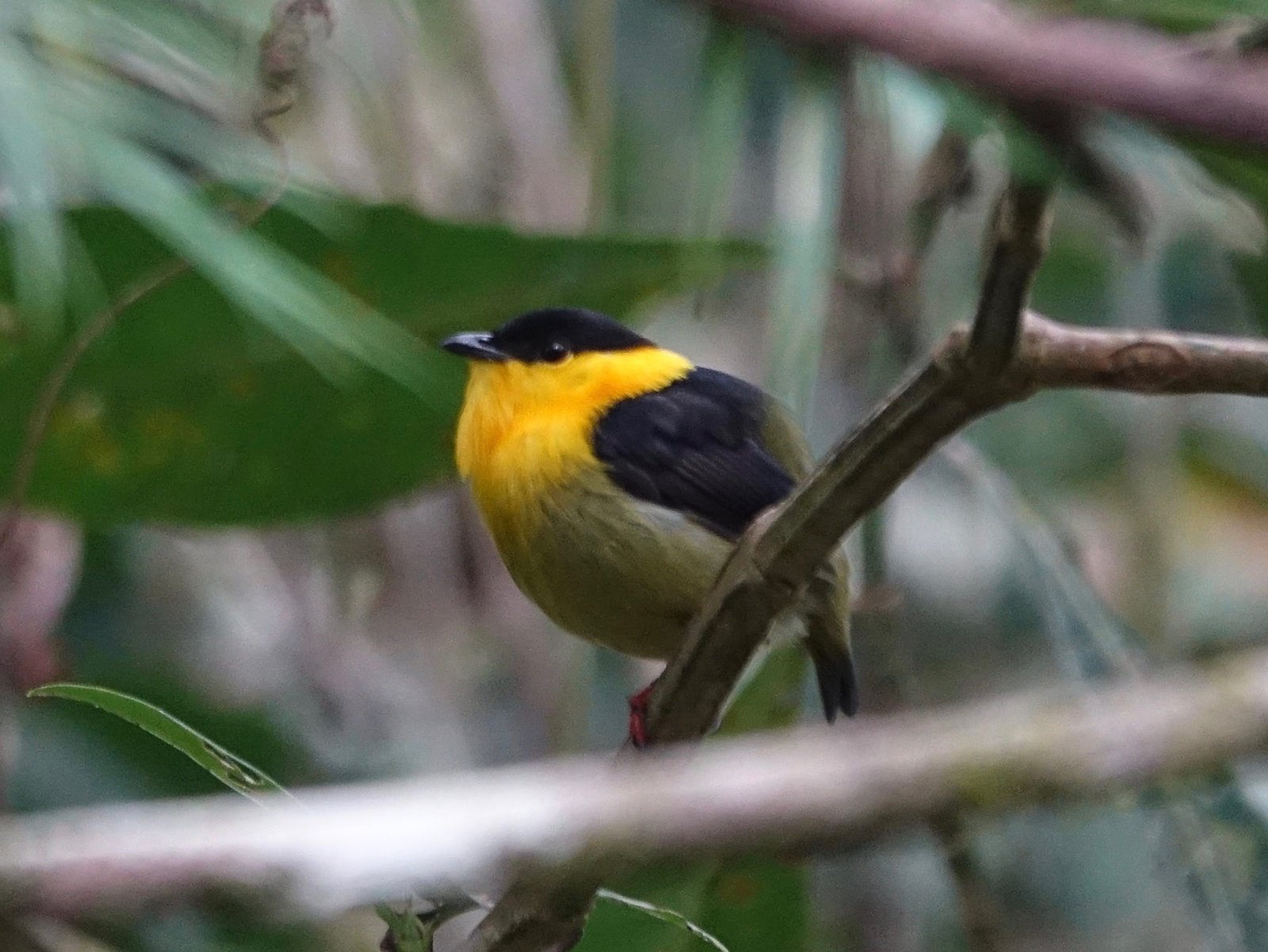
The Golden-collared Manakin is a small manakin of Panama, where the male with its golden-yellow throat and collar can be seen at display grounds in the undergrowth. Groups of males jump back and forth between thin saplings and make loud snaps with their wings. In the guide area it occurs only in Panama.
Voice
A clear chee-poo and short, sharp calls. At the display ground the wings crack like firecrackers and produce a whirring rattle.
Recording: David Monroy Rengifo — CC BY-NC-SA 4.0 · converted to mono · xeno-canto
Identification
11 cm. Male: crown, back and wings black; throat, cheeks and a broad collar around the neck golden-yellow, with long throat feathers puffed out as a beard during display. Rump and belly olive-green. Legs orange. Female and young olive-green, slightly yellower below, with orange legs.
Confusion species
Orange-collared Manakin Manacus aurantiacus (Pacific slope of southern Costa Rica and western Panama) has an orange collar. White-collared Manakin Manacus candei (Caribbean slope to western Panama) has a white collar. In Bocas del Toro, where Golden-collared and White-collared Manakins meet, hybrids with a yellowish collar occur. Females can be told apart only by range.
Habitat
Edges and clearings of humid lowland and foothill forest, secondary forest, dense scrub and thickets along streams, mostly below 1000 m. It eats mainly small fruits and some insects. Males sweep small patches of forest floor clean for display.
Where the bird is most at home, classified by the vegetation units of Mexico and Central America.




Range and movements
Panama, on both slopes from Bocas del Toro and Veraguas east through the provinces of Coclé, Colón and Panamá to Guna Yala and Darién. Outside the guide area in northern and western Colombia.
- Resident
- dark = core range, pale = thinly spread
How and when to look
Common along Pipeline Road (Camino del Oleoducto) and elsewhere in Soberanía National Park by the Panama Canal. The wing snaps are often heard before the birds are seen.
Conservation status
Not threatened. Common in Panama and tolerant of secondary forest and forest edge.
Scientific name
Manacus vitellinus | (Gould, 1843)
Gould described the species in 1843 as Pipra vitellina; because it was later moved to another genus, the author and year stand in brackets. The genus Manacus was introduced in 1760 by Brisson. Manacus was Latinised by Brisson from the Dutch 'manakin' (from 'manneken', little man), the name these birds bore in Surinam. vitellinus is Latin for 'egg-yolk yellow', from vitellus 'yolk', after the male's golden-yellow collar. The specimen the first description was based on came from Panama City, Panama.