All species › Passerines › Manakins › White-collared Manakin
Position in the tree Birds Aves › Birds with a flexible palate Neognathae › All other modern birds Neoaves › Landbirds Telluraves › Falcons, parrots and passerines Australaves › Falcons and passerines Eufalconimorphae › Parrots and passerines Psittacopasserae
White-collared Manakin | Manacus candei
Withalsmanakin | Saltarín cuelliblanco
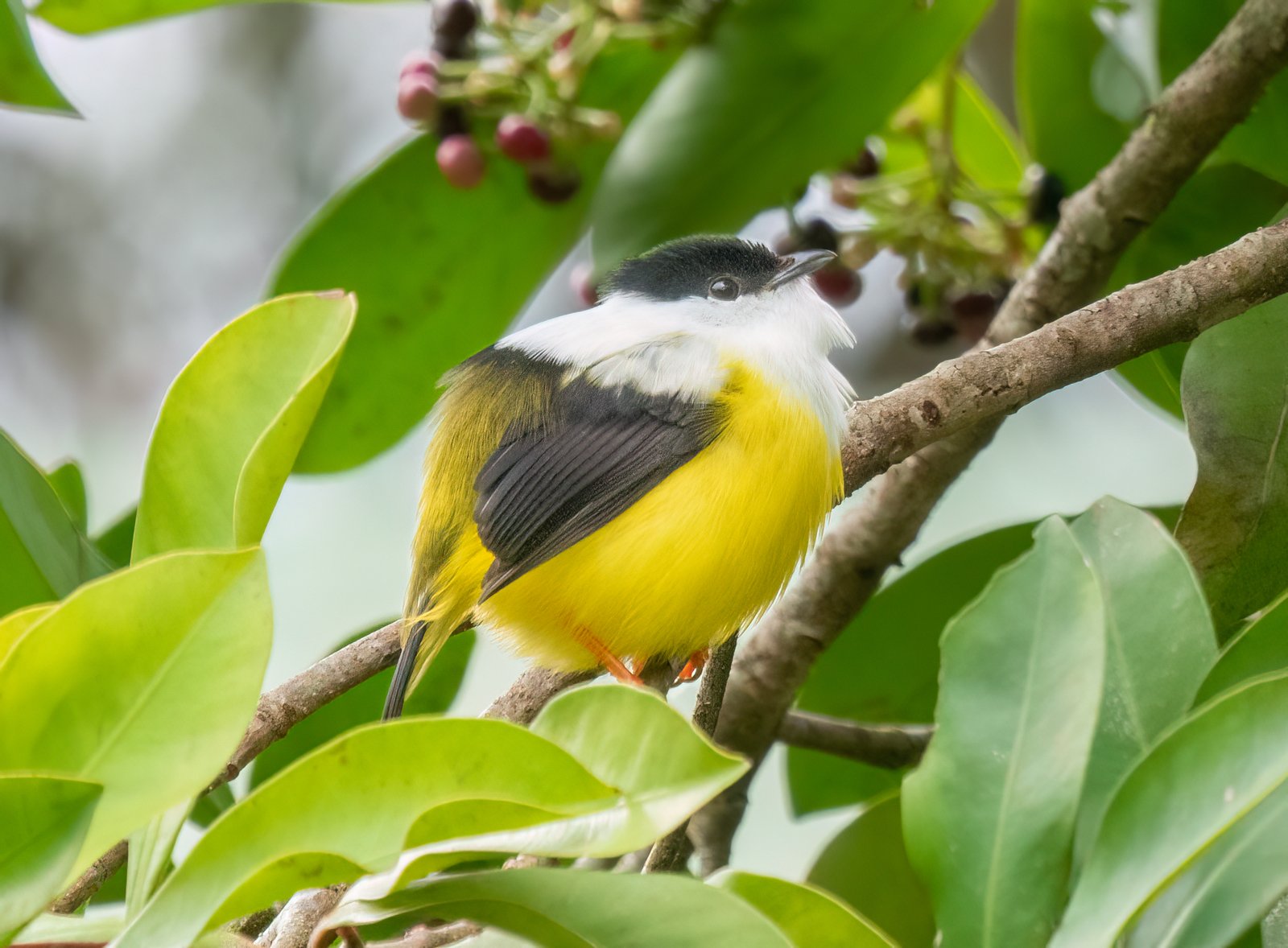
The White-collared Manakin is a Manacus manakin of forest edges and thickets in the humid Caribbean lowlands. The male is black, white and olive-green with a yellow belly and orange legs; the female is olive-green. Males display in groups on cleared patches of forest floor, making loud snaps with their wings. The species occurs only in the guide area, from south-eastern Mexico to western Panama.
Voice
In display, loud, snapping cracks and a whirring rrrrt made by the wings, which carry far through the forest. Also a clear chee-poo and short chip notes.
Recording: Manuel Grosselet — CC BY-NC-SA 4.0 · converted to mono · xeno-canto
Identification
10–11 cm. Compact, with a short tail and fairly long orange legs. Male with a black cap, black wings and a black upper back; throat, collar and breast white, the throat feathers pushed forward as a small beard in display. Lower back and rump olive-green, belly bright yellow. Female olive-green, paler below and yellowish green on the belly, with orange legs. Young males resemble females.
Confusion species
The male Orange-collared Manakin Manacus aurantiacus (Pacific slope of Costa Rica and western Panama) has an orange rather than white collar and throat. Golden-collared Manakin Manacus vitellinus (central and eastern Panama) has a golden-yellow collar and an olive-green belly; in Bocas del Toro intermediate birds with a yellowish collar occur. Female Manacus are barely separable from each other; females of other manakins lack the orange legs.
Habitat
Forest edges, mature second growth, thickets, densely vegetated riverbanks and the edges of cacao and other plantations in the humid lowlands, locally in the interior of forest with a dense understorey, up to about 900 m. It eats small fruits and insects. Each male clears a bare patch of forest floor between thin saplings and jumps to and fro across it with loud wing snaps; the patches lie close together at a traditional display site. The female breeds alone.
Where the bird is most at home, classified by the vegetation units of Mexico and Central America.





Range and movements
Caribbean slope of south-eastern Mexico (southern Veracruz, northern Oaxaca, Tabasco, Chiapas, Campeche and southern Quintana Roo) through Belize, Guatemala, Honduras and Nicaragua to Costa Rica and western Panama (Bocas del Toro). In northern Costa Rica locally also inland to the edge of Guanacaste.
- Resident
- dark = core range, pale = thinly spread
How and when to look
Common at La Selva and Tortuguero in Costa Rica and in the Cockscomb Basin in Belize. The snaps of displaying males are the first sign; the display site lies low in dense thickets at the forest edge.
Conservation status
Not threatened. Common and tolerant of second growth and forest edges; it disappears only where all forest and thickets are lost.
Scientific name
Manacus candei | (Parzudaki, 1841)
Parzudaki described the species in 1841 as Pipra candei; because it was later moved to another genus, the author and year stand in brackets. The genus Manacus was introduced in 1760 by Brisson. Manacus was Latinised by Brisson from the Dutch 'manakin' (from 'manneken', little man), the name these birds bore in Surinam. candei honours the French naval officer and explorer Antoine Marie Ferdinand Maussion de Candé (1801–1867), who travelled in South America. The specimen the first description was based on came from Trujillo, Honduras.