All species › Passerines › Manakins › Velvety Manakin
Position in the tree Birds Aves › Birds with a flexible palate Neognathae › All other modern birds Neoaves › Landbirds Telluraves › Falcons, parrots and passerines Australaves › Falcons and passerines Eufalconimorphae › Parrots and passerines Psittacopasserae
Velvety Manakin | Lepidothrix velutina
Fluweelmanakin | Saltarín coroniceleste
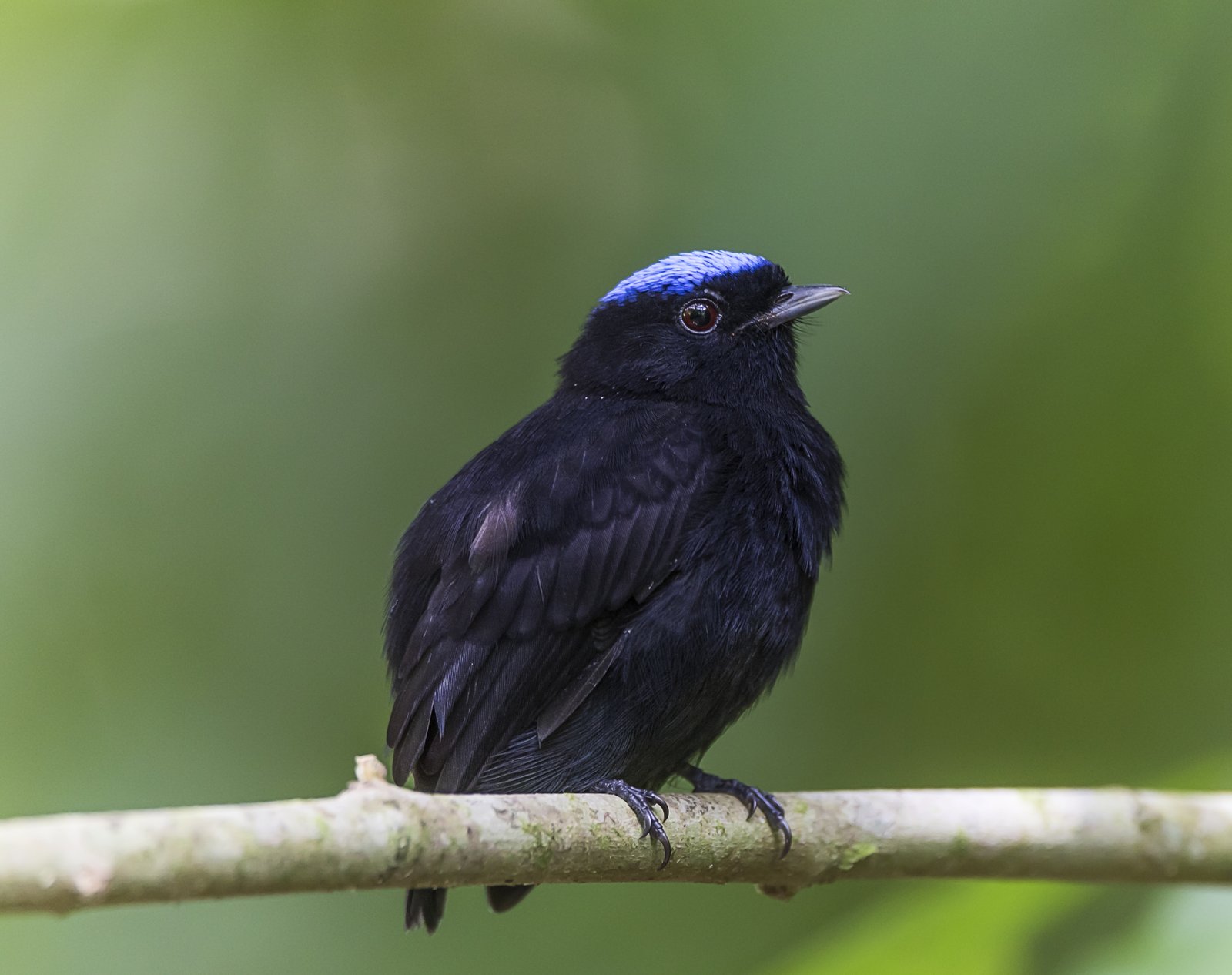
The Velvety Manakin is a very small Lepidothrix manakin of the understorey of humid lowland forest. The male is velvety black with a pale blue crown; the female is grass-green. Males sing and display in dispersed groups low in the forest. In the guide area it lives in south-western Costa Rica and Panama.
Voice
A soft, rolling, rather hoarse chee-wrrr or trrrr, often repeated from a fixed song perch. Also buzzing notes in display.
Recording: Mabelin — CC BY-NC 4.0 · converted to mono · iNaturalist
Identification
9 cm. Very small and compact, with a short tail and a short, dark bill. Male uniform velvety black with a bright sky-blue crown. Female bright grass-green, paler below with a yellowish-green belly; young males are green but already have a bluish crown. Legs dark grey.
Confusion species
The male White-ruffed Manakin Corapipo altera has a white throat and no blue on the head. Males of Red-capped Manakin Ceratopipra mentalis and Golden-headed Manakin Ceratopipra erythrocephala are black with a red or golden head. The female resembles that of Red-capped Manakin, which is duller olive-green, and the Choco Manakin Cryptopipo litae, which is larger, longer-tailed and darker moss-green.
Habitat
Understorey of humid evergreen lowland and foothill forest and mature second growth, up to about 1000 m. It eats small fruits and insects, plucked in short flights. Males display in dispersed groups, each at its own site low in the understorey, with short, buzzing flights between thin branches. The female builds the nest and incubates alone.
Where the bird is most at home, classified by the vegetation units of Mexico and Central America.




Range and movements
Pacific lowlands of south-western Costa Rica (mainly around the Golfo Dulce and on the Osa Peninsula) and western Chiriquí; in central and eastern Panama on both slopes, east to Darién and Guna Yala. Outside the guide area in western Colombia and north-western Ecuador.
- Resident
- dark = core range, pale = thinly spread
How and when to look
Common along Pipeline Road (Camino del Oleoducto) in Soberanía National Park in Panama and at Corcovado on the Osa Peninsula in Costa Rica. The rolling chee-wrrr gives the males away.
Conservation status
Not evaluated as a separate species; the IUCN includes it in a broadly defined Lepidothrix coronata, which is not threatened. Common in humid forest in the guide area, but dependent on forest with a dense understorey.
Scientific name
Lepidothrix velutina | (Berlepsch, 1883) (GBIF: Lepidothrix coronata)
Berlepsch described the species in 1883 as Pipra velutina; because it was later moved to another genus, the author and year stand in brackets. The genus Lepidothrix was introduced in 1854 by Bonaparte. Lepidothrix is Greek, from lepis, lepidos 'scale' and thrix 'hair', after the scale-like, glossy crown feathers. velutina is Modern Latin for 'velvety', after the male's velvety black plumage. The specimen the first description was based on came from Veraguas, Panama.