All species › Passerines › Tyrant flycatchers and allies › Western Wood Pewee
Position in the tree Birds Aves › Birds with a flexible palate Neognathae › All other modern birds Neoaves › Landbirds Telluraves › Falcons, parrots and passerines Australaves › Falcons and passerines Eufalconimorphae › Parrots and passerines Psittacopasserae
Western Wood Pewee | Contopus sordidulus
Westelijke bospiewie | Pibí occidental
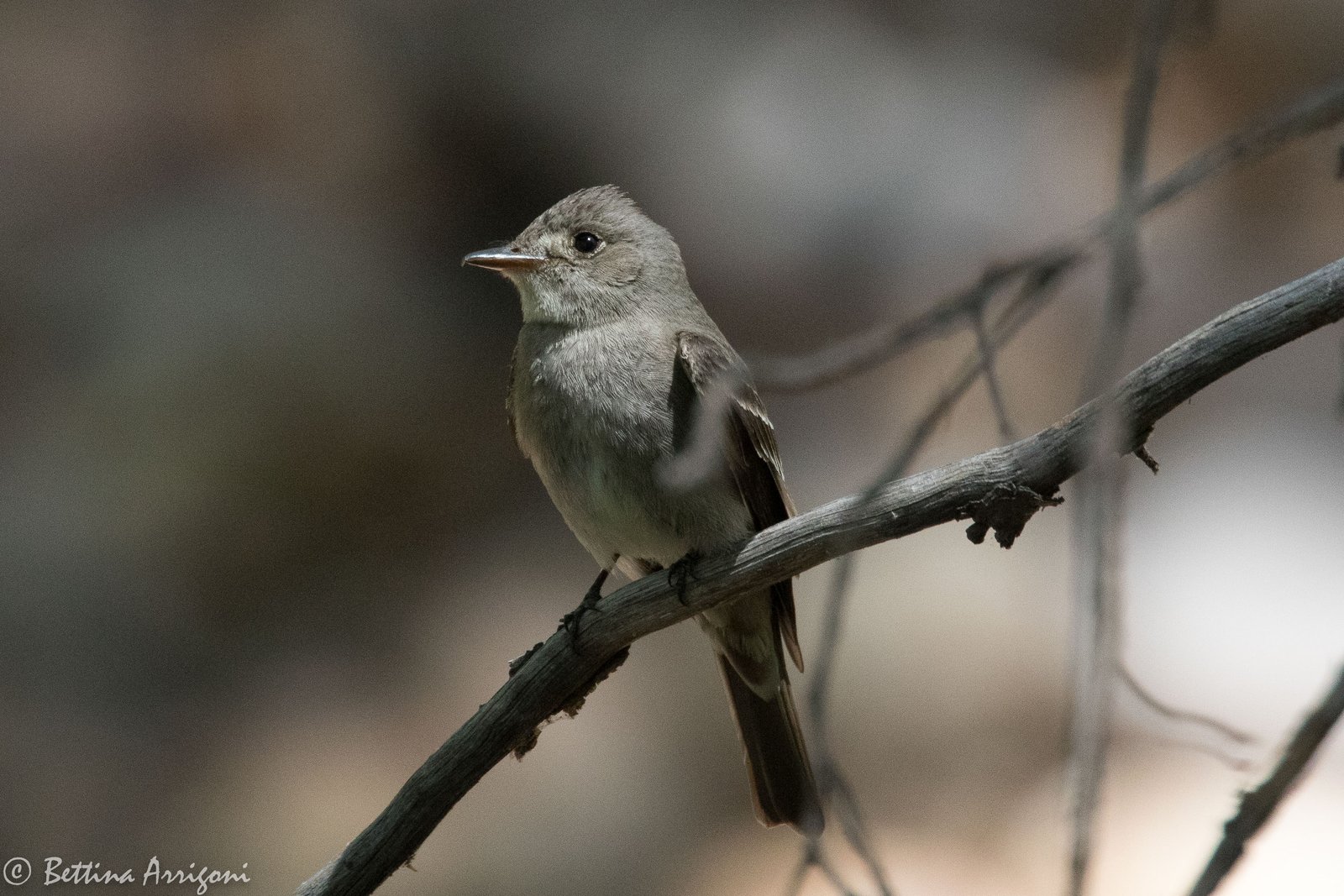
The Western Wood Pewee is a small, greyish-brown pewee that breeds in the mountains of Mexico and northern Central America and passes through the whole guide area in large numbers on its way to and from South America. In the field it is almost impossible to separate from the Eastern Wood Pewee; the song is the most reliable feature.
Voice
The song is a hoarse, nasal, falling pfee-eer or dzee-yer, repeated on the breeding grounds also in the early morning. The call is a short, dry chip.
Recording: Greg Irving — CC BY-NC-SA 4.0 · shortened to the first 60 s, mono · xeno-canto
Identification
15–16 cm, with a slightly peaked crown, long wings projecting far beyond the upper tail coverts and a fairly long tail. Upperparts dark greyish brown with an olive tinge. Breast and flanks greyish brown like a vest, throat and centre of the belly dull white. Two dull grey wing bars. Lower mandible usually mostly dark, sometimes yellowish at the base. No eye ring. Male and female are alike.
Confusion species
Eastern Wood Pewee Contopus virens is slightly greener olive, with a paler breast and usually a mostly orange-yellow lower mandible, but can only be reliably separated by voice. Northern Tropical Pewee Contopus bogotensis has shorter wings and pale lores. The Empidonax flycatchers have shorter wings, often an eye ring, and move their tail and wings a lot. Greater Pewee Contopus pertinax is larger, with a pointed crest and an entirely orange lower mandible.
Habitat
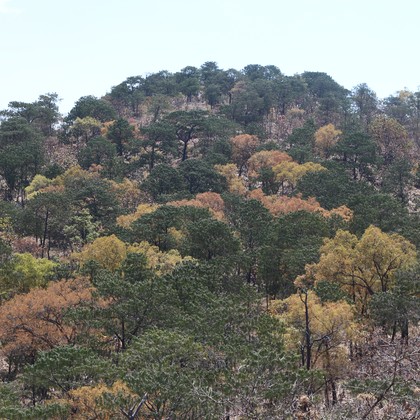
Breeds in open pine-oak forest, coniferous forest and riparian woodland in the mountains, often at edges and clearings. On migration in almost any landscape with trees, from montane forest to forest edges, gallery forest and gardens in the lowlands. It perches on an open branch and sallies from there after insects, often returning to the same post.
Where the bird is most at home, classified by the vegetation units of Mexico and Central America.





Range and movements
Breeds in the mountains of Baja California and in the highlands of Mexico, from the Sierra Madre Occidental and Sierra Madre Oriental south to Chiapas, and further in the highlands of Guatemala and Honduras. A passage migrant throughout the guide area, mainly in April and May and from August to October. Almost absent in winter. Outside the guide area it breeds in western North America, from Alaska to the south-western United States; it winters mainly in north-western South America, from Colombia and Venezuela to Bolivia.
- Summer visitor (c. Apr–Sep)
- dark = core range, pale = thinly spread
How and when to look
During spring migration birds sing regularly, which allows separation from Eastern Wood Pewee. Without song a silent bird is best recorded simply as a wood pewee.
Conservation status
Not threatened, but numbers in North America have declined over recent decades. Little is known about the trend of the breeding birds in the guide area.
Scientific name
Contopus sordidulus | Sclater, 1859
Sclater described the species in 1859 and placed it straight away in the genus where it still stands. The genus Contopus was introduced in 1855 by Cabanis. Contopus is Greek, from kontos 'pole, shaft' and pous 'foot', after the short legs. sordidulus is Latin, diminutive of sordidus 'dirty, dingy', after the dull grey-brown plumage. The specimen the first description was based on came from Orizaba, Veracruz, Mexico.