All species › Passerines › Tyrant flycatchers and allies › Dark Pewee
Position in the tree Birds Aves › Birds with a flexible palate Neognathae › All other modern birds Neoaves › Landbirds Telluraves › Falcons, parrots and passerines Australaves › Falcons and passerines Eufalconimorphae › Parrots and passerines Psittacopasserae
Dark Pewee | Contopus lugubris
Barrancapiewie | Pibí oscuro
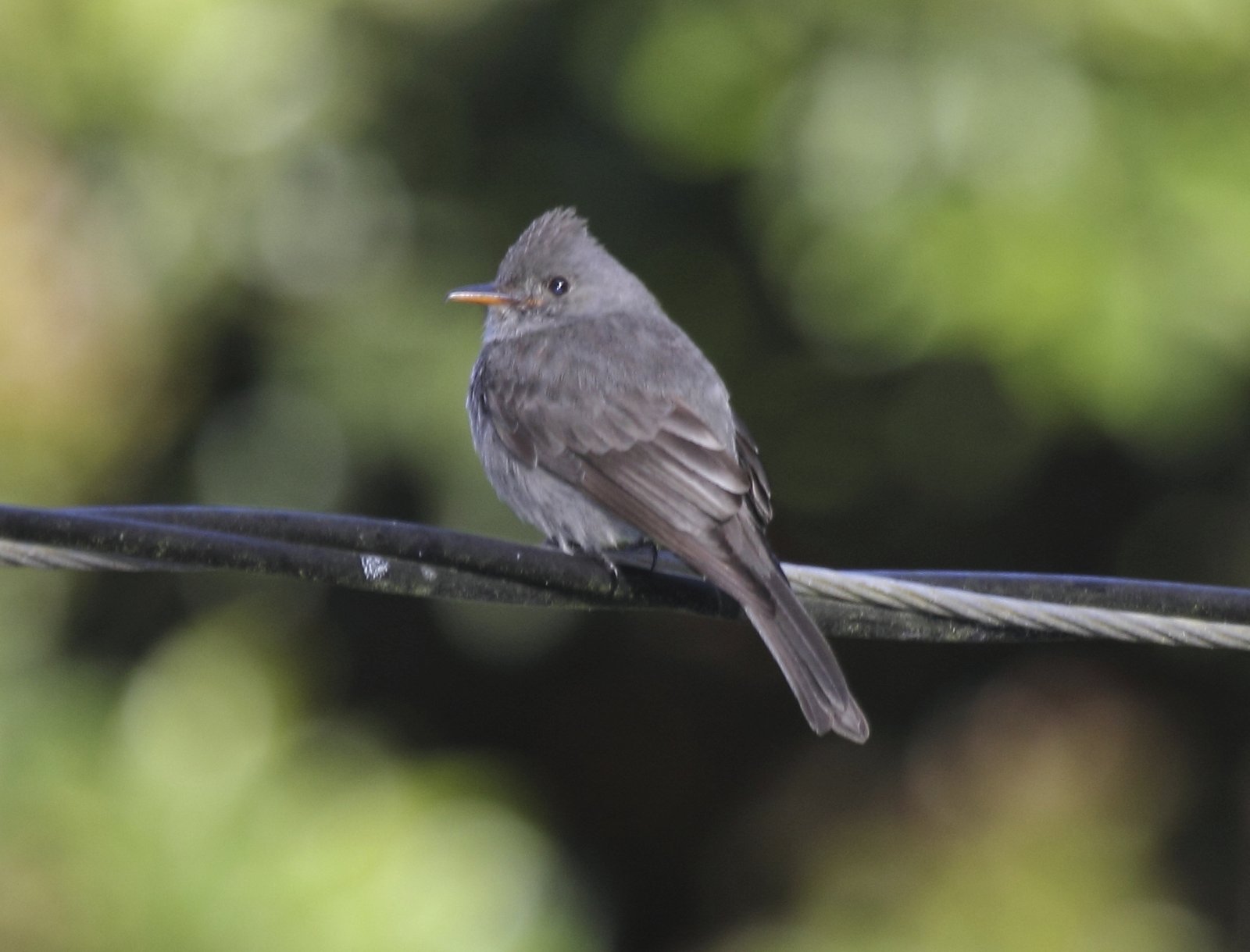
The Dark Pewee is a dark, sooty-grey pewee with a conspicuous pointed crest, found only in the mountains of Costa Rica and western Panama. It perches upright on a bare branch at a forest edge or above a ravine and sallies from there after insects.
Voice
Often calls with a repeated, sharp pip-pip-pip. The song is a short series of whistled notes.
Recording: Alain Malengreau — CC BY-NC-SA 4.0 · converted to mono · xeno-canto
Identification
15–16 cm, with a pointed, often raised crest and a fairly long tail. Almost entirely dark sooty grey with an olive tinge, head and crest darkest; belly slightly paler. Wing bars indistinct or absent. Lower mandible orange-yellow, upper mandible black. Male and female are alike.
Confusion species
Ochraceous Pewee Contopus ochraceus is also crested, but has an olive-brown back and ochre underparts. Western Wood Pewee Contopus sordidulus and Eastern Wood Pewee Contopus virens (passage migrants) are paler greyish olive, uncrested and with distinct wing bars. Olive-sided Flycatcher Contopus cooperi is bulkier and has a white central stripe down breast and belly.
Habitat
Edges and clearings of montane rainforest and foothill forest, roughly between 1200 and 2500 m, often along rivers, ravines, roads and in clearings with dead trees. It perches high and upright on a bare branch and often returns to the same post after a sally.
Where the bird is most at home, classified by the vegetation units of Mexico and Central America.



Range and movements
Endemic to the guide area: the mountains of Costa Rica (Cordillera de Tilarán, Cordillera Central and Cordillera de Talamanca) and western Panama, east to Veraguas.
- Resident
- dark = core range, pale = thinly spread
How and when to look
Mostly found along mountain roads and forest edges with dead trees, where it waits on a high bare branch and regularly gives its pip-pip call.
Conservation status
Not threatened. Fairly common within its small range, much of which lies in protected areas.
Scientific name
Contopus lugubris | Lawrence, 1865
Lawrence described the species in 1865 and placed it straight away in the genus where it still stands. The genus Contopus was introduced in 1855 by Cabanis. Contopus is Greek, from kontos 'pole, shaft' and pous 'foot', after the short legs. lugubris is Latin for 'mournful', after the sombre dark grey plumage. The specimen the first description was based on came from Barranca, Costa Rica.