All species › Passerines › Tyrant flycatchers and allies › Northern Tropical Pewee
Position in the tree Birds Aves › Birds with a flexible palate Neognathae › All other modern birds Neoaves › Landbirds Telluraves › Falcons, parrots and passerines Australaves › Falcons and passerines Eufalconimorphae › Parrots and passerines Psittacopasserae
Northern Tropical Pewee | Contopus bogotensis
Noordelijke Spix' piewie | Pibí tropical norteño
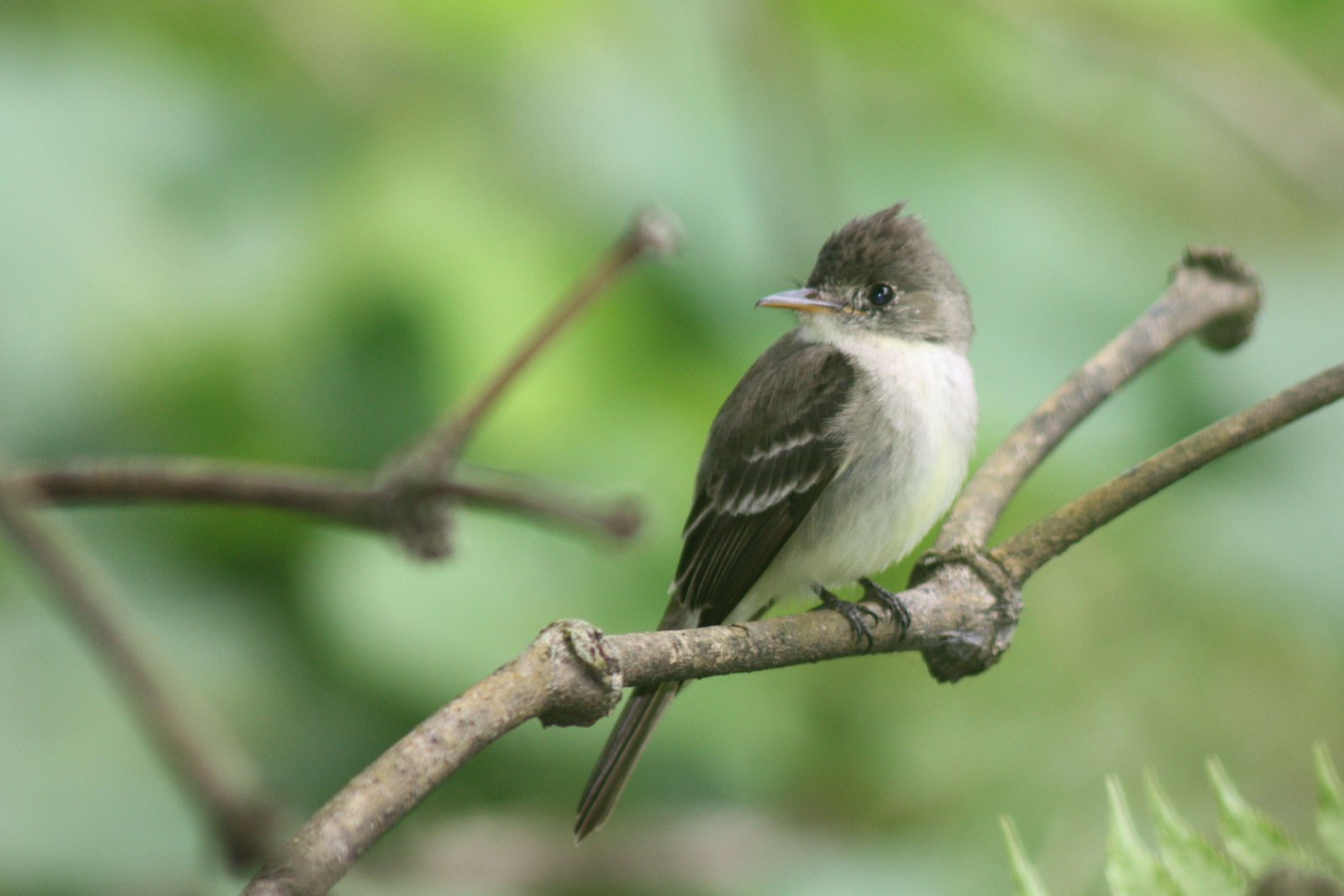
The Northern Tropical Pewee is a small, greyish-brown pewee of semi-open lowland country, from south-eastern Mexico to Panama. It perches low to mid-level on an open branch at a forest edge or in pine savanna and sallies from there after insects. It has been split from the more southerly Southern Tropical Pewee Contopus cinereus.
Voice
Calls with a sharp peet and a quick, dry trill, pree-ee-ee, often repeated at dawn.
Recording: Baylana Hiebert — CC BY-NC 4.0 · converted to mono · iNaturalist
Identification
14–15 cm, with a slightly peaked crown and a fairly long tail. Upperparts dark greyish olive, crown darker. Lores pale grey to whitish. Throat pale grey; breast greyish olive, belly pale yellowish white. Wings fairly short for a pewee, with dull greyish wing bars. Lower mandible yellow to orange-yellow, upper mandible dark. Male and female are alike.
Confusion species
Western Wood Pewee Contopus sordidulus and Eastern Wood Pewee Contopus virens (passage migrants) are slightly larger, with longer wings that extend further beyond the upper tail coverts and dark lores. The Empidonax flycatchers, such as Acadian Flycatcher Empidonax virescens and Willow Flycatcher Empidonax traillii, have shorter wings, often an eye ring, and move their tail and wings a lot.
Habitat
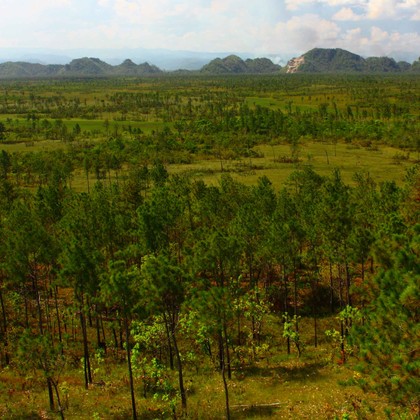
Forest edges, clearings in humid forest, secondary woodland, pasture with trees, pine savanna, mangroves, gallery forest and shade coffee, mainly in the lowlands and foothills up to about 1200 m. It perches fairly low on an open branch and often returns to the same spot after a sally.
Where the bird is most at home, classified by the vegetation units of Mexico and Central America.





Range and movements
From south-eastern Mexico, including southern Veracruz, Oaxaca, Chiapas and the Yucatán Peninsula, through Belize, Guatemala, Honduras, Nicaragua and Costa Rica to Panama. Outside the guide area in northern South America.
- Resident
- dark = core range, pale = thinly spread
How and when to look
Found in the pine savannas of Belize and Honduras and along forest edges and clearings in the lowlands; it often perches in the open on a low dead branch.
Conservation status
Not threatened. Fairly common in semi-open lowlands; benefits partly from clearings and forest edges.
Scientific name
Contopus bogotensis | (Bonaparte, 1850) (GBIF: Contopus cinereus)
Bonaparte described the species in 1850 as T[yrannula] bogotensis; because it was later moved to another genus, the author and year stand in brackets. The genus Contopus was introduced in 1855 by Cabanis. Contopus is Greek, from kontos 'pole, shaft' and pous 'foot', after the short legs. bogotensis refers to Bogotá in Colombia, the source of the type specimen (a trade 'Bogotá' skin). The specimen the first description was based on came from Bogotá, Colombia.