All species › Passerines › Tyrant flycatchers and allies › Western Kingbird
Position in the tree Birds Aves › Birds with a flexible palate Neognathae › All other modern birds Neoaves › Landbirds Telluraves › Falcons, parrots and passerines Australaves › Falcons and passerines Eufalconimorphae › Parrots and passerines Psittacopasserae
Western Kingbird | Tyrannus verticalis
Arkansaskoningstiran | Tirano pálido
The Western Kingbird is a kingbird of open, dry country, with a pale grey head, a yellow belly and a black tail with white sides. It breeds in western North America, including northern Mexico, and winters on the Pacific slope of Mexico and Central America.
Voice
A sharp kip or whit and twittering, quarrelsome bickering; in the breeding season a series of harsh, high clicking notes.
Recording: Richard E. Webster — CC BY-NC-SA 4.0 · shortened to the first 60 s, mono · xeno-canto
Identification
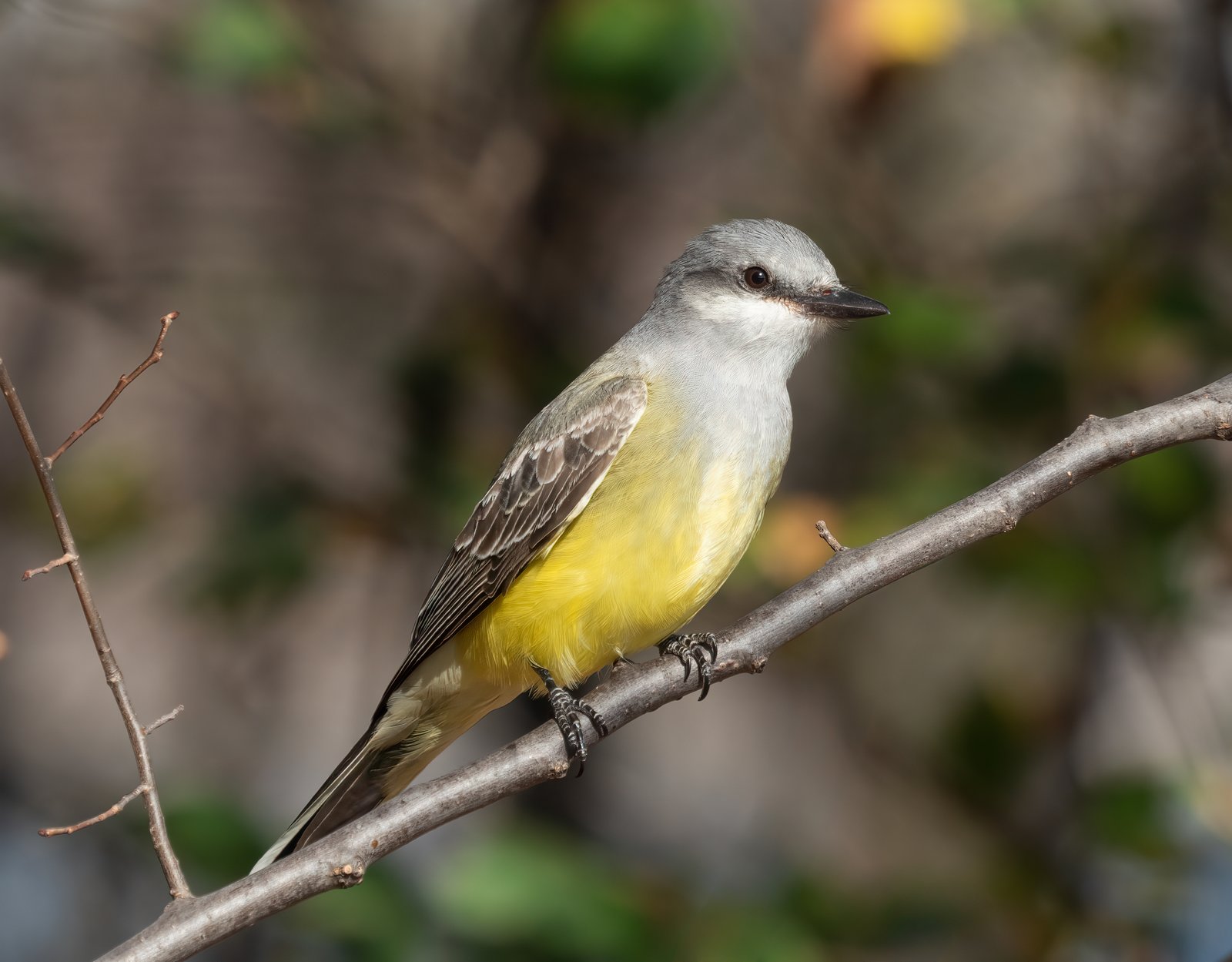
20–22 cm. Head and breast pale grey, with a slightly darker grey mask through the eye and a whitish throat. Back grey with an olive tinge, wings brownish-grey. Belly and undertail coverts lemon-yellow. Tail black and square, with narrow white outer edges along its whole length. A red crown patch is usually concealed. Bill black, fairly short. Male and female are alike.
Confusion species
Cassin's Kingbird Tyrannus vociferans has a darker grey head and breast with a sharply defined white chin and no white tail edges. Tropical Kingbird Tyrannus melancholicus and Couch's Kingbird Tyrannus couchii have a yellow breast, a longer bill and a notched brown tail without white.
Habitat
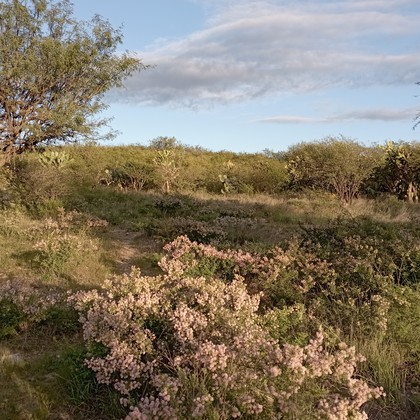
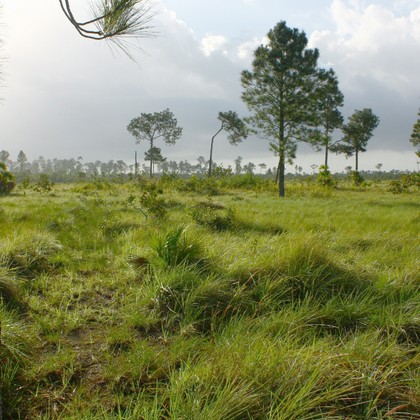
Open and semi-open country with scattered trees: semi-desert grassland, fields, pasture, savanna, thorn scrub, dry forest with clearings, riparian woodland and village edges. It catches insects from an open perch, often a wire, post or treetop.
Where the bird is most at home, classified by the vegetation units of Mexico and Central America.





Range and movements
Breeds in northern Mexico (northern Baja California, Sonora, Chihuahua and Coahuila). Winters on the Pacific slope of Mexico, from about Nayarit and Jalisco, and from Guatemala to Costa Rica; scarce as far as Panama. Outside the guide area a breeding bird in the western United States and south-western Canada.
- Resident
- Summer visitor (c. Apr–Sep)
- Winter visitor (c. Oct–Mar)
- Passage (Mar–Apr, Oct–Nov)
- dark = core range, pale = thinly spread
How and when to look
In winter common on roadside wires in the dry Pacific lowlands, for example in Guanacaste in Costa Rica. The white tail edges are best seen when it takes off.
Conservation status
Not threatened. Common; it benefits from the opening up of the landscape.
Scientific name
Tyrannus verticalis | Say, 1822
Say described the species in 1822 and placed it straight away in the genus where it still stands. The genus Tyrannus was introduced in 1799 by De Lacépède. Tyrannus is Latin (from Greek turannos) for 'tyrant, despot', after the aggressive way these birds drive off even raptors. verticalis is Latin for 'of the crown', from vertex 'crown', after the concealed orange-red crown patch. The specimen the first description was based on came from near La Junta, Colorado.