All species › Passerines › Tyrant flycatchers and allies › Bran-colored Flycatcher
Position in the tree Birds Aves › Birds with a flexible palate Neognathae › All other modern birds Neoaves › Landbirds Telluraves › Falcons, parrots and passerines Australaves › Falcons and passerines Eufalconimorphae › Parrots and passerines Psittacopasserae
Bran-colored Flycatcher | Myiophobus fasciatus
Roesttiran | Mosquerito pechirrayado
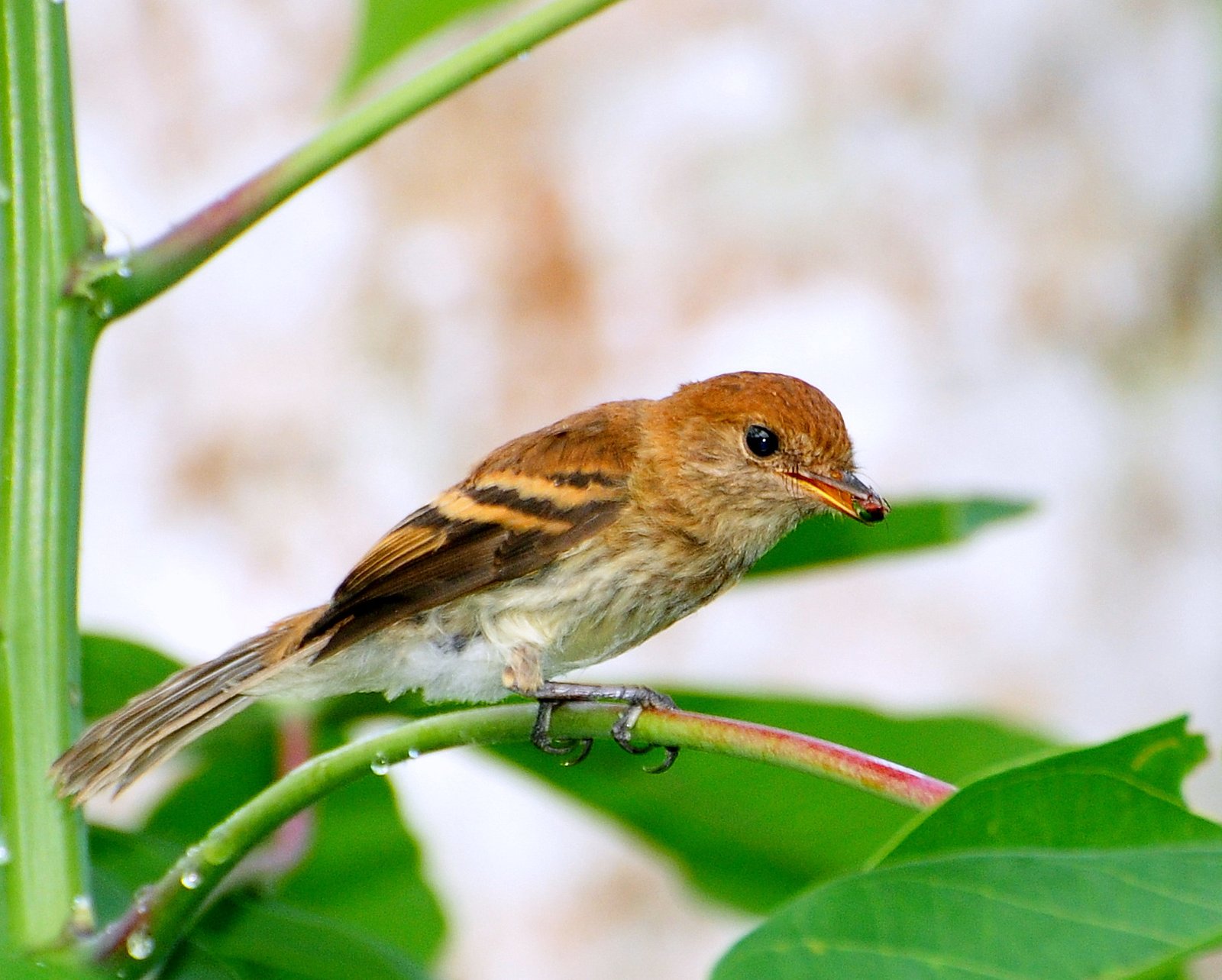
The Bran-colored Flycatcher is a small, warm brown flycatcher with a streaked breast that lives hidden in scrub and thickets. In the guide area it occurs only in Panama and southern Costa Rica, at the northern edge of a large South American range.
Voice
A rapid series of short, clear notes and a short, soft call; often heard before it is seen.
Recording: Mateus Gonçalves Santos — CC BY-NC-SA 4.0 · converted to mono · xeno-canto
Identification
12–13 cm, with a short, flat bill; the upper mandible is dark, the lower mandible pale. Upperparts warm rusty brown. A faint pale supercilium. Wings dark brown with two distinct buff wing-bars. Throat whitish; breast dull buff with brown streaks, belly whitish to pale yellow. Some birds have a concealed yellow to orange crown patch. Male and female are alike.
Confusion species
Empidonax flycatchers, which use the same habitat in winter, are olive-green or greyish above and have an unstreaked breast. Ruddy-tailed Flycatcher Terenotriccus erythrurus is smaller, with a grey head, unstreaked cinnamon underparts and a rufous tail, and lives inside forest.
Habitat
Scrub, thickets and young secondary growth, overgrown pastures, forest edges and bushes along roads and streams, in the lowlands and lower mountains. It perches low and hidden in dense vegetation and takes small insects with short sallies to leaves.
Where the bird is most at home, classified by the vegetation units of Mexico and Central America.



Range and movements
In the guide area in southern Costa Rica, mainly on the Pacific slope, and over much of Panama. Outside the guide area widespread in South America, to northern Argentina.
- Resident
- dark = core range, pale = thinly spread
How and when to look
Best found by listening along scrubby, overgrown edges and waiting until it briefly perches on an open twig. The streaked breast and rusty-brown upperparts are then the features to look for.
Conservation status
Not threatened. Locally fairly common in Panama; scarce and local in Costa Rica.
Scientific name
Myiophobus fasciatus | (Müller, 1776)
Müller described the species in 1776 as Muscicapa fasciata; because it was later moved to another genus, the author and year stand in brackets. The genus Myiophobus was introduced in 1850 by Reichenbach. Myiophobus is Greek, from muia 'fly' and phobos 'terror, fear': 'terror of flies'. fasciatus is Late Latin for 'banded', from fascia 'band', after the pale wing bars. The specimen the first description was based on came from Cayenne, French Guiana.