All species › Passerines › Tyrant flycatchers and allies › Scissor-tailed Flycatcher
Position in the tree Birds Aves › Birds with a flexible palate Neognathae › All other modern birds Neoaves › Landbirds Telluraves › Falcons, parrots and passerines Australaves › Falcons and passerines Eufalconimorphae › Parrots and passerines Psittacopasserae
Scissor-tailed Flycatcher | Tyrannus forficatus
Zwaluwstaartkoningstiran | Tirano tijereta rosado
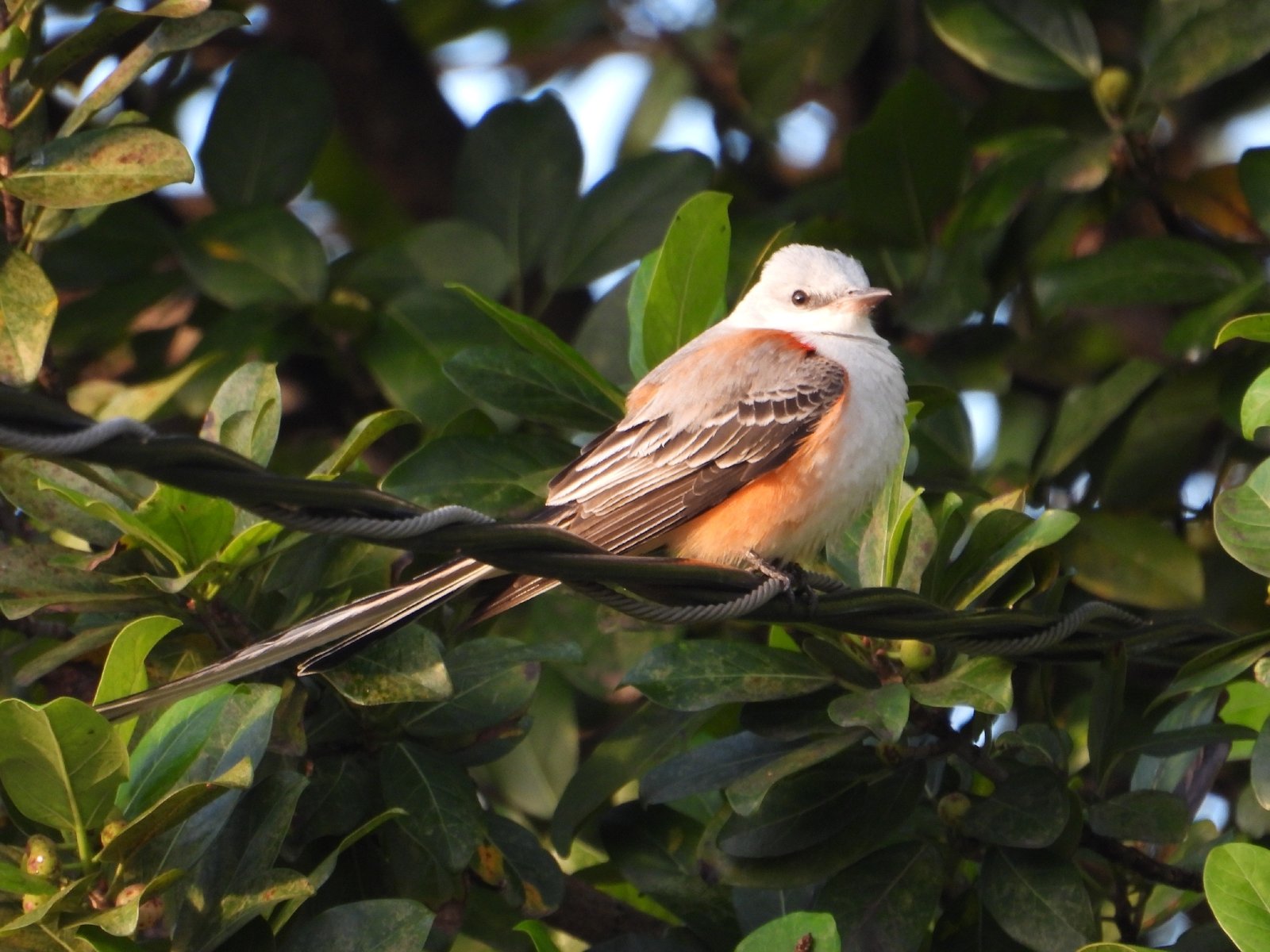
The Scissor-tailed Flycatcher is a pale grey kingbird with salmon-pink flanks and a very long, deeply forked tail. It breeds in the southern United States and north-eastern Mexico and winters in large numbers in open country from southern Mexico to Costa Rica.
Voice
A sharp pik or kek and twittering, quarrelsome bickering; in the breeding season a rapid, stuttering pup-pup-pup-perleep, especially at dawn.
Recording: Terry Davis — CC BY-NC-SA 4.0 · shortened to the first 60 s, mono · xeno-canto
Identification
20–22 cm excluding the elongated outer tail feathers; including the tail up to about 38 cm in the male, shorter in the female. Head, back and breast very pale grey to pearl-grey, belly whitish. Flanks and undertail coverts salmon-pink; the axillaries and underwing coverts are brighter pink to salmon-red, visible mainly in flight. Wings blackish-brown with pale edges. Tail deeply forked, black and white. A red crown patch is usually concealed. Young birds are paler, with little pink and a much shorter tail.
Confusion species
Fork-tailed Flycatcher Tyrannus savana has a black head, a mid-grey back, pure white underparts without pink and an all-black tail. Young Scissor-tailed Flycatchers with a short tail resemble Western Kingbird Tyrannus verticalis, but lack the yellow belly and have a pink wash on the flanks.
Habitat
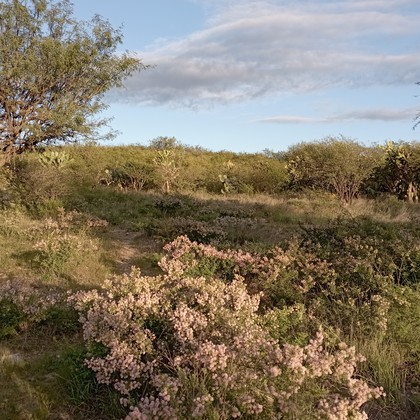
Open country with scattered trees and bushes: pasture, savanna, field edges, thorn scrub, dry forest with clearings, roadsides with wires and the edges of villages and towns. It catches insects from a low, open perch, often a wire or fence, and also hunts from the ground.
Where the bird is most at home, classified by the vegetation units of Mexico and Central America.





Range and movements
Breeds in north-eastern Mexico (Coahuila, Nuevo León and Tamaulipas). Migrates through eastern and central Mexico and winters from southern Mexico to Costa Rica, mainly on the Pacific slope; scarce as far as western Panama. Outside the guide area a breeding bird in the southern Great Plains of the United States.
- Resident
- Summer visitor (c. Apr–Sep)
- Winter visitor (c. Oct–Mar)
- Passage (Mar–Apr, Oct–Nov)
- dark = core range, pale = thinly spread
How and when to look
In winter often in small groups on roadside wires in open, dry country. In the evening they gather at communal roosts in trees, sometimes with hundreds of birds.
Conservation status
Not threatened. Common; it benefits from open country and the creation of pastures, but the breeding population in the United States has declined in recent decades.
Scientific name
Tyrannus forficatus | (Gmelin, 1789)
Gmelin described the species in 1789 as M[uscicapa] forficata; because it was later moved to another genus, the author and year stand in brackets. The genus Tyrannus was introduced in 1799 by De Lacépède. Tyrannus is Latin (from Greek turannos) for 'tyrant, despot', after the aggressive way these birds drive off even raptors. forficatus is Latin for 'forked like scissors', from forfex 'scissors', after the very long forked tail. The specimen the first description was based on came from Mexico (not further specified).