All species › Passerines › Tanagers and allies › Slate-colored Grosbeak
Position in the tree Birds Aves › Birds with a flexible palate Neognathae › All other modern birds Neoaves › Landbirds Telluraves › Falcons, parrots and passerines Australaves › Falcons and passerines Eufalconimorphae › Parrots and passerines Psittacopasserae
Slate-colored Grosbeak | Saltator grossus
Witkeelsaltator | Picogrueso piquirrojo
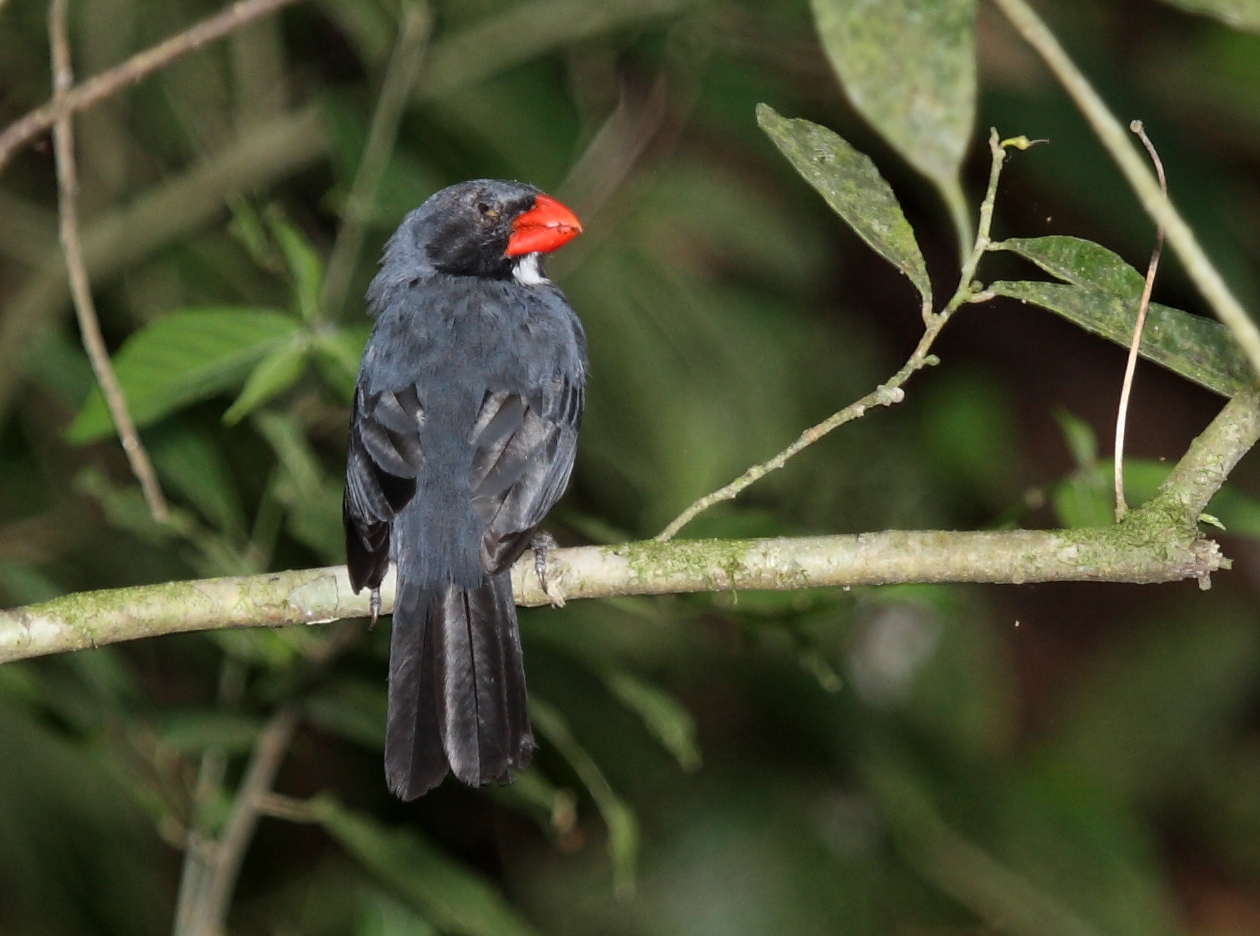
The Slate-colored Grosbeak is a slate-grey saltator of the interior of humid lowland forest, with a white throat and a heavy red bill. It lives mainly in the middle and upper levels of the forest and often travels with mixed flocks. In the guide area it occurs from eastern Honduras to Panama.
Voice
Song a series of rich, clear whistles, often in two or three parts and repeated, somewhat thrush-like. Call a nasal, harsh rraah and a sharp pink.
Recording: Juan Freile — CC BY-NC-SA 4.0 · converted to mono · xeno-canto
Identification
19–20 cm. Male dark slate-grey, with a white throat patch bordered black at the sides and below. Bill heavy, deep and coral-red to orange-red. Female slightly paler grey, with a smaller white throat patch without a black border and also a red bill. Young birds duller grey, with a darker bill.
Confusion species
Blue-black Grosbeak Cyanoloxia cyanoides is blue-black, lacks the white throat and has a black bill; it keeps more to the understorey. Black-faced Grosbeak Caryothraustes poliogaster has a black face, an olive-yellow head and a black bill. Other saltators have olive or grey upperparts, a white supercilium and a black bill.
Habitat
Interior and edges of humid evergreen lowland and foothill forest, also mature secondary forest, mostly below 1000 m. It keeps to the middle and upper levels of the forest, often in mixed flocks with tanagers and other birds. It eats fruit, seeds and insects.
Where the bird is most at home, classified by the vegetation units of Mexico and Central America.




Range and movements
Caribbean slope of eastern Honduras, Nicaragua and Costa Rica; in Panama on both slopes. Outside the guide area in western and northern Colombia, Ecuador, Venezuela, the Guianas and Amazonia to Bolivia and Brazil.
- Resident
- dark = core range, pale = thinly spread
How and when to look
Regularly heard and seen at La Selva in Costa Rica and along Pipeline Road (Camino del Oleoducto) in Panama. It often sits still in the middle levels of the forest; in the gloom the red bill is often the first thing to be seen.
Conservation status
Not threatened (LC). Fairly common in continuous humid forest; declines where that forest disappears.
Scientific name
Saltator grossus | (Linnaeus, 1766)
Linnaeus described the species in 1766 as Loxia grossa; because it was later moved to another genus, the author and year stand in brackets. The genus Saltator was introduced in 1816 by Vieillot. Saltator is Latin for 'dancer, leaper', after the birds' hopping movements. grossus is Latin for 'thick, large', after the heavy red bill. The specimen the first description was based on came from Cayenne, French Guiana.