All species › Swifts › Hummingbirds › Veraguan Mango
Position in the tree Birds Aves › Birds with a flexible palate Neognathae › All other modern birds Neoaves › Birds of the elements Elementaves › Nightjars and swifts Strisores
Veraguan Mango | Anthracothorax veraguensis
Veraguamango | Mango de Veragua
The Veraguan Mango is the only mango confined to the guide area: its range is limited to the Pacific lowlands of Panama and south-western Costa Rica. For a long time it was treated as a subspecies of Green-breasted Mango. Following deforestation and the creation of pastures it has spread north-west in Costa Rica.
Voice
High, sharp tsik calls and in chases a dry, rapid chirping. The song is a series of thin, buzzy notes from a high perch.
Recording: Andrew Spencer — CC BY-NC-SA 3.0 · converted to mono · xeno-canto
Identification
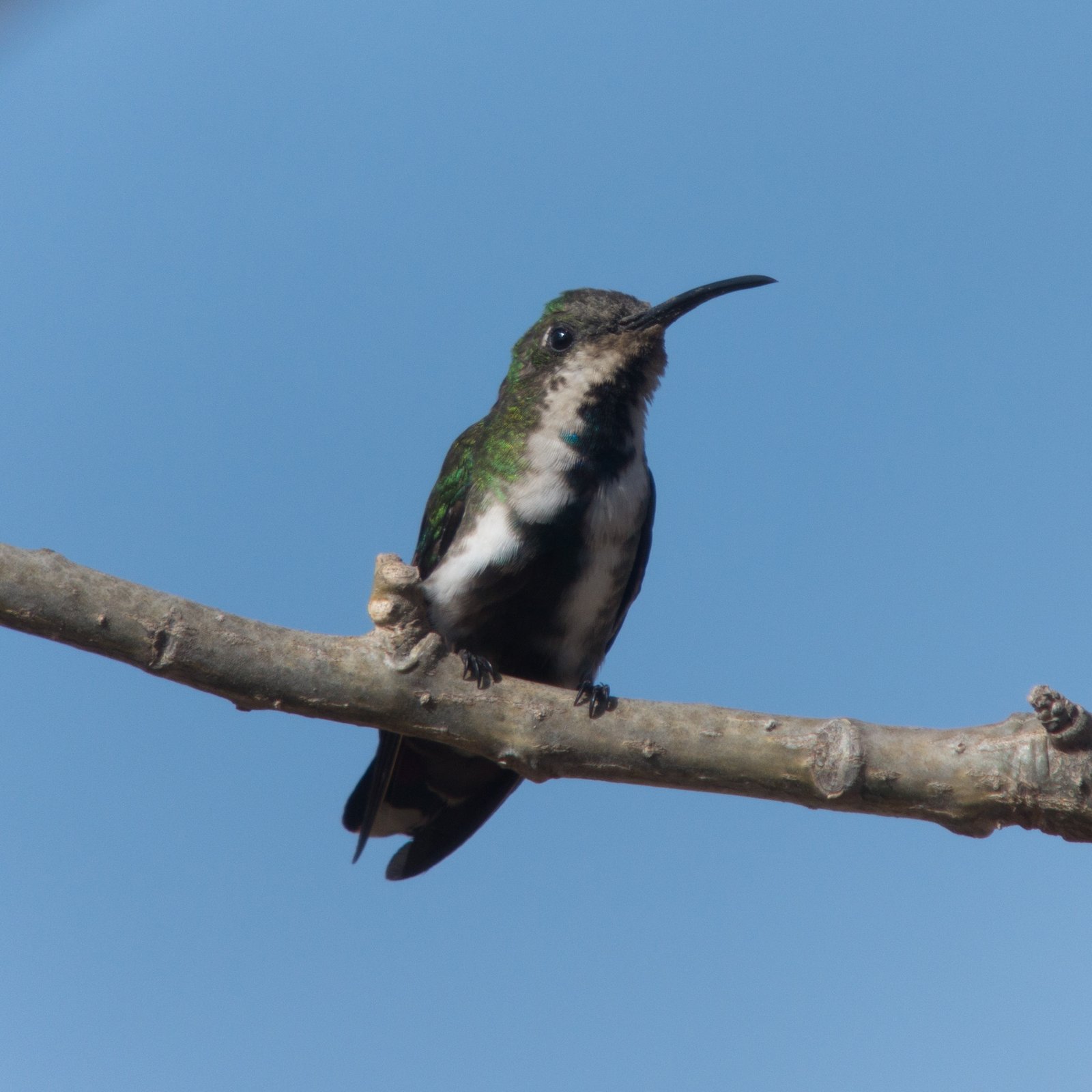
11–12 cm, with a fairly long, slightly decurved black bill. The male is glossy green with a velvety black stripe in the centre of the throat and breast, bordered on each side by a glittering blue-green edge. The tail is purple-red to wine-red with dark edges; the central feathers are dark bronze-green. The female is white below with a black central stripe from throat to belly and green flanks; the outer tail feathers are wine-red with a dark band and a white tip. Young birds have rufous borders along the central stripe.
Confusion species
Green-breasted Mango Anthracothorax prevostii and Black-throated Mango Anthracothorax nigricollis are very similar. In Panama, Green-breasted Mango occurs only in Bocas del Toro and in Costa Rica in the north-west and the Caribbean lowlands, outside the range of Veraguan Mango. Black-throated Mango occurs in central and eastern Panama; where both meet in central Panama, they often cannot be told apart with certainty in the field.
Habitat
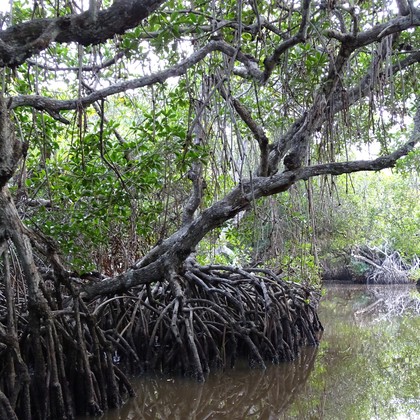
Open and semi-open lowlands and lower hills: savanna and pasture with scattered trees, living fences, forest edges, dry forest, mangrove edges, gardens and villages. It often feeds high in flowering trees and defends them against other hummingbirds.
Where the bird is most at home, classified by the vegetation units of Mexico and Central America.





Range and movements
Confined to the guide area. In Panama in the Pacific lowlands from Chiriquí through Veraguas, Herrera and Los Santos to Coclé and western Panamá province; scarce on the Caribbean side in Colón and Bocas del Toro. In Costa Rica in the south-western Pacific lowlands of Puntarenas and around the Golfo Dulce, with scattered reports further north. Old reports from Mexico are based on confusion with Green-breasted Mango.
- Resident
- dark = core range, pale = thinly spread
How and when to look
In the dry Pacific lowlands of Panama, for example on the plains of Coclé and the Azuero Peninsula, and in gardens in Chiriquí; males like to perch high on bare branches above flowering trees and hedges.
Conservation status
Not threatened. The species benefits from open, deforested landscapes with trees and appears to be expanding in Costa Rica.
Scientific name
Anthracothorax veraguensis | Reichenbach, 1855
Reichenbach described the species in 1855 and placed it straight away in the genus where it still stands. The genus Anthracothorax was introduced in 1831 by Boie. Anthracothorax is Greek, from anthrax 'coal' (i.e. 'black') and thōrax 'chest', after the black central stripe on breast and belly. veraguensis refers to Veraguas in western Panama, where the species was collected. The specimen the first description was based on came from Veraguas, Panama.