All species › Swifts › Hummingbirds › Green-breasted Mango
Position in the tree Birds Aves › Birds with a flexible palate Neognathae › All other modern birds Neoaves › Birds of the elements Elementaves › Nightjars and swifts Strisores
Green-breasted Mango | Anthracothorax prevostii
Groenborstmango | Mango pechiverde
The Green-breasted Mango is the mango of Mexico and northern Central America and the only mango in most of the guide area. It is a bulky hummingbird of open, warm lowlands that adapts well to gardens and farmland. In the north of its range birds wander after breeding, and there are a few records from southern Texas.
Voice
Sharp, high tsik and tchik calls, often repeated, and in chases a dry chirping. The song is a series of high, buzzy notes, sung from a high, open perch.
Recording: Paul Driver — CC BY-NC-SA 4.0 · converted to mono · xeno-canto
Identification
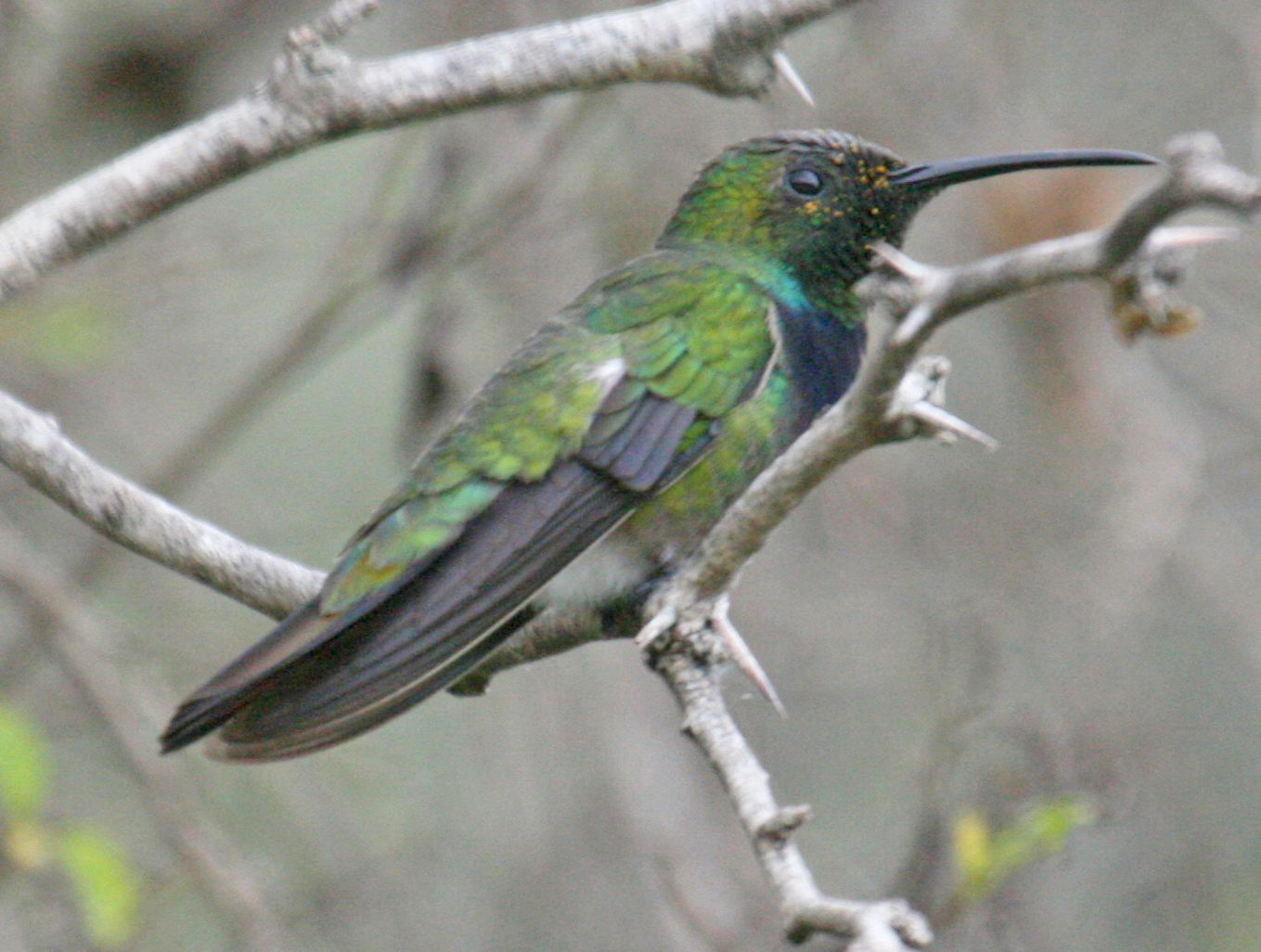
11–12 cm, with a fairly long, slightly decurved black bill. The male is largely glossy green; in the centre of the throat and breast lies a velvety black stripe with a glittering blue-green border. The tail is purple-red to wine-red with dark edges; the central feathers are dark bronze-green. The female is white below with a dark, green-black central stripe from throat to belly and green flanks; the outer tail feathers are wine-red with a dark band and a white tip. Young birds have a rufous border along the central stripe and rufous fringes on the head.
Confusion species
Veraguan Mango Anthracothorax veraguensis is very similar but occurs only in south-western Costa Rica and in Panama, where Green-breasted Mango is found in Bocas del Toro; in the field range is the main help. Females of other large hummingbirds, such as Wedge-tailed Sabrewing Pampa curvipennis, lack the black central stripe. Plain-capped Starthroat Heliomaster constantii has a longer, straight bill, grey underparts and white facial stripes.
Habitat
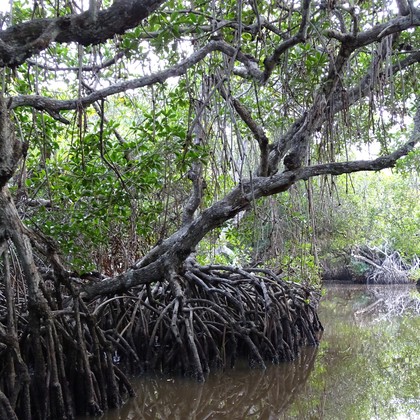
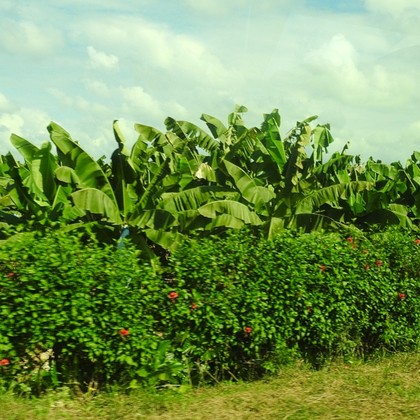
Open and semi-open lowlands up to about 1000 m, locally higher: forest edges, scattered trees in pastures, gallery forest, mangrove and coastal forest, plantations, gardens and parks. It often feeds high in flowering trees, including coral trees, and catches many insects in the air.
Where the bird is most at home, classified by the vegetation units of Mexico and Central America.





Range and movements
In Mexico on the Gulf slope from southern Tamaulipas and San Luis Potosí through Veracruz and Tabasco to the whole Yucatán Peninsula, and on the Pacific slope on the Isthmus of Tehuantepec in Oaxaca and in Chiapas. Further in Belize, Guatemala, El Salvador, Honduras and Nicaragua, in Costa Rica in the north-western Pacific lowlands and the Caribbean lowlands, and in Panama only in Bocas del Toro. Also on islands in the western Caribbean Sea. Outside the guide area in northern Colombia and Venezuela and in western Ecuador and north-western Peru.
- Resident
- dark = core range, pale = thinly spread
How and when to look
On the Yucatán Peninsula and in Quintana Roo often in gardens and at coastal hotels; in Costa Rica for example in the Guanacaste lowlands and at Caño Negro. A male on a high, bare branch above a flowering tree is the most typical view.
Conservation status
Not threatened. The world population is large and the species is common in farmland and gardens.
Scientific name
Anthracothorax prevostii | (Lesson, 1832)
Lesson described the species in 1832 as Trochilus prevostii; because it was later moved to another genus, the author and year stand in brackets. The genus Anthracothorax was introduced in 1831 by Boie. Anthracothorax is Greek, from anthrax 'coal' (i.e. 'black') and thōrax 'chest', after the black central stripe on breast and belly. prevostii honours a French Prévost, probably the naturalist and illustrator Florent Prévost (1794–1870); some suggest the artist Alphonse Prévost instead. The specimen the first description was based on came from South America (unspecified).