All species › Swifts › Hummingbirds › Greenish Puffleg
Position in the tree Birds Aves › Birds with a flexible palate Neognathae › All other modern birds Neoaves › Birds of the elements Elementaves › Nightjars and swifts Strisores
Greenish Puffleg | Haplophaedia aureliae
Aureliapluimbroekje | Calzadito verdoso
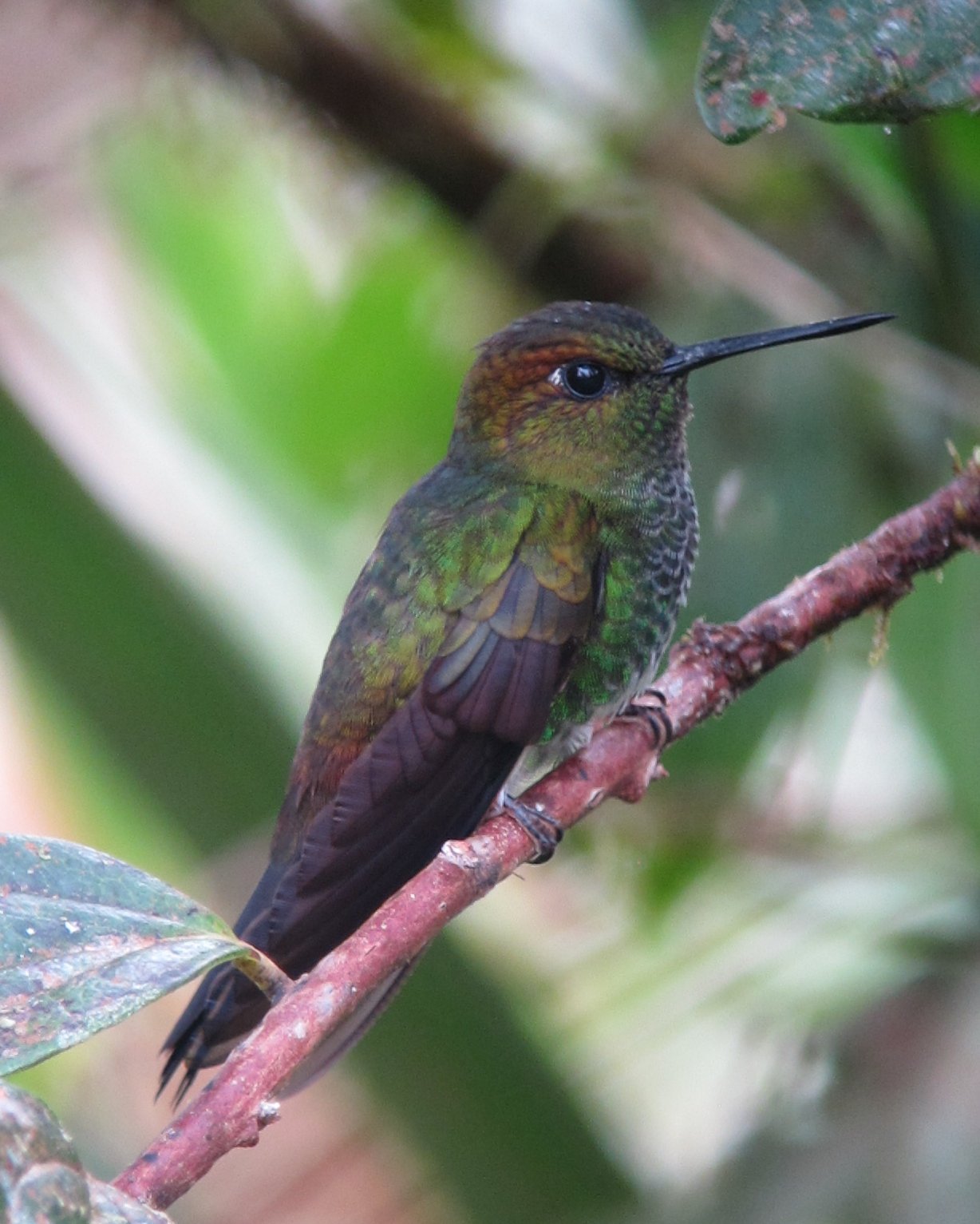
The Greenish Puffleg is an Andean hummingbird that reaches the guide area only on the highest mountains of eastern Darién, on the border with Colombia. Pufflegs owe their name to the dense, downy feather tufts around the legs. In this species these tufts are white and stand out when the bird hovers at a flower.
Voice
High, thin tsit calls, often repeated while feeding; poorly known.
Recording: John V. Moore — CC BY-NC-SA 4.0 · converted to mono · xeno-canto
Identification
9–10 cm, with a straight, medium-length black bill. The upperparts are bronze-green, more coppery on the lower back and uppertail coverts. The underparts are green with greyish-white feather edges, giving the throat and breast a scaly look; the belly is paler. White downy puffs surround the legs. The tail is blue-black and slightly forked. The sexes are alike; the female is usually whiter and less green below.
Confusion species
Rufous-cheeked Hummingbird Goldmania bella, found on the same mountains, has rufous on the face and a rufous tail and lacks the white leg puffs. Female Crowned Woodnymph Thalurania colombica has a uniform grey throat and breast, a darker belly and white tail tips. Green Hermit Phaethornis guy is much larger, with a long, decurved bill and elongated central tail feathers.
Habitat
Humid montane and cloud forest, mainly in the lower and middle strata of the forest and along edges and clearings with flowering shrubs. It visits flowers low in the forest, often perching briefly on or beside the flower, and holds its wings raised for a moment after landing.
Where the bird is most at home, classified by the vegetation units of Mexico and Central America.


Range and movements
In the guide area only in eastern Panama, in the montane forest of the Serranía de Pirre and the Serranía del Darién, including Cerro Tacarcuna, on the border with Colombia. Outside the guide area in the Andes and coastal ranges of Colombia, Ecuador and Peru.
- Resident
- dark = core range, pale = thinly spread
How and when to look
Only seen on trips to the higher parts of Cerro Pirre in Darién, a remote area that requires a guide and a permit. Look for the white leg puffs on birds feeding at flowers low in the forest.
Conservation status
Not threatened. The world population is large, spread across the Andes. In the guide area confined to a small, remote mountain area that lies largely within a national park.
Scientific name
Haplophaedia aureliae | (Bourcier & Mulsant, 1846)
Bourcier & Mulsant described the species in 1846 as Trochilus Aureliae; because it was later moved to another genus, the author and year stand in brackets. The genus Haplophaedia was introduced in 1918 by Simon. Haplophaedia is Greek, from haploos 'simple' and phaidros 'bright': 'simply bright', after the fairly plain green plumage. aureliae honours Péronne Aurélie Hénon (1814–1889), wife of the French botanist and politician Jacques-Louis Hénon. The specimen the first description was based on came from Bogotá, Colombia.