All species › Passerines › Crows, jays and magpies › Tufted Jay
Position in the tree Birds Aves › Birds with a flexible palate Neognathae › All other modern birds Neoaves › Landbirds Telluraves › Falcons, parrots and passerines Australaves › Falcons and passerines Eufalconimorphae › Parrots and passerines Psittacopasserae
Tufted Jay | Cyanocorax dickeyi
Bonte gaai | Chara pinta
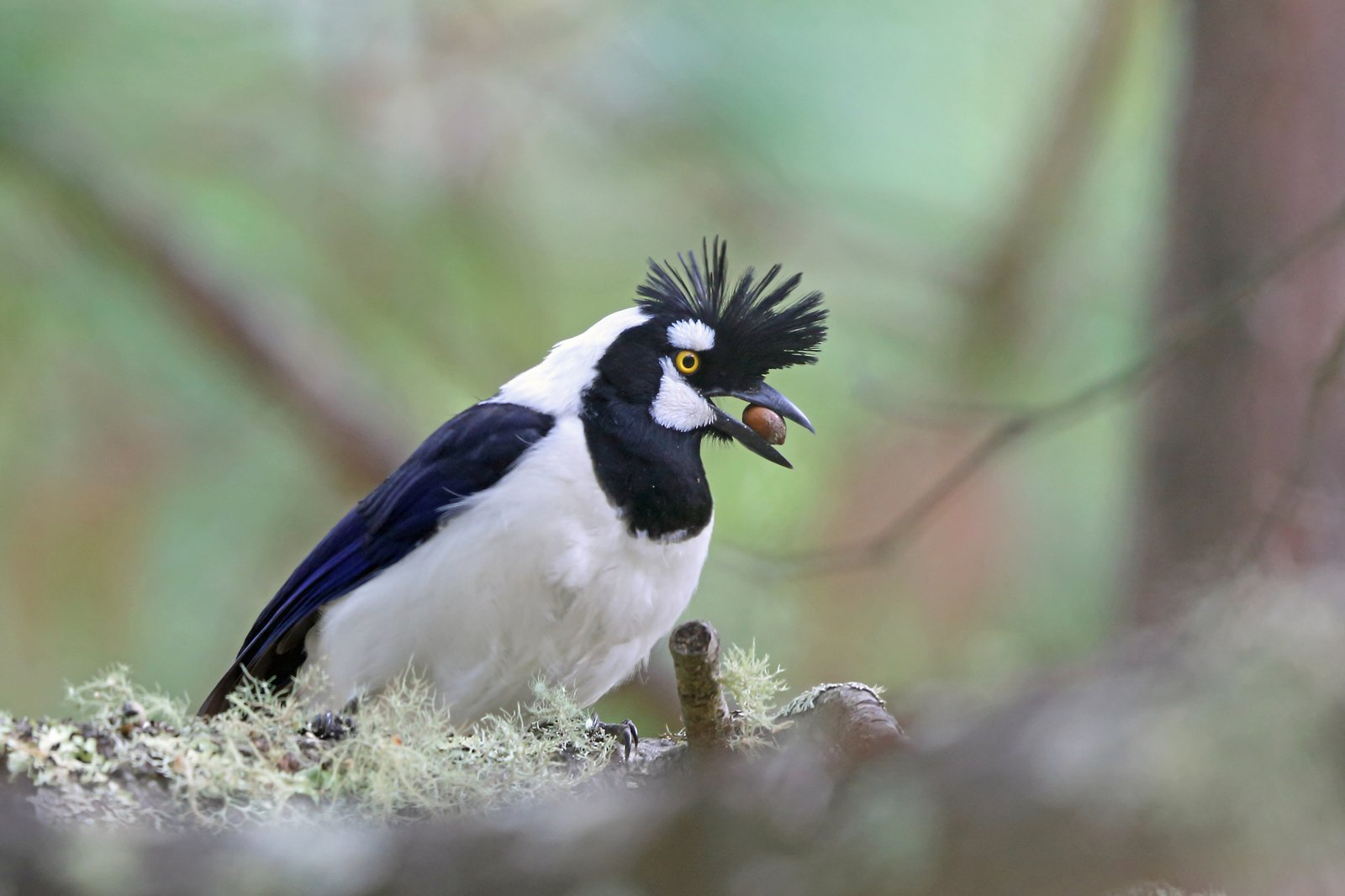
The Tufted Jay is a large, boldly patterned jay with a tall, stiff black crest, a white belly and a white tail tip. It lives only in a small part of the Sierra Madre Occidental in western Mexico. In the guide area it is confined to the border region of Sinaloa, Durango and Nayarit.
Voice
Noisy. Loud, harsh calls and rattling sounds, often by several birds of the group at once.
Recording: Manuel Grosselet — CC BY-NC-SA 4.0 · converted to mono · xeno-canto
Identification
35–39 cm, with a long tail. On the forehead a tall, stiff, forward-curving black crest. Face, throat and breast black, with small white spots above and below the eye. Back and wings dark purplish blue; belly and undertail coverts white. Tail blue with a broad white tip. Iris yellow. Male and female are alike.
Confusion species
No other jay in the guide area shows this combination of tall crest, white belly and white tail tip. Steller's Jay Cyanocitta stelleri, found in the same mountains, has a pointed crest and is entirely dark blue and black. Purplish-backed Jay Cyanocorax beecheii lives lower, in dry lowland forest, and has a black belly and no crest.
Habitat
Humid pine-oak and broadleaf forest in deep, shaded ravines in the mountains. It lives in groups and breeds cooperatively. It eats insects, small vertebrates and fruit.
Where the bird is most at home, classified by the vegetation units of Mexico and Central America.


Range and movements
Western slope of the Sierra Madre Occidental, in eastern Sinaloa, western Durango and northern Nayarit. It does not occur outside the guide area.
- Resident
- dark = core range, pale = thinly spread
How and when to look
The best-known site is the Barranca Rancho Liebre near El Palmito, on the road between Mazatlán and Durango. Groups move through the ravine and are often heard first.
Conservation status
Near Threatened. The range is small and the species depends on humid montane forest in ravines, which is declining through logging and other degradation.
Scientific name
Cyanocorax dickeyi | Moore, 1935
Moore described the species in 1935 and placed it straight away in the genus where it still stands. The genus Cyanocorax was introduced in 1826 by Boie. Cyanocorax is Greek, from kuanos 'dark blue' and korax 'raven': a 'blue raven', after the blue colours of many species. dickeyi honours the American ornithologist and collector Donald Ryder Dickey (1887–1932). The specimen the first description was based on came from Rancho Batel near Santa Lucía, Sinaloa, Mexico.