All species › Tinamous › Tinamous › Thicket Tinamou
Position in the tree Birds Aves › Ratites and tinamous Palaeognathae
Thicket Tinamou | Crypturellus cinnamomeus
Struiktinamoe | Tinamú canelo
The Thicket Tinamou is the tinamou of dry and semi-humid forest in Mexico and northern Central America, the only one that penetrates far into the dry Pacific regions. It lives in dense thickets and forest with tangled undergrowth, from Sinaloa and Tamaulipas to north-western Costa Rica. Its long, mournful whistle is one of the characteristic sounds of dry forest. The species does not occur outside the guide area.
Voice
A long, monotonous, slightly tremulous whistle, hoooooo-oo, reminiscent of a low steam whistle and repeated at intervals. It calls mainly at dusk and early in the morning, also during the day in the breeding season.
Recording: Manuel Grosselet — CC BY-NC-SA 4.0 · shortened to the first 60 s, mono · xeno-canto
Identification
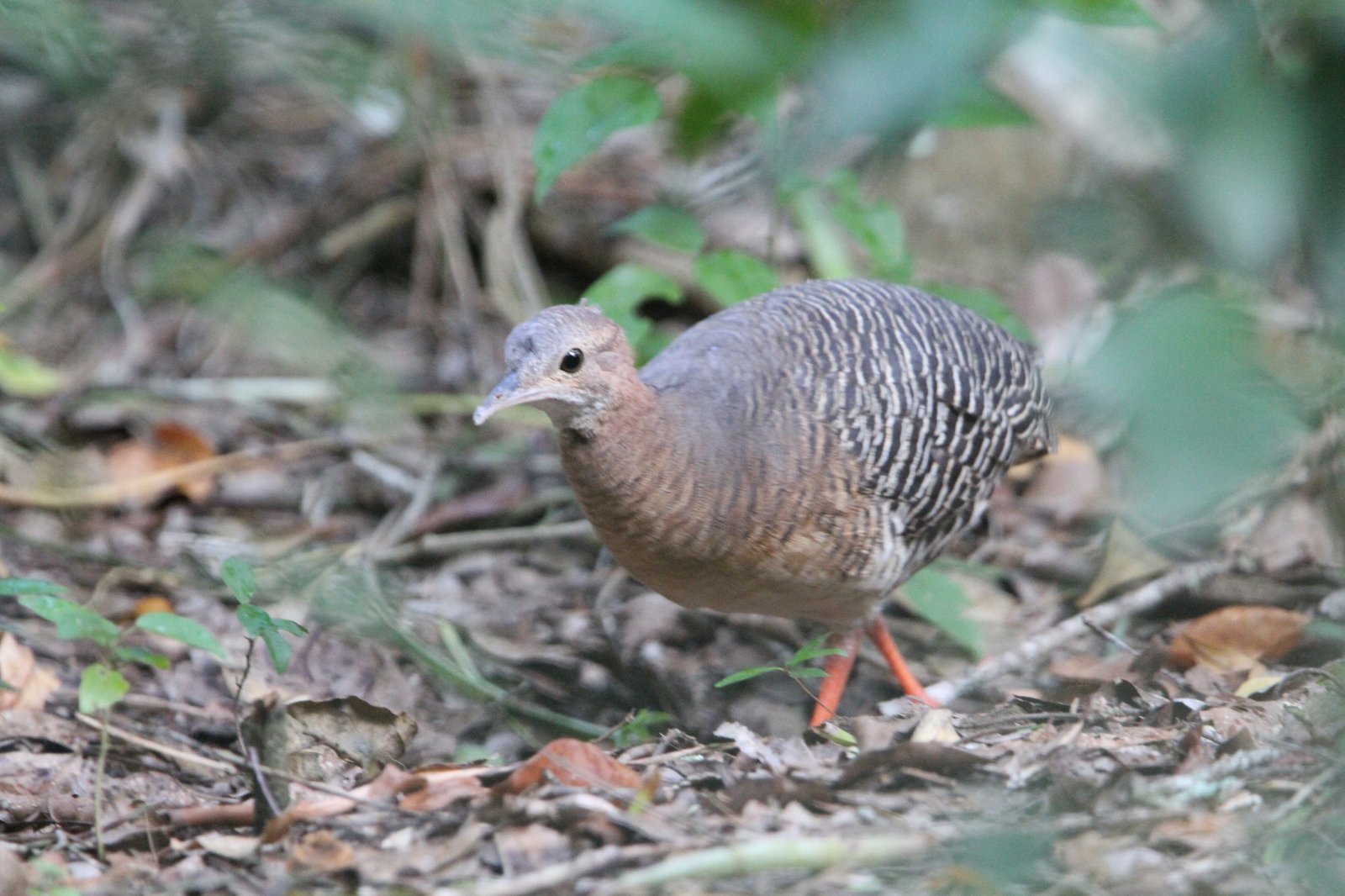
25–30 cm; a medium-sized, warm brown tinamou with red legs. The crown is grey-brown to rufous-brown, with a pale ochre supercilium, a dark ear patch and a whitish throat. The neck and breast are cinnamon, the belly greyer, the undertail coverts paler with dark barring. The upperparts are brown with blackish barring on the back, rump and wings; in the female this barring is heavier and denser than in the male. The bill is brownish. The species has a series of subspecies, which differ mainly in tone and in the strength of the barring: birds of the dry Pacific side are paler and greyer, those of Yucatán (C. c. goldmani) darker and more heavily barred.
Confusion species
Slaty-breasted Tinamou Crypturellus boucardi occurs alongside Thicket Tinamou at a few places in the Gulf lowlands and in southern Yucatán, but has a blackish-brown head, a slate-grey breast and almost unbarred upperparts, and lives in wet, tall forest. Little Tinamou Crypturellus soui is smaller and plain, without barring or supercilium. Singing Quail Dactylortyx thoracicus and other quails are smaller, have a distinct tail and live in small groups.
Habitat
Dry and semi-deciduous forest, thorn scrub, gallery forest, the seasonal forest of Yucatán and tangled edges of humid forest, from sea level to about 1800 m in the highlands of Chiapas, Guatemala and Honduras. It favours dense, tangled undergrowth and young secondary forest, and tolerates more disturbance than the other tinamous of the guide area. It prefers walking to flying and lives singly, in pairs or in family groups. It eats fruit, seeds and invertebrates from the forest floor.
Where the bird is most at home, classified by the vegetation units of Mexico and Central America.






Range and movements
Pacific slope from southern Sinaloa through Nayarit, Jalisco, Colima, Michoacán, Guerrero and Oaxaca to Chiapas; Gulf slope from southern Tamaulipas through San Luis Potosí, Puebla and Veracruz to Tabasco; the Yucatán Peninsula with Belize and northern Guatemala. Further through the highlands and Pacific side of Guatemala, El Salvador, Honduras and Nicaragua to Guanacaste and northern Puntarenas in north-western Costa Rica.
- Resident
- dark = core range, pale = thinly spread
How and when to look
In the dry forest of Guanacaste, for example at Santa Rosa and Palo Verde, and on the Yucatán Peninsula, for example around Calakmul, the call is readily heard early in the morning. Late in the dry season, when the forest is leafless, the birds are often seen walking along dusty trails and dirt roads.
Conservation status
Least Concern. Still common in much of its range, also in fragmented forest and secondary growth. Pacific dry forest has, however, been greatly reduced, and the species is heavily hunted locally.
Scientific name
Crypturellus cinnamomeus | (Lesson, 1842)
Lesson described the species in 1842 as Tinamus (nothura) cinnamomeus; because it was later moved to another genus, the author and year stand in brackets. The genus Crypturellus was introduced in 1914 by Brabourne, WWK-H & Chubb. Crypturellus is a diminutive of the older tinamou genus Crypturus (Greek kruptos 'hidden' and oura 'tail'): 'little hidden-tail'. cinnamomeus is Latin for 'cinnamon-coloured', after the warm brown plumage. The specimen the first description was based on came from La Unión, El Salvador.