All species › Owls › Owls › Tamaulipas Pygmy Owl
Position in the tree Birds Aves › Birds with a flexible palate Neognathae › All other modern birds Neoaves › Landbirds Telluraves › Raptors, owls, kingfishers and woodpeckers Afroaves › Hawks and owls Hieraves
Tamaulipas Pygmy Owl | Glaucidium sanchezi
Tamaulipasdwerguil | Tecolote tamaulipeco
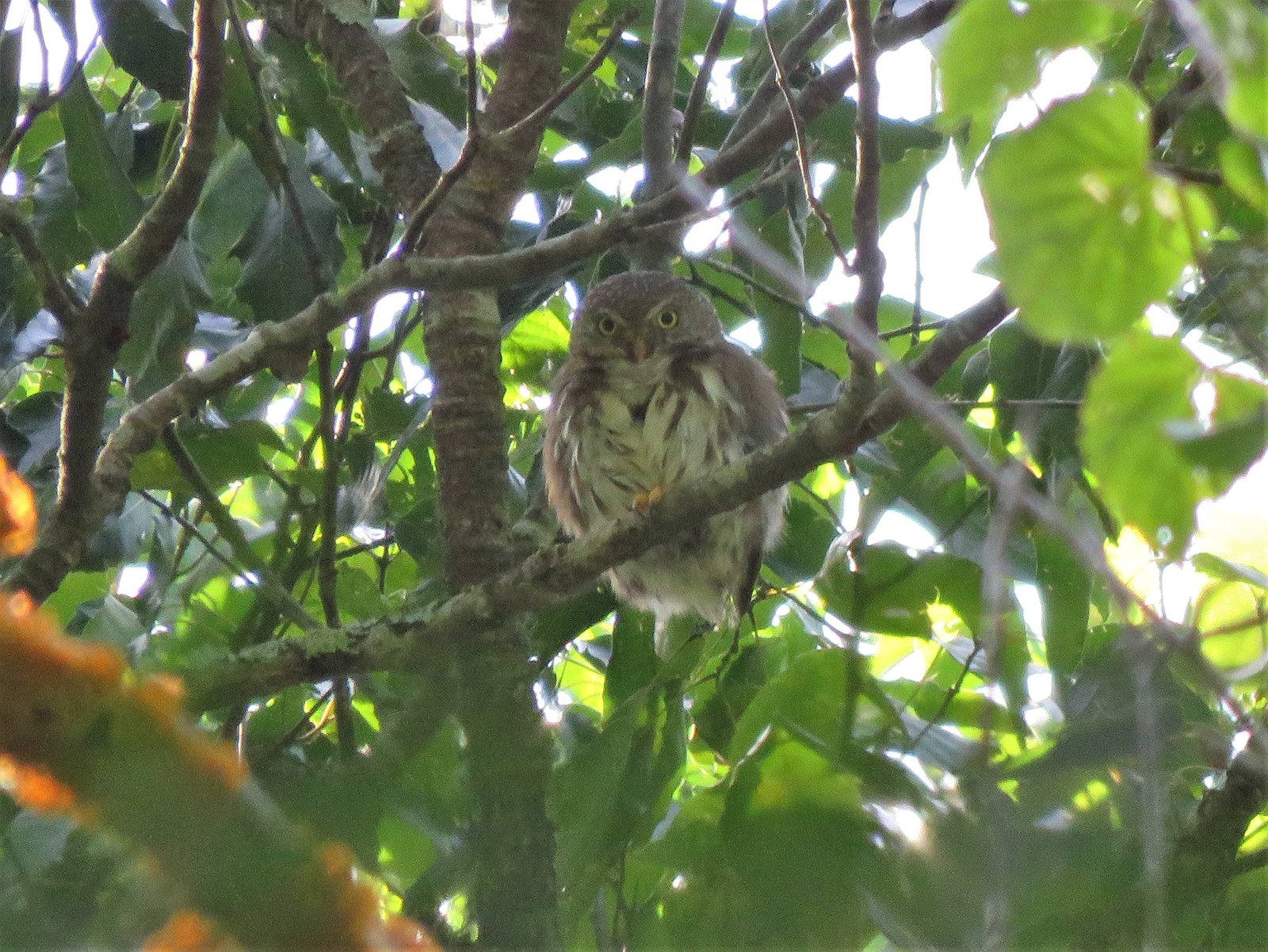
The Tamaulipas Pygmy Owl is a small pygmy owl found only in northeastern Mexico, in the humid forests of the Sierra Madre Oriental. It was long included in the Least Pygmy Owl Glaucidium minutissimum and is now treated as a separate species. It is also active by day and is usually detected by its song or by small birds mobbing it with loud alarm calls.
Voice
The song is a short series of usually two or three hollow, whistled toots, too-too or too-too-too, repeated after a pause; sometimes the series is longer. It also sings by day, especially in the morning and at dusk, and most in spring.
Recording: David Ruíz Domínguez — CC BY-NC-SA 4.0 · shortened to the first 60 s, mono · xeno-canto
Identification
14–15 cm, compact, with a round head without ear tufts, yellow eyes, short white eyebrows and a fairly long tail. The crown and nape are brown with small pale dots; on the nape two black spots with a pale border act as false eyes. The upperparts are warm olive-brown, the tail dark with a few narrow, broken whitish bars. The underparts are white with rufous streaks on the flanks and rufous sides to the breast. Females are often warmer rufous than males.
Confusion species
The Ferruginous Pygmy Owl Glaucidium brasilianum lives lower, in drier and more open country, has fine pale streaks instead of dots on the crown, more tail bars and a long, rapid series of dozens of toots. The Northern Pygmy Owl Glaucidium gnoma is slightly larger, greyer brown and lives mainly higher up, in pine-oak forest; its toots are often given in pairs. The Colima Pygmy Owl Glaucidium palmarum is very similar to the Tamaulipas Pygmy Owl but lives only on the Pacific side of Mexico; the two species do not overlap.
Habitat
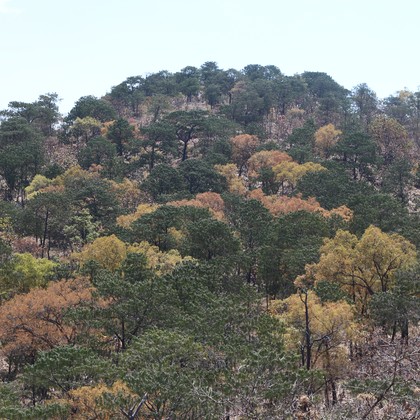
Humid montane forest and cloud forest rich in epiphytes, oak forest and pine-oak forest on slopes, mainly between about 900 and 2,100 metres, locally also lower in humid foothill forest. It hunts from a perch in the middle and upper levels of the forest for large insects, lizards and small birds. It nests in tree cavities, often old woodpecker holes.
Where the bird is most at home, classified by the vegetation units of Mexico and Central America.


Range and movements
Endemic to northeastern Mexico: in the Sierra Madre Oriental from southwestern Tamaulipas south through eastern San Luis Potosí, Querétaro and Hidalgo into northern Puebla. Resident; some birds may move slightly downslope outside the breeding season. It does not occur outside the guide area.
- Resident
- Summer visitor (c. Apr–Sep)
- Winter visitor (c. Oct–Mar)
- dark = core range, pale = thinly spread
How and when to look
Most often looked for in the El Cielo Biosphere Reserve in Tamaulipas, around Gómez Farías and higher up in the cloud forest, where the song can be heard in spring, also by day. A group of alarm-calling songbirds and hummingbirds around one spot in a tree often points to a pygmy owl.
Conservation status
Near Threatened. The range is small and the humid montane forest of the Sierra Madre Oriental is being cleared and converted to pasture, maize fields and coffee plantations.
Scientific name
Glaucidium sanchezi | Lowery & Newman, 1949
Lowery & Newman described the species in 1949 and placed it straight away in the genus where it still stands. The genus Glaucidium was introduced in 1826 by Boie. Glaucidium is Greek glaukidion 'little owl' or 'owlet', a diminutive of glaux 'owl'. sanchezi honours the Mexican naturalist Carlos Sánchez Mejorada Jr. (fl. 1948), who sponsored the describers' fieldwork. The specimen the first description was based on came from San Luis Potosí, Mexico (not verified).