All species › Owls › Owls › Central American Pygmy Owl
Position in the tree Birds Aves › Birds with a flexible palate Neognathae › All other modern birds Neoaves › Landbirds Telluraves › Raptors, owls, kingfishers and woodpeckers Afroaves › Hawks and owls Hieraves
Central American Pygmy Owl | Glaucidium griseiceps
Grijskopdwerguil | Tecolote mesoamericano
The Central American Pygmy Owl is a very small pygmy owl of humid lowland forest, from southeastern Mexico to northwestern South America. It lives high in the canopy and is usually detected by its song, which is also given by day. It was formerly included in the Least Pygmy Owl Glaucidium minutissimum.
Voice
The song is a series of a few to about ten hollow, whistled toots, too-too-too-too, slower and shorter than the long series of the Ferruginous Pygmy Owl; the series is repeated after a pause. Often sings by day, even at midday.
Recording: Scott Olmstead — CC BY-NC-SA 4.0 · shortened to the first 60 s, mono · xeno-canto
Identification
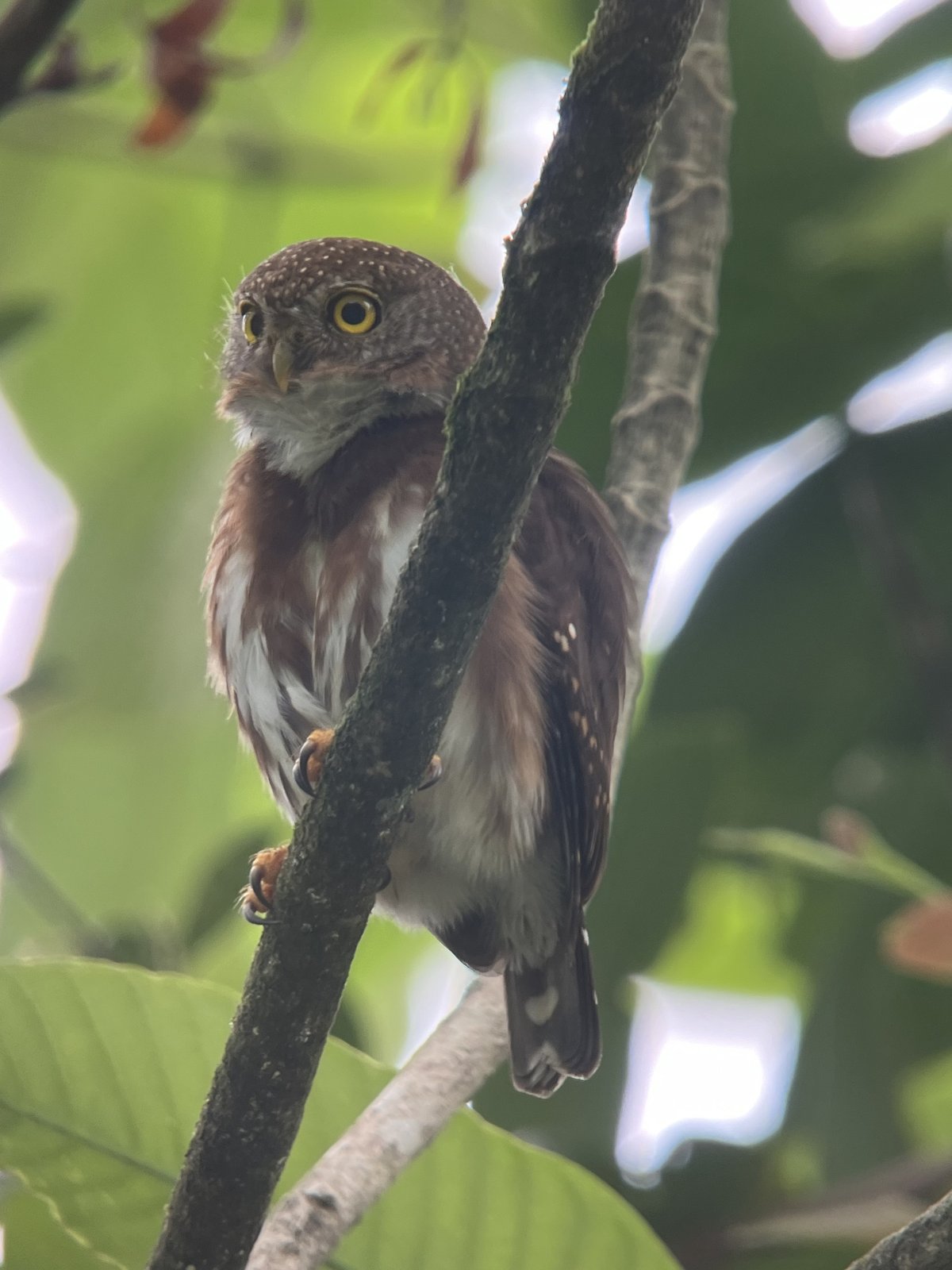
14–15 cm, with a round head without ear tufts, yellow eyes and a fairly short tail. The head is grey to grey-brown with fine white dots on the crown and forehead and contrasts with the warm brown back. The nape bears false eyes. The tail is dark brown with two or three broken white bars. The underparts are white, with rufous breast sides and rufous streaks on the flanks.
Confusion species
The Ferruginous Pygmy Owl Glaucidium brasilianum is slightly larger, has a brown head with fine pale streaks instead of dots and more tail bars, and lives mainly in drier, more open country; its song is a long, rapid series of dozens of toots. The Costa Rican Pygmy Owl Glaucidium costaricanum lives higher in the mountains and has a brown head and more tail bars. The Northern Pygmy Owl Glaucidium gnoma lives in montane pine-oak forest.
Habitat
Humid evergreen lowland and foothill forest, also old secondary forest, forest edges and shade cacao and coffee; from sea level to about 1300 m. Usually stays in the upper tree layers. It nests in woodpecker holes. It hunts large insects, small birds and lizards.
Where the bird is most at home, classified by the vegetation units of Mexico and Central America.





Range and movements
Resident in the humid lowlands of southeastern Mexico, in southern Veracruz, Oaxaca and Chiapas, and further in Belize, Guatemala, Honduras and Nicaragua, mainly on the Caribbean side, and in Costa Rica and Panama on both sides of the mountains. Outside the guide area in northwestern Colombia and western Ecuador.
- Resident
- dark = core range, pale = thinly spread
How and when to look
Heard most often in lowland forest on the Caribbean side, for example around La Selva in Costa Rica, along Pipeline Road near the Panama Canal and in the forests of Belize. A group of small birds giving alarm calls high in the canopy often points to a pygmy owl.
Conservation status
Not threatened, but dependent on humid forest, which has been cleared in large parts of its range.
Scientific name
Glaucidium griseiceps | Sharpe, 1875
Sharpe described the species in 1875 and placed it straight away in the genus where it still stands. The genus Glaucidium was introduced in 1826 by Boie. Glaucidium is Greek glaukidion 'little owl' or 'owlet', a diminutive of glaux 'owl'. griseiceps is Latin, from griseus 'grey' and -ceps '-headed', after the grey head. The specimen the first description was based on came from lowlands of Alta Verapaz, Guatemala.