All species › Tubenoses › Petrels, shearwaters and diving petrels › Tahiti Petrel
Position in the tree Birds Aves › Birds with a flexible palate Neognathae › All other modern birds Neoaves › Birds of the elements Elementaves › Tropicbirds and waterbirds Phaethoquornithes › Core waterbirds Aequornithes
Tahiti Petrel | Pseudobulweria rostrata
Tahitistormvogel | Petrel de Tahití
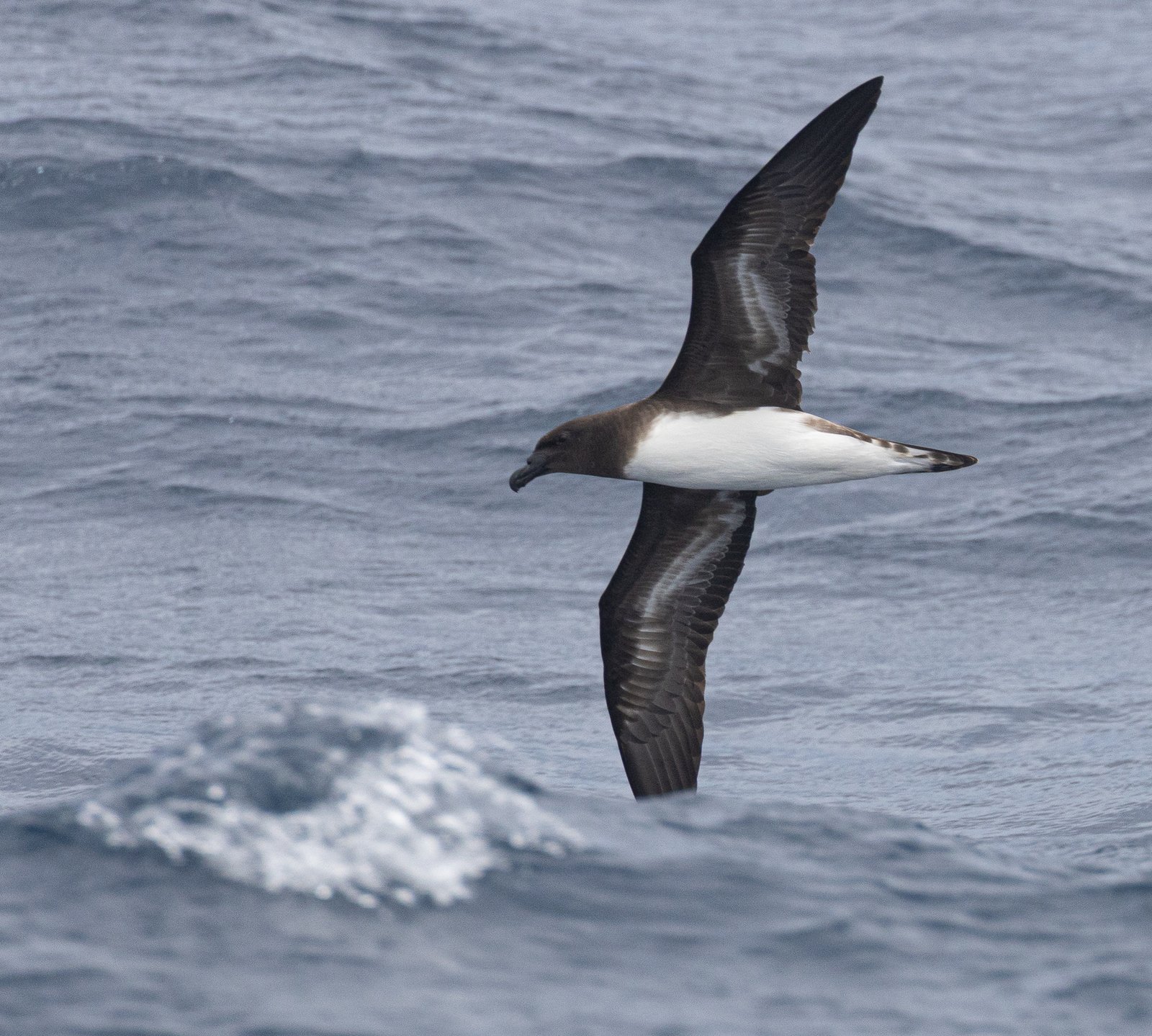
The Tahiti Petrel is a large, dark brown petrel with a white belly that breeds on islands in the tropical Pacific. Non-breeding birds range far to the east and occur all year in the deep waters off the Pacific coast of the guide area. The species is hardly ever seen from land.
Voice
Silent at sea. At the breeding sites a series of rising, high whistles at night.
Recording: Frédéric Desmoulins — CC BY-NC 4.0 · converted to mono · iNaturalist
Identification
38–40 cm, with long wings, a fairly long, wedge-shaped tail and a strikingly heavy black bill. Head, neck, breast, upperparts and undertail coverts are dark chocolate brown, sharply demarcated from the white lower breast and belly. The underwing is dark, with a narrow pale stripe across the base of the coverts. The legs are flesh-coloured with dark toes. Flies lightly and calmly, with long glides on slightly forward-held, bowed wings, alternating with a few supple beats; rarely in high arcs.
Confusion species
Light morph Wedge-tailed Shearwater Ardenna pacifica has a white underwing with dark margins, white undertail coverts and a thin, dark grey bill. Cook's Petrel Pterodroma cookii is smaller, pale grey above with a dark M across the wings and largely white below. Black Petrel Procellaria parkinsoni is entirely dark, including the belly, and has a pale bill with a dark tip.
Habitat
Deep, warm ocean far offshore, often where currents meet. Feeds mainly at night and at dusk on squid and fish at the surface, sometimes in mixed flocks with other seabirds over schools of tuna or dolphins. Breeds in burrows and crevices on steep, forested slopes of oceanic islands.
Where the bird is most at home, classified by the vegetation units of Mexico and Central America.
Range and movements
Far out at sea off the Pacific coast of the guide area, from the waters off Guerrero and Oaxaca to off Costa Rica and Panama; rare off northern Mexico. Because records come almost exclusively from ships, its distribution at sea is incompletely known. Outside the guide area the species breeds on islands in the tropical Pacific, including French Polynesia and New Caledonia, and ranges over the whole tropical Pacific outside the breeding season.
- Resident
- Passage (Mar–Apr, Oct–Nov)
- dark = core range, pale = thinly spread
How and when to look
Pelagic trips to deep water off southern Mexico, Costa Rica or Panama offer the best chance. A large, dark petrel with a white belly, a heavy black bill and a calm, gliding flight is almost certainly this species in this area.
Conservation status
Near Threatened. The world population probably numbers a few tens of thousands of birds and is declining. On the breeding islands introduced rats and cats eat eggs, chicks and adults; loss of forest and artificial light, which disorients young birds, are other threats.
Scientific name
Pseudobulweria rostrata | (Peale, 1849)
Peale described the species in 1849 as Procellaria rostrata; because it was later moved to another genus, the author and year stand in brackets. The genus Pseudobulweria was introduced in 1936 by Mathews. Pseudobulweria combines Greek pseudos 'false' with the genus Bulweria: a 'false Bulweria', a petrel resembling Bulwer's petrel. rostrata is Latin for 'large-billed', from rostrum 'bill', after the stout, heavy bill. The specimen the first description was based on came from mountains of Tahiti (c. 1,800 m), Society Islands, French Polynesia.