All species › Tubenoses › Petrels, shearwaters and diving petrels › Northern Fulmar
Position in the tree Birds Aves › Birds with a flexible palate Neognathae › All other modern birds Neoaves › Birds of the elements Elementaves › Tropicbirds and waterbirds Phaethoquornithes › Core waterbirds Aequornithes
Northern Fulmar | Fulmarus glacialis
Noordse stormvogel | Fulmar boreal
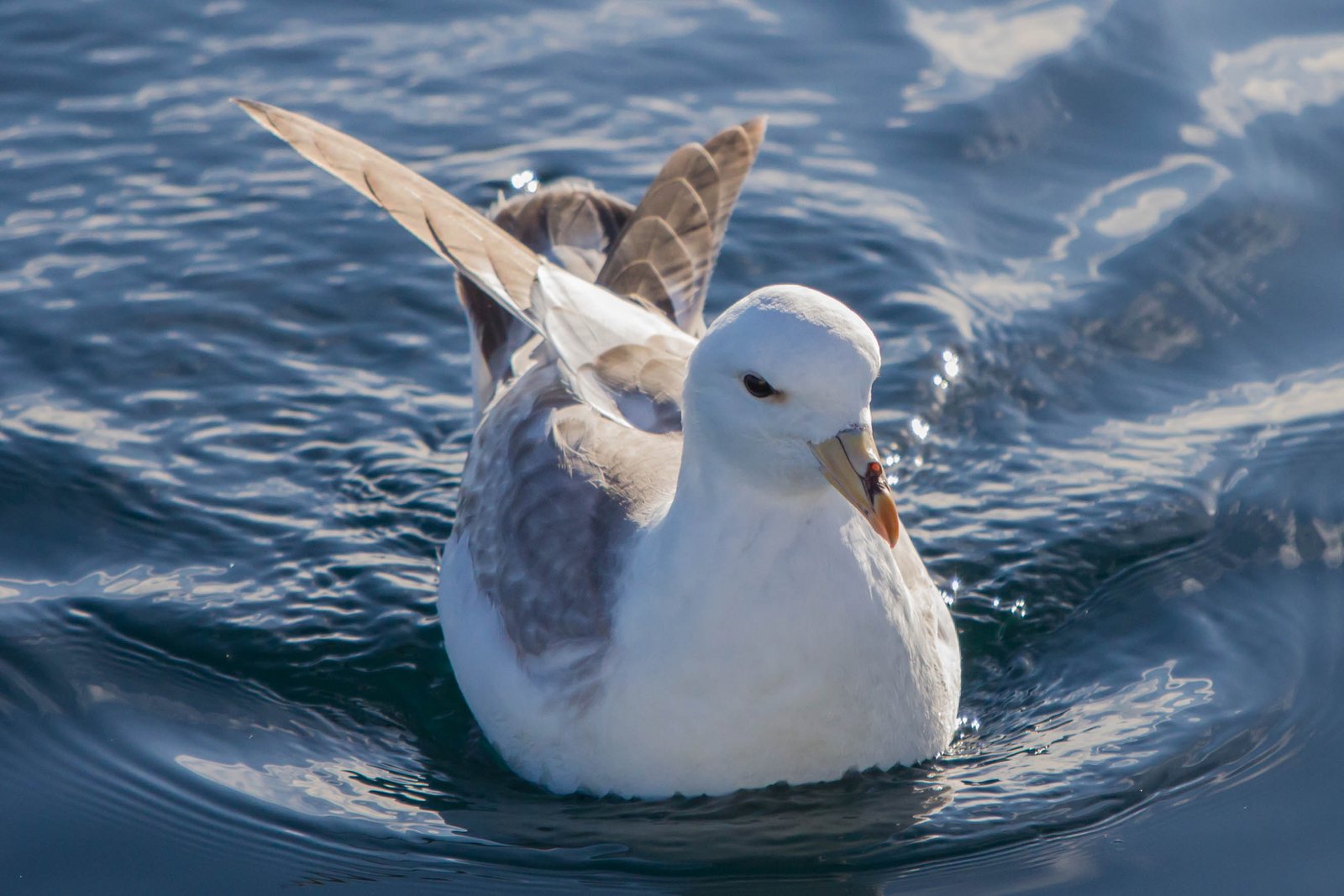
The Northern Fulmar is a stocky petrel of the cold northern oceans that at first glance resembles a gull. The guide area lies at the southern edge of the winter range of the North Pacific population. The number reaching Baja California varies greatly: in some winters large numbers move south, often in poor condition, in others hardly any arrive.
Voice
Usually silent at sea. At food, for instance behind fishing boats, cackling and grunting sounds.
Recording: Roland Arnison — CC BY-NC-SA 4.0 · converted to mono · xeno-canto
Identification
45–50 cm, stocky, with a thick neck, a round head and a short, thick bill with a prominent tube on the upper mandible. The bill is yellowish, often with a greenish or dark tip. Plumage varies greatly: light birds have a white head and underparts and grey mantle and wings, dark birds are uniformly dark leaden grey. In the North Pacific all intermediates occur and mid-grey and dark birds are common. The tail is short and grey. Flies on stiff, straight wings with bursts of quick, shallow beats alternating with glides low over the water.
Confusion species
Gulls such as Western Gull Larus occidentalis have a longer neck, a bill without a tube and a more flexible wingbeat on angled wings. Dark birds resemble Sooty Shearwater Ardenna grisea, but that species has a long, thin, dark bill, a silvery band on the underwing and longer, narrower wings. Pink-footed Shearwater Ardenna creatopus has a long pink bill with a dark tip and a slimmer build.
Habitat
Open sea and the continental shelf, often where cold, nutrient-rich water wells up. Takes fish, squid, crustaceans and fishing offal from the surface and gathers behind fishing boats. In poor years weakened birds end up in bays and along the coast.
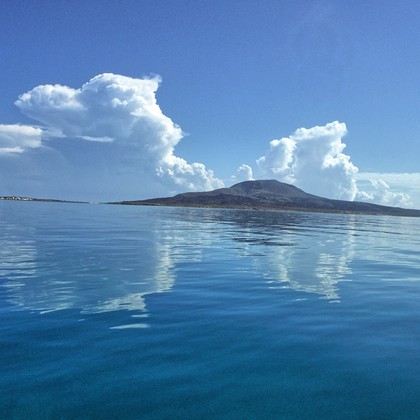
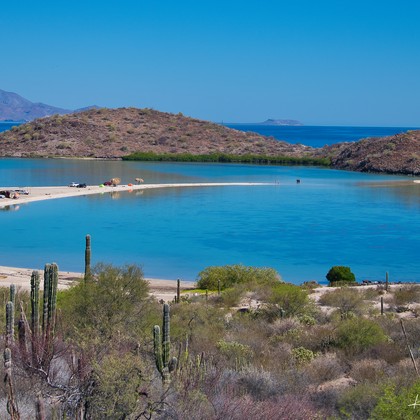
Where the bird is most at home, classified by the vegetation units of Mexico and Central America.
Range and movements
Mainly off the Pacific coast of Baja California, in strongly fluctuating numbers. Rare in the Gulf of California and further south along the west coast of Mexico; there are only scattered records from further south and from the Gulf coast. Outside the guide area the species breeds on cliffs and islands in the North Atlantic and North Pacific and the adjacent Arctic seas, and winters at sea south to California and the Bay of Biscay.
- Resident
- Summer visitor (c. Apr–Sep)
- Winter visitor (c. Oct–Mar)
- Passage (Mar–Apr, Oct–Nov)
- dark = core range, pale = thinly spread
How and when to look
Pelagic trips off Baja California in winter offer the best chance, especially in winters when many birds are seen along the coast of California. The stocky build, the thick yellow bill and the stiff wingbeat separate the species from gulls.
Conservation status
Not threatened. The world population numbers many millions of birds. Numbers have declined in parts of the range, among other things through bycatch in fisheries and ingestion of plastic; in warm years large numbers sometimes die at sea from lack of food. In the guide area an irregular winter visitor.
Scientific name
Fulmarus glacialis | (Linnaeus, 1761)
Linnaeus described the species in 1761 as Procellaria glacialis; because it was later moved to another genus, the author and year stand in brackets. The genus Fulmarus was introduced in 1826 by Stephens. Fulmarus goes back to Old Norse fúlmár 'foul gull', after the birds' habit of ejecting a foul-smelling oil. glacialis is Latin for 'icy', after the cold northern seas where the bird breeds. The specimen the first description was based on came from north of the Arctic Circle.