All species › Passerines › New World sparrows › Lincoln's Sparrow
Position in the tree Birds Aves › Birds with a flexible palate Neognathae › All other modern birds Neoaves › Landbirds Telluraves › Falcons, parrots and passerines Australaves › Falcons and passerines Eufalconimorphae › Parrots and passerines Psittacopasserae
Lincoln's Sparrow | Melospiza lincolnii
Lincolns gors | Gorrión de Lincoln
Lincoln's Sparrow is a finely marked, rather shy sparrow of damp thickets and rank growth. It breeds in northern North America and the western mountains and winters in large numbers in Mexico. In the guide area it is one of the most widespread sparrows in winter.
Voice
In winter mainly a sharp, dry chep and a buzzy zeet. The song, sometimes heard in Mexico in spring, is a fast, bubbling series reminiscent of a wren.
Recording: Don Profota — CC BY-NC-SA 4.0 · shortened to the first 60 s, mono · xeno-canto
Identification
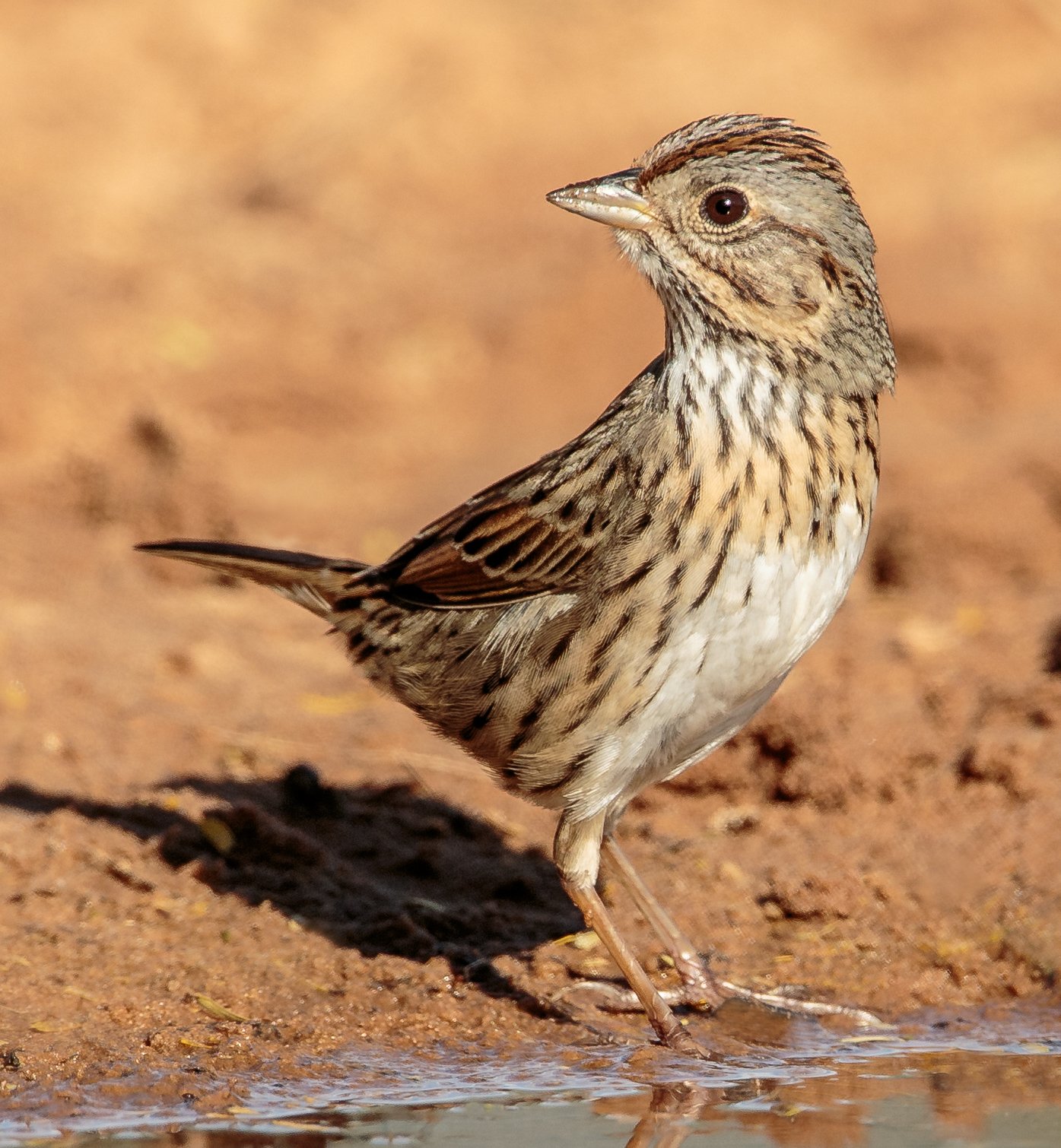
13–15 cm. Crown brown with fine black streaks and a grey central stripe, which can be raised into a small crest when excited. Face grey with a narrow brown eye-stripe and a thin white eye-ring. A buff moustachial stripe and a buff breast band and flanks with crisp, fine black streaks contrast with a white throat and an unstreaked white belly. Back brown and grey with black streaks. The sexes are alike.
Confusion species
Song Sparrow Melospiza melodia is larger and more coarsely streaked, with a white ground colour to the breast and a broad dark malar stripe. Swamp Sparrow Melospiza georgiana has rusty wings and a grey, barely streaked breast. Young Savannah Sparrows Passerculus sandwichensis have a shorter, notched tail, lack the buff breast band and live in open grassland.
Habitat
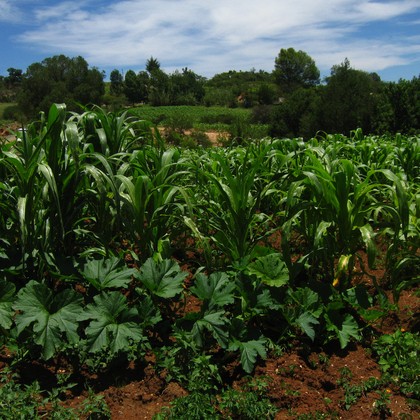
In winter dense, often damp thickets and rank growth: overgrown field margins, hedgerows, forest edges, clearings in pine-oak forest, riverside vegetation and overgrown gardens, from sea level to above 3000 m, mainly in the highlands. It stays close to cover and feeds on the ground on seeds and insects.
Where the bird is most at home, classified by the vegetation units of Mexico and Central America.





Range and movements
Breeds in Alaska, Canada and the north-eastern United States, and south in the western mountains to Arizona and New Mexico. Winters from the southern United States through almost all of Mexico to Guatemala, El Salvador and Honduras; rare further south. In the guide area most numerous on the plateau and in the mountains of central and southern Mexico.
- Winter visitor (c. Oct–Mar)
- dark = core range, pale = thinly spread
How and when to look
Often with other sparrows in rank field margins and hedgerows in the highlands. It shows best when one stands still at the edge of a thicket, after which it sometimes comes up to an open branch.
Conservation status
Not threatened (LC). Widespread and numerous; its breeding habitats in the northern boreal forest and in mountain bogs are largely intact.
Scientific name
Melospiza lincolnii | (Audubon, 1834)
Audubon described the species in 1834 as Fringilla Lincolnii; because it was later moved to another genus, the author and year stand in brackets. The genus Melospiza was introduced in 1858 by Baird. Melospiza is Greek, from melos 'song' and spiza 'finch'. lincolnii honours Thomas Lincoln (1812–1883), who accompanied Audubon to Labrador in 1833 and collected the first specimen there. The specimen the first description was based on came from mouth of the Natashquan River, Quebec (Canada).