All species › Passerines › Cardinals and allies › Summer Tanager
Position in the tree Birds Aves › Birds with a flexible palate Neognathae › All other modern birds Neoaves › Landbirds Telluraves › Falcons, parrots and passerines Australaves › Falcons and passerines Eufalconimorphae › Parrots and passerines Psittacopasserae
Summer Tanager | Piranga rubra
Zomertangare | Tángara roja
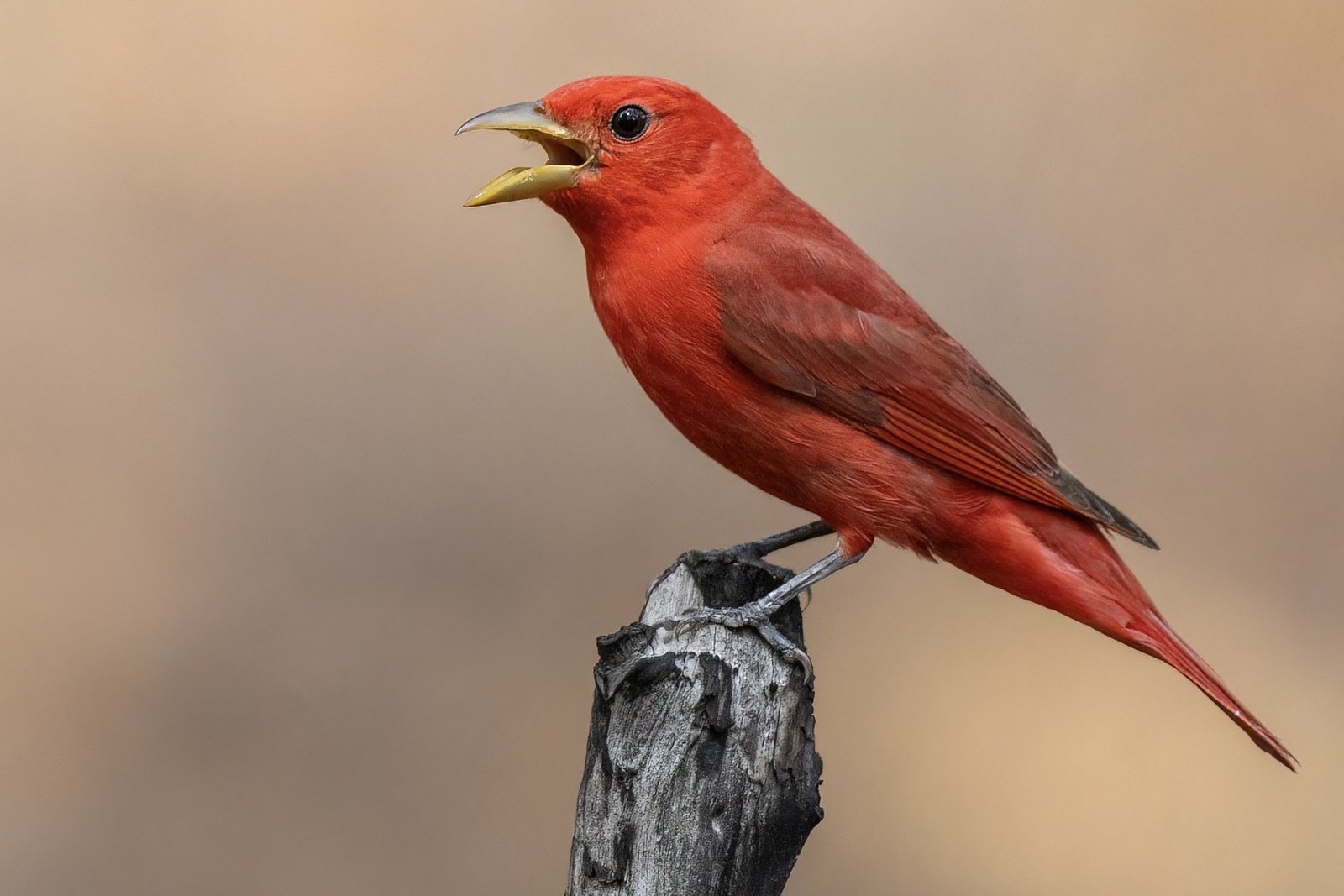
The Summer Tanager is a medium-sized tanager in which the male is entirely rose-red, without black in the wings. It breeds in North America and northern Mexico and winters in large numbers in southern Mexico and Central America. There it is one of the most common winter visitors at forest edges, in gardens and in coffee plantations.
Voice
The call is a staccato pi-tuk or pik-i-tuk-i-tuk, often heard in winter too. The song, on the breeding grounds, is a series of clear, robin-like phrases.
Recording: Mario Reyes Jr — CC BY-NC-SA 4.0 · shortened to the first 60 s, mono · xeno-canto
Identification
17–20 cm. A fairly robust tanager with a long, thick, pale horn-coloured bill and a slightly crested-looking head. The male is uniformly rose-red, the wings slightly darker. The female is olive-yellow above and warm ochre-yellow below, without wing bars; some females have an orange or reddish tinge. Young males in their first winter and spring are blotched red and yellow.
Confusion species
Hepatic Tanager Piranga flava has a dark grey bill, grey cheeks and a grey wash on the back and flanks; the male is a deeper brick red. Flame-colored Tanager Piranga bidentata has a streaked back and white wing bars. Females of Scarlet Tanager Piranga olivacea are greener, with darker wings and a smaller bill.
Habitat
In northern Mexico it breeds in riparian woodland with cottonwoods, willows and mesquite. It winters at forest edges, in secondary forest, semi-open country with trees, shade coffee, parks and gardens, from the lowlands to about 2500 m. It eats insects, especially bees and wasps, and fruit.
Where the bird is most at home, classified by the vegetation units of Mexico and Central America.







Range and movements
Breeds in northern Mexico, in north-eastern Baja California, Sonora, Chihuahua, Coahuila, Nuevo León and Tamaulipas and south to Durango. Winters from southern Baja California, Sinaloa and central Mexico through all of Central America to Panama, and further in South America to Bolivia and Brazil. Outside the guide area it breeds in the southern and eastern United States.
- Resident
- Summer visitor (c. Apr–Sep)
- Winter visitor (c. Oct–Mar)
- Passage (Mar–Apr, Oct–Nov)
- dark = core range, pale = thinly spread
How and when to look
In winter regularly found in gardens, parks and coffee plantations, often by its pi-tuk call. It regularly sits quietly in the crown of scattered trees.
Conservation status
Not threatened (LC). Common and widespread; adapts well to semi-open and human-modified country.
Scientific name
Piranga rubra | (Linnaeus, 1758)
Linnaeus described the species in 1758 as Fringilla rubra; because it was later moved to another genus, the author and year stand in brackets. The genus Piranga was introduced in 1808 by Vieillot. Piranga comes from the Tupi tijepiranga, the name of an unidentified small bird. rubra is Latin for 'red', after the all-red male. The specimen the first description was based on came from South Carolina.