All species › Passerines › Cardinals and allies › Rose-throated Tanager
Position in the tree Birds Aves › Birds with a flexible palate Neognathae › All other modern birds Neoaves › Landbirds Telluraves › Falcons, parrots and passerines Australaves › Falcons and passerines Eufalconimorphae › Parrots and passerines Psittacopasserae
Rose-throated Tanager | Piranga roseogularis
Rozekeeltangare | Tángara yucateca
The Rose-throated Tanager is a grey tanager with pink to red accents, found almost only on the Yucatán Peninsula and just to the south of it. It lives in the dense lower and middle levels of dry and semi-evergreen forest and often stays hidden. In the guide area it is restricted to south-eastern Mexico, northern Guatemala and Belize.
Voice
The song is a short series of clear, whistled notes, such as chewee chewee chewee. The call is a nasal, rather grating cheh or cheh-eh.
Recording: Manuel Grosselet — CC BY-NC-SA 4.0 · shortened to the first 60 s, mono · xeno-canto
Identification
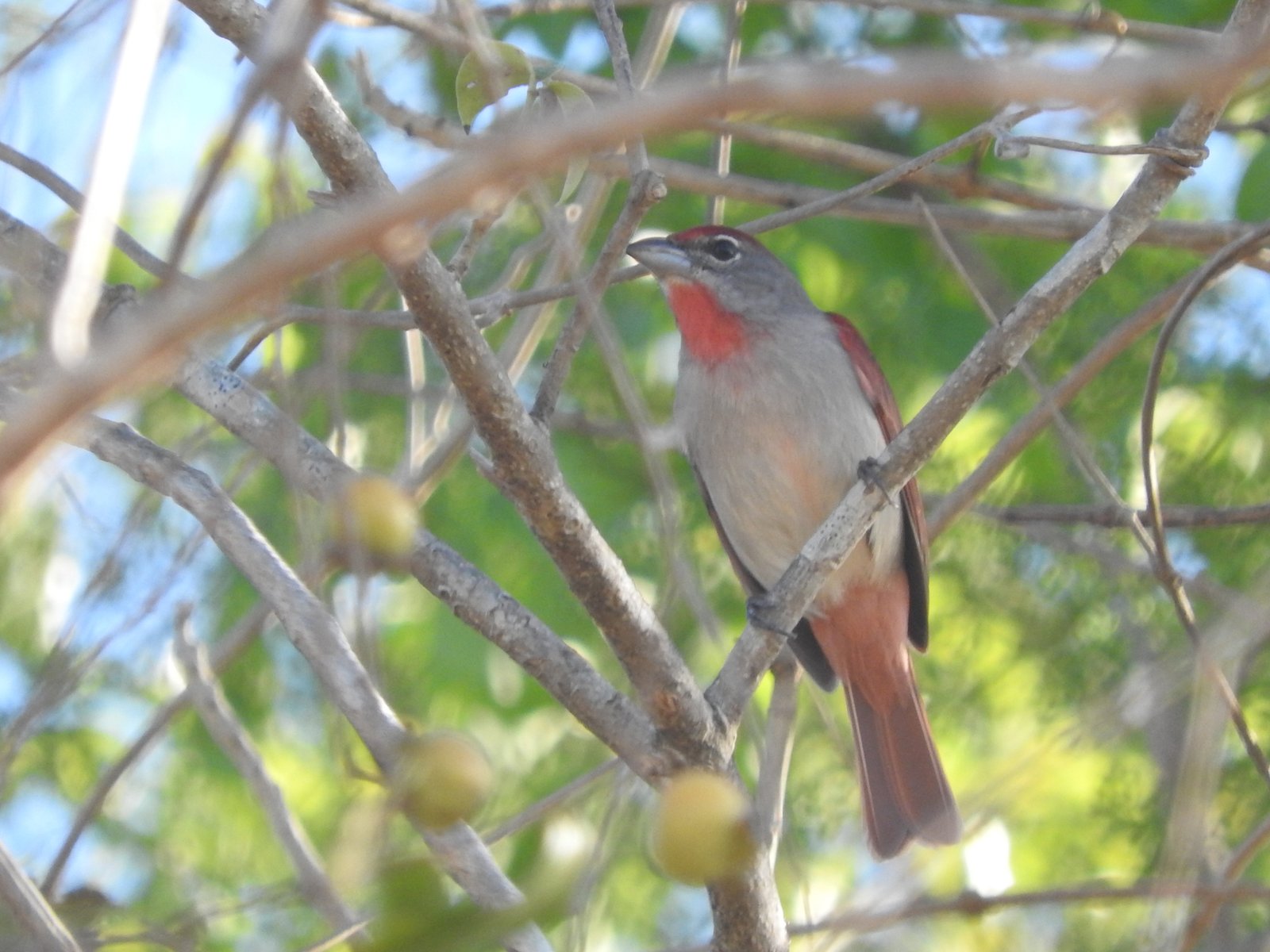
15–17 cm. A slender tanager with a fairly long tail and a grey bill. The male is grey above and pale grey below, with a rose-red crown, a pink throat, red wing edgings and a red tail; the undertail coverts are pink. A narrow, broken white ring surrounds the eye. The female shows the same pattern, but the crown, throat, wing edgings and tail are olive-yellow instead of red.
Confusion species
Males of Red-crowned Ant Tanager Habia rubica and Red-throated Ant Tanager Driophlox fuscicauda are uniformly dull reddish brown, without grey back and breast. Females of Summer Tanager Piranga rubra are entirely yellowish, without a grey body.
Habitat
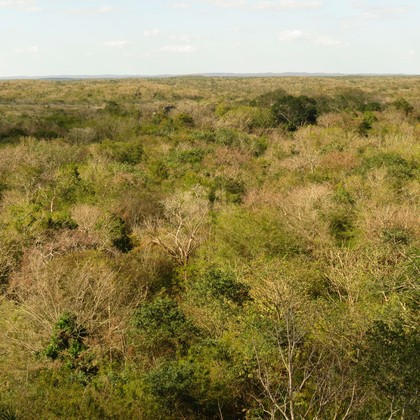
Lower and middle levels and edges of seasonal dry and semi-evergreen forest and dense scrub on limestone, also tall secondary forest, in the lowlands. It searches dense vegetation for insects and fruit, usually in pairs, sometimes with mixed flocks.
Where the bird is most at home, classified by the vegetation units of Mexico and Central America.


Range and movements
Endemic to the guide area: the Yucatán Peninsula in Campeche, Yucatán and Quintana Roo, including Cozumel, and further northern Belize and northern Guatemala (Petén). It does not occur outside this area.
- Resident
- dark = core range, pale = thinly spread
How and when to look
Most quickly found by its song from dense forest, for example along the access road to Calakmul in Campeche. The birds often keep to the shade beneath the canopy.
Conservation status
Not threatened (LC). Locally fairly common within its small range; sensitive to clearing and fires in the dry forest of Yucatán.
Scientific name
Piranga roseogularis | Cabot, 1846
Cabot described the species in 1846 and placed it straight away in the genus where it still stands. The genus Piranga was introduced in 1808 by Vieillot. Piranga comes from the Tupi tijepiranga, the name of an unidentified small bird. roseogularis is Latin, from roseus 'rosy' and gula 'throat', after the rosy throat. The specimen the first description was based on came from between Chemax (Yucatán) and Yalahau (Quintana Roo), Mexico.