All species › Passerines › Cardinals and allies › Hepatic Tanager
Position in the tree Birds Aves › Birds with a flexible palate Neognathae › All other modern birds Neoaves › Landbirds Telluraves › Falcons, parrots and passerines Australaves › Falcons and passerines Eufalconimorphae › Parrots and passerines Psittacopasserae
Hepatic Tanager | Piranga flava
Levertangare | Tángara encinera
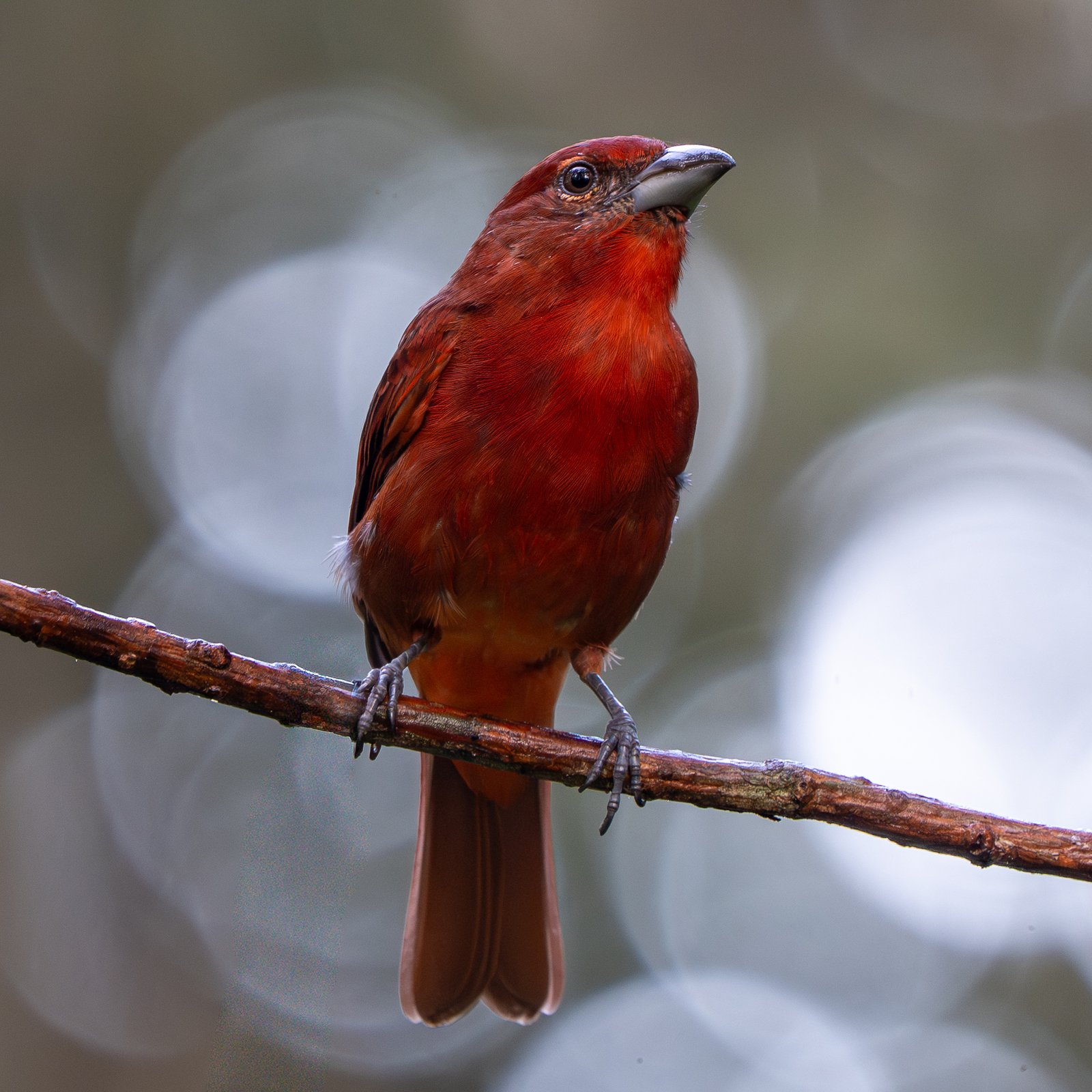
The Hepatic Tanager is a fairly large tanager of open mountain forest and pine savanna. The male is dull brick red with a dark bill and grey cheeks. In the guide area it lives from northern Mexico to Panama; birds from the south-western United States winter in Mexico.
Voice
The call is a single, dry chuk, unlike the multi-syllabled call of Summer Tanager. The song is a series of clear, robin-like phrases.
Recording: Paul Molina Abril — CC BY-NC-SA 4.0 · converted to mono · xeno-canto
Identification
18–20 cm. A robust tanager with a thick, dark grey bill. The male is dull brick to liver red, with a grey wash on the back and flanks, grey cheeks and a brighter red crown and throat. The female is olive-grey above and yellow below, with grey cheeks and a brighter yellow throat and crown. In Costa Rica and Panama the males are brighter red and slightly smaller.
Confusion species
Summer Tanager Piranga rubra has a pale bill and is a more uniform rose-red, without grey cheeks. Flame-colored Tanager Piranga bidentata has a streaked back, white wing bars and white tail corners.
Habitat
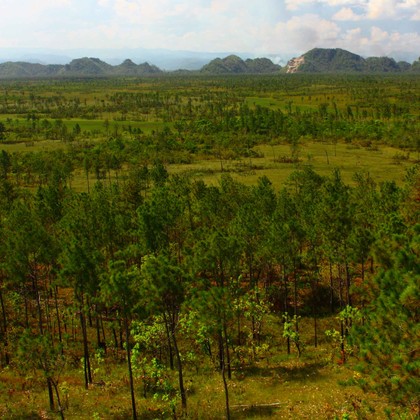
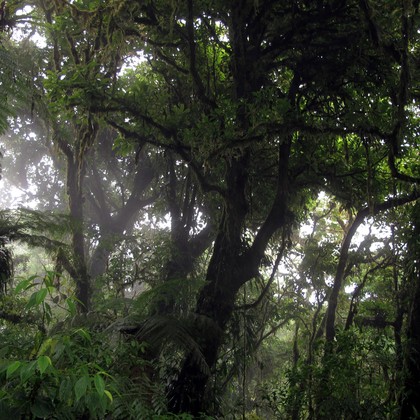
Open pine and oak forest and pine-oak forest in the mountains, mainly from about 1000 to 3000 m; in Belize, Honduras and Nicaragua also lowland pine savanna. In Costa Rica and Panama at edges and clearings of humid foothill and lower montane forest. It searches the canopy for insects and fruit.
Where the bird is most at home, classified by the vegetation units of Mexico and Central America.



Range and movements
In Mexico widespread in the mountains, from Sonora, Chihuahua and Nuevo León south to Chiapas, and further through Guatemala, El Salvador and Honduras to Nicaragua, including the pine savannas of Belize and the Mosquitia. A separate population lives in Costa Rica and Panama. Outside the guide area in the south-western United States, where it is a summer visitor, and in South America to Argentina.
- Resident
- dark = core range, pale = thinly spread
How and when to look
In the north of the guide area best searched for in pine-oak forest of the Sierra Madre, in Belize in the Mountain Pine Ridge. The male often sings from a high branch in a pine.
Conservation status
Not threatened (LC). Fairly common in suitable forest; locally declining through logging of pine-oak forest.
Scientific name
Piranga flava | (Vieillot, 1822)
Vieillot described the species in 1822 as S[altator] Flavus; because it was later moved to another genus, the author and year stand in brackets. The genus Piranga was introduced in 1808 by Vieillot. Piranga comes from the Tupi tijepiranga, the name of an unidentified small bird. flava is Latin for 'yellow', after the yellowish female. The specimen the first description was based on came from Paraguay.