All species › Woodpeckers and allies › Woodpeckers › Strickland's Woodpecker
Position in the tree Birds Aves › Birds with a flexible palate Neognathae › All other modern birds Neoaves › Landbirds Telluraves › Raptors, owls, kingfishers and woodpeckers Afroaves › Mousebirds, rollers and woodpeckers Coraciimorphae › Trogons and cavity nesters Cavitaves › Hornbills, kingfishers and woodpeckers Picocoraciae › Kingfishers, bee-eaters and woodpeckers Picodynastornithes
Strickland's Woodpecker | Leuconotopicus stricklandi
Stricklands specht | Carpintero de Strickland
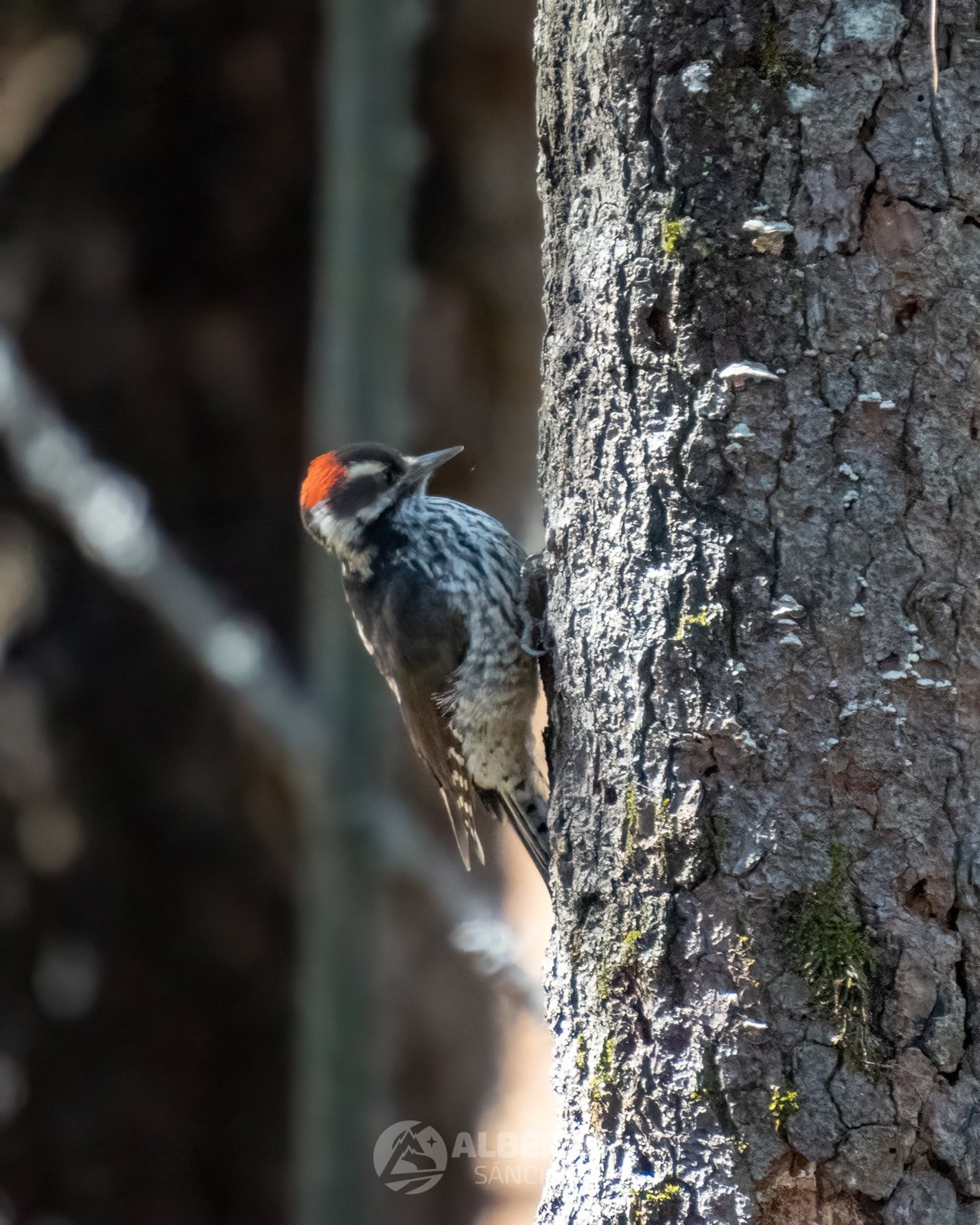
Strickland's Woodpecker is a small brown-and-white woodpecker of the high mountains of central Mexico. It lives in open pine forest on the volcanoes of the Trans-Mexican Volcanic Belt, often close to the treeline. It was formerly treated as one species with Arizona Woodpecker.
Voice
A sharp peek or keech and a rasping rattle. Drums in short rolls on dead wood.
Recording: Manuel Grosselet — CC BY-NC-SA 4.0 · converted to mono · xeno-canto
Identification
17–19 cm. Back dark brown with narrow white bars; wings brown with small white spots. Head brown with a white stripe above and below the brown ear patch and a white patch on the side of the neck. Underparts white, densely marked with dark brown streaks and spots, which become bars on the flanks. Outer tail feathers white with brown bars. The male has a red patch on the nape, the female does not.
Confusion species
Arizona Woodpecker Leuconotopicus arizonae has a plain brown back and underparts more spotted than streaked; its range lies further west and north. Hairy Woodpecker Leuconotopicus villosus is larger, with a black head, a white back stripe and unmarked underparts. Ladder-backed Woodpecker Dryobates scalaris has a black-and-white barred back and a head with black stripes, and lives in lower, drier country.
Habitat
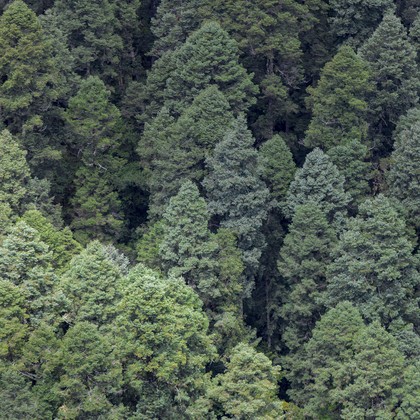
Open pine forest, especially of Pinus hartwegii, and mixed forest of pine and sacred fir on high volcanic slopes, roughly between 2500 and 4000 m; locally also in pine-oak forest lower down. It searches for insects and larvae on trunks and branches, also in fire-damaged trees. The nest hole is excavated in a dead trunk or branch.
Where the bird is most at home, classified by the vegetation units of Mexico and Central America.

Range and movements
Only in central Mexico, on the volcanoes and high mountains of the Trans-Mexican Volcanic Belt: around Mexico City on Ajusco, on the Nevado de Toluca, in Morelos, on Iztaccíhuatl and Popocatépetl, on La Malinche in Tlaxcala and Puebla, and on Cofre de Perote and Pico de Orizaba in western Veracruz. It does not occur outside the guide area.
- Resident
- dark = core range, pale = thinly spread
How and when to look
In the pine forest of Izta-Popo National Park, for example around Paso de Cortés, and on the slopes of La Malinche and the Nevado de Toluca. It often works its way up a trunk in a spiral.
Conservation status
Not threatened. The range is small and confined to high mountains, where logging, forest fires and grazing degrade the forest.
Scientific name
Leuconotopicus stricklandi | (Malherbe, 1845)
Malherbe described the species in 1845 as Picus (Leuconotopicus) Stricklandi; because it was later moved to another genus, the author and year stand in brackets. The genus Leuconotopicus was introduced in 1845 by Malherbe. Leuconotopicus combines Greek leukos 'white' and nōtos 'back' with Latin picus 'woodpecker': 'white-backed woodpecker'. stricklandi honours the English naturalist Hugh Edwin Strickland (1811–1853), a pioneer of zoological nomenclature. The specimen the first description was based on came from the Pico de Orizaba massif, Mexico (restricted later).